


“China will surely be reunified, and all Chinese on both sides of the Taiwan Strait should be bound by a common sense of purpose and share in the glory of the rejuvenation of the Chinese nation.” Chinese President Xi Jinping’s (習近平) New Year’s message leaves little room for doubt concerning his resolve to take Taiwan, “by force if necessary,” as he has repeatedly said over the past decade.
Democracies across the world are alarmed by Beijing’s growing assertiveness, especially in light of Taiwan’s presidential election on Saturday. Under Xi’s rule, China has threatened peace and stability in the Indo-Pacific region and beyond, challenging the rules-based international order, while promoting an authoritarian alternative governance model. This has deteriorated China’s global image.
Responding to shifting perceptions, international media coverage of Taiwan’s elections has centered on the existential threat from China, but failed to pay enough attention to other pressing issues in public debates.
In European media, that narrow focus reveals ignorance of Taiwan beyond cross-strait relations, hence an inability to take a comprehensive view of the elections considering the domestic issues that Taiwanese voters face. Everyday problems are the ones Taiwanese voters care about most.
These include socioeconomic issues related to high living costs (particularly for housing), low wages, a declining birthrate, insufficient care for preschool children and the elderly, road safety, corruption, and Taiwan’s energy transition and its pollution implications. While threats from China have increased, demands for socioeconomic reforms have played a more significant role than in previous elections.
The outcome of the race between Democratic Progressive Party candidate Vice President William Lai (賴清德), Chinese Nationalist Party (KMT) candidate New Taipei City Mayor Hou You-yi (侯友宜) and Taiwan People’s Party Chairman Ko Wen-je (柯文哲) could more significantly affect the country’s democratic governance than cross-strait relations. Yet, European commentators are ignoring these key election issues.
Taiwan has already moved up the EU’s political agenda and risen in its discourse, while the bloc has started to pursue economic and political de-risking of its relations with China. The latter has created space for the former in current European narratives. It is essential that the EU pursues these two dynamics together.
While its relationship with China is defined by mutual distrust rather than strategic trust, the EU now sees Taiwan as a like-minded and trustworthy partner, one it can engage with as they both rethink their relations with China. EU-Taiwan relations can be a genuine win-win, but only through strategic mutual engagement and investment.
The EU must invest more in bringing Taiwan closer to Europeans with all of its diversity and the challenges it faces, many of which they share, namely how to enhance social justice, address demographic shifts and improve economic structures to benefit all, and achieve economic security. Without a better understanding of Taiwan’s domestic landscape, Europe cannot improve the mutual awareness necessary to contribute to each other’s resilience — economically and democratically.
As the largest foreign investor in Taiwan facing Chinese threats, Europe has reason to worry about its interests in the country. Europe also has good reason to continue to engage Taiwan as a democracy that faces the homegrown challenges this election reveals, but also external threats. The future of democracy is at stake if Xi pursues his ambitions to annex Taiwan.
For the past three decades, Taiwanese have worked hard — and bottom-up — to establish a democratic system that is rooted in transparency, rule of law and human rights. The system they have built is the opposite of Xi’s top-down, opaque, authoritarian rule. Maintaining and improving on their democracy defines Taiwanese identity. Losing it would mean being stripped of that identity.
It is in Europe’s interest to support democratic efforts and prevent such a loss.
Also, regardless of who Taiwan’s next leader is, it remains in the interest of the Taiwanese to keep Europe, its fourth-largest trading partner, close as an ally that has contributed significantly to expanding its internationalization.
From June 6 to June 9, it would be Europeans’ turn to exercise their democratic rights to shape their future. At a time of significant geopolitical shifts, the European Parliament elections would likely be dominated by socioeconomic issues, concerns that European voters deal with in their everyday lives: cost of living and inflation, job creation, migration and increasing fuel prices, among others.
By engaging Europe on these issues, Taiwan can improve its understanding of the bloc’s diversity and complexity. It would serve the interests of both sides to help each other tackle the domestic problems they both face through international collaboration.
Rather than allowing China to dominate — and constrain — the discourse, Europe and Taiwan should be coming together about their shared domestic concerns. Through strategically planning and implementing economic and diplomatic exchanges, Taiwan and Europe can continue contributing to the pursuit of shared goals — economic and political, international and domestic.
Zsuzsa Anna Ferenczy is assistant professor at National Dong Hwa University in Hualien and a former political adviser in the European Parliament.
Taiwanese pragmatism has long been praised when it comes to addressing Chinese attempts to erase Taiwan from the international stage. “Taipei” and the even more inaccurate and degrading “Chinese Taipei,” imposed titles required to participate in international events, are loathed by Taiwanese. That is why there was huge applause in Taiwan when Japanese public broadcaster NHK referred to the Taiwanese Olympic team as “Taiwan,” instead of “Chinese Taipei” during the opening ceremony of the Tokyo Olympics. What is standard protocol for most nations — calling a national team by the name their country is commonly known by — is impossible for
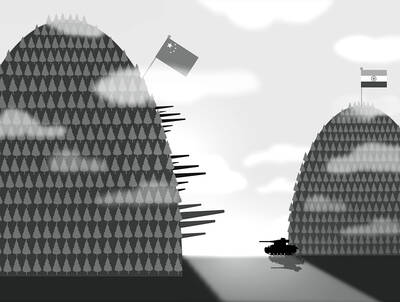
India is not China, and many of its residents fear it never will be. It is hard to imagine a future in which the subcontinent’s manufacturing dominates the world, its foreign investment shapes nations’ destinies, and the challenge of its economic system forces the West to reshape its own policies and principles. However, that is, apparently, what the US administration fears. Speaking in New Delhi last week, US Deputy Secretary of State Christopher Landau warned that “we will not make the same mistakes with India that we did with China 20 years ago.” Although he claimed the recently agreed framework
The Office of the US Trade Representative (USTR) on Wednesday last week announced it is launching investigations into 16 US trading partners, including Taiwan, under Section 301 of the Trade Act of 1974 to determine whether they have engaged in unfair trade practices, such as overproduction. A day later, the agency announced a separate Section 301 investigation into 60 economies based on the implementation of measures to prohibit the importation of goods produced with forced labor. Several of Taiwan’s main trading rivals — including China, Japan, South Korea and the EU — also made the US’ investigation list. The announcements come
Taiwan is not invited to the table. It never has been, but this year, with the Philippines holding the ASEAN chair, the question that matters is no longer who gets formally named, it is who becomes structurally indispensable. The “one China” formula continues to do its job. It sets the outer boundary of official diplomatic speech, and no one in the region has a serious interest in openly challenging it. However, beneath the surface, something is thickening. Trade corridors, digital infrastructure, artificial intelligence (AI) cooperation, supply chains, cross-border investment: The connective tissue between Taiwan and ASEAN is quietly and methodically growing


 RSS
RSS