


Tomorrow marks 365 days since India assumed the G20 presidency. It is a moment to reflect, recommit and rejuvenate the spirit of Vasudhaiva Kutumbakam, or “One Earth, One Family, One Future.”
As we undertook this responsibility last year, the global landscape grappled with multifaceted challenges: recovery from the COVID-19 pandemic, looming climate threats, financial instability and debt distress in developing nations all amid declining multilateralism.
In the middle of conflicts and competition, development cooperation suffered, impeding progress.
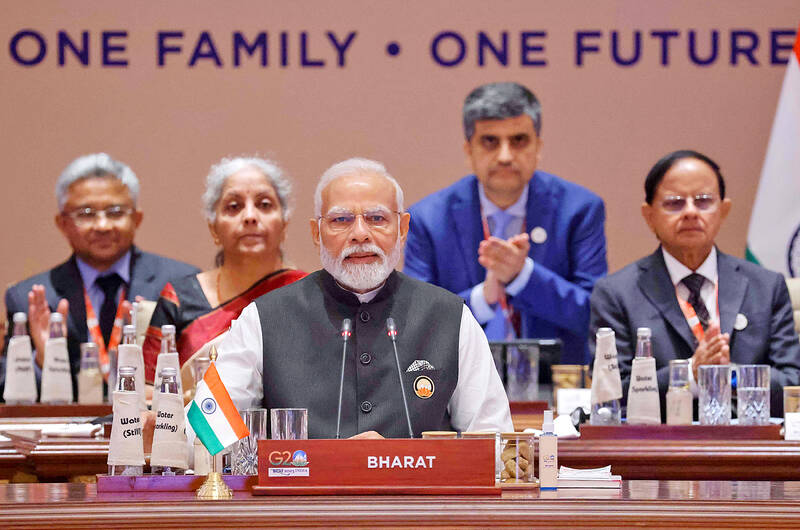
Photo: AFP
Assuming the G20 chair, India sought to offer the world an alternative to the “status quo,” a shift from a GDP-centric to human-centric progress.
India aimed to remind the world of what unites us, rather than what divides us.
Finally, the global conversation had to evolve — the interests of the few had to give way to the aspirations of the many. This required a fundamental reform of multilateralism as we knew it.
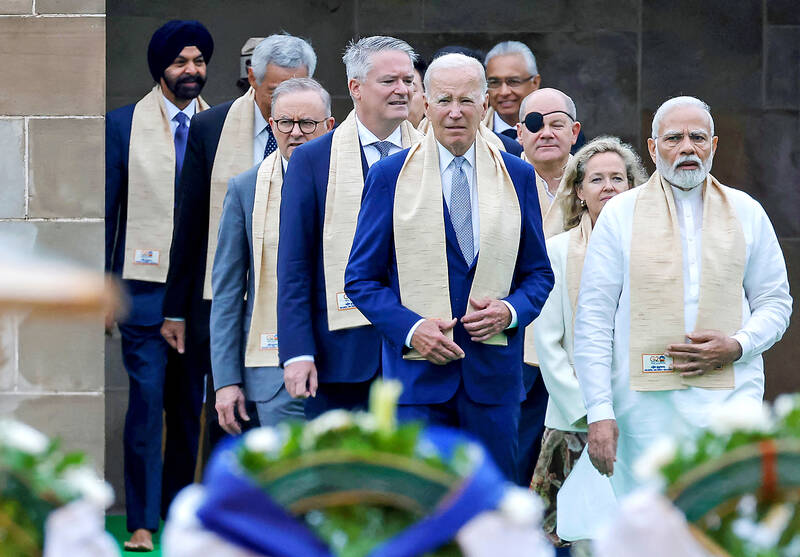
Photo: AFP
Inclusive, ambitious, action-oriented and decisive — these four words defined our approach as G20 president, and the New Delhi Leaders’ Declaration, unanimously adopted by all G20 members, is testimony to our commitment to deliver on these principles.
Inclusivity has been at the heart of our presidency. The inclusion of the African Union as a permanent member of the G20 integrated 55 African nations into the forum, expanding it to encompass 80 percent of the global population. This proactive stance has fostered a more comprehensive dialogue on global challenges and opportunities.
The first-of-its-kind Voice of the Global South Summit, convened by India in two editions, heralded a new dawn of multilateralism. India mainstreamed the Global South’s concerns in international discourse and has ushered in an era where developing countries take their rightful place in shaping the global narrative.
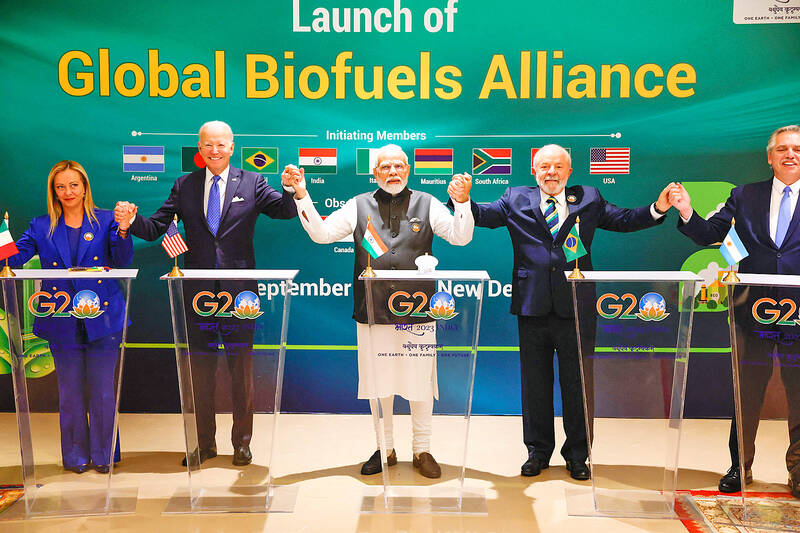
Photo: AFP
Inclusivity also infused India’s domestic approach to the G20, making it a people’s presidency that befits that world’s largest democracy.
Through jan bhagidari (“people’s participation”) events, the G20 reached 1.4 billion citizens, involving all states and union territories as partners.
On substantive elements, India ensured that international attention was directed to broader developmental aims, aligning with the G20’s mandate.
At the critical midpoint of the 2030 Agenda, India delivered the G20 2023 Action Plan to Accelerate Progress on the Sustainable Development Goals, taking a cross-cutting, action-oriented approach to interconnected issues, including health, education, gender equality and environmental sustainability.
A key area driving this progress is robust digital public infrastructure. Here, India was decisive in its recommendations, having witnessed the revolutionary impact of digital innovations such as Aadhaar, UPI and Digilocker first-hand.
Through the G20, we successfully completed the Digital Public Infrastructure Repository, a significant stride in global technological collaboration. The repository, featuring more than 50 digital public infrastructure programs from 16 countries, will help the Global South build, adopt and scale the programs to unlock the power of inclusive growth.
For “One Earth,” we introduced ambitious and inclusive aims to create urgent, lasting and equitable change. The G20 Declaration’s Green Development Pact addresses the challenges of choosing between combating hunger and protecting the planet by outlining a comprehensive road map where employment and ecosystems are complimentary, consumption is climate conscious and production is planet-friendly.
In tandem, the G20 Declaration calls for an ambitious tripling of global renewable energy capacity by 2030. Coupled with the establishment of the Global Biofuels Alliance and a concerted push for green hydrogen, the G20’s ambition to build a cleaner, greener world is undeniable.
This has always been India’s ethos and through Lifestyles for Sustainable Development, or LiFE, the world can benefit from our age-old sustainable traditions.
Furthermore, the G20 Declaration underscores our commitment to climate justice and equity, urging substantial financial and technological support from the Global North. For the first time, there was a recognition of the quantum jump needed in the magnitude of development financing, moving from billions to trillions of dollars. The G20 acknowledged that developing countries require US$5.9 trillion to fulfil their Nationally Determined Contributions by 2030.
Given the monumental resources required, the G20 emphasized the importance of better, larger and more effective multilateral development banks.
Concurrently, India is taking a leading role in UN reforms, especially in the restructuring of principal organs such as the UN Security Council that will ensure a more equitable global order.
Gender equality took center stage in the G20 Declaration, culminating in the formation of a dedicated working group on the empowerment of women next year. India’s Women’s Reservation Bill 2023, reserving one-third of India’s parliament and state legislative assembly seats for women, epitomizes our commitment to women-led development.
The New Delhi Declaration embodies a renewed spirit of collaboration across these key priorities, focusing on policy coherence, reliable trade and ambitious climate action.
It is a matter of pride that during our presidency, the G20 achieved 87 outcomes and 118 adopted documents, a marked rise from the past.
During our G20 presidency, India led deliberations on geopolitical issues, and their effect on economic growth and development. Terrorism and the senseless killing of civilians is unacceptable, and we must address it with a policy of zero tolerance. We must embody humanitarianism over hostility and reiterate that this is not an era of war.
I am delighted that during our presidency, India achieved the extraordinary: It revitalized multilateralism, amplified the voice of the Global South, championed development and fought for the empowerment of women everywhere.
As we hand over the G20 presidency to Brazil, we do so with the conviction that our collective steps for people, planet, peace and prosperity will resonate for years to come.
Narendra Modi is the prime minister of India

On March 22, 2023, at the close of their meeting in Moscow, media microphones were allowed to record Chinese Communist Party (CCP) dictator Xi Jinping (習近平) telling Russia’s dictator Vladimir Putin, “Right now there are changes — the likes of which we haven’t seen for 100 years — and we are the ones driving these changes together.” Widely read as Xi’s oath to create a China-Russia-dominated world order, it can be considered a high point for the China-Russia-Iran-North Korea (CRINK) informal alliance, which also included the dictatorships of Venezuela and Cuba. China enables and assists Russia’s war against Ukraine and North Korea’s
After thousands of Taiwanese fans poured into the Tokyo Dome to cheer for Taiwan’s national team in the World Baseball Classic’s (WBC) Pool C games, an image of food and drink waste left at the stadium said to have been left by Taiwanese fans began spreading on social media. The image sparked wide debate, only later to be revealed as an artificially generated image. The image caption claimed that “Taiwanese left trash everywhere after watching the game in Tokyo Dome,” and said that one of the “three bad habits” of Taiwanese is littering. However, a reporter from a Japanese media outlet
An article published in the Dec. 12, 1949, edition of the Central Daily News (中央日報) bore a headline with the intimidating phrase: “You Cannot Escape.” The article was about the execution of seven “communist spies,” some say on the basis of forced confessions, at the end of the 713 Penghu Incident. Those were different times, born of political paranoia shortly after the Chinese Nationalist Party (KMT) relocated to Taiwan following defeat in China by the Chinese Communist Party (CCP). The phrase was a warning by the KMT regime to the local populace not to challenge its power or threaten national unity. The
Since taking office, President William Lai (賴清德) has been an active proponent of the Healthy Taiwan initiative. As a member of the Healthy Taiwan Promotion Committee, I have also contributed recommendations on various pharmaceutical policies. After the committee concluded its seventh meeting on Saturday last week, Lai announced that the government is considering a three-year suspension on the Drug Expenditure Target (DET) system’s routine drug price surveys, highlighting the need to further support drug supply resilience. While I am supportive of this policy direction, I must also stress the importance of maintaining our original objective of improving the quality of


 RSS
RSS