


If there is one thing Hollywood screenwriters know how to deliver, it is a snappy one-liner.
“Pay your writers, or we’ll spoil Succession,” read one of the placards paraded outside movie studios in Los Angeles last week, as thousands of film and television writers went on strike.
“Pencils down, middle fingers up,” another said.
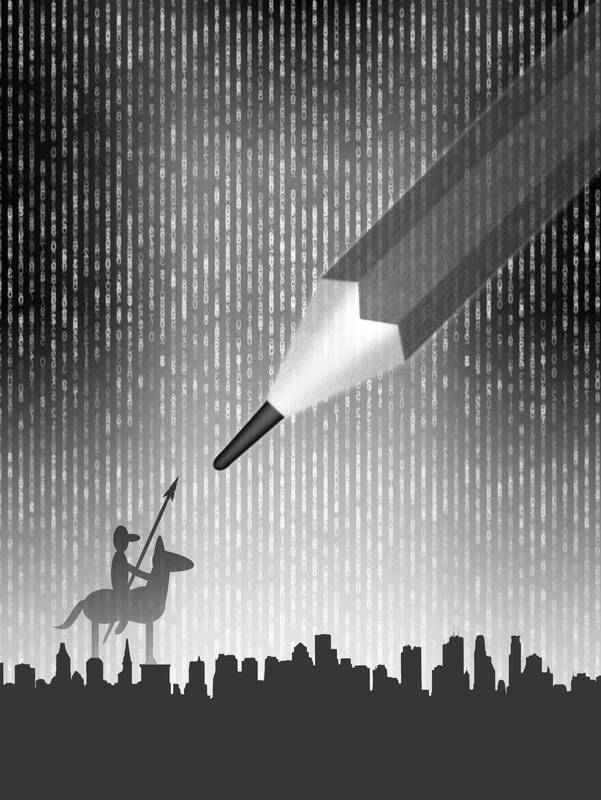
Illustration: Yusha
However, closer to the bone was a placard reading: “Wrote ChatGPT This.”
The plot twist is that this strike is not just over money. The Writers Guild of America also wants to establish some ground rules preventing studios from using artificial intelligence (AI) to generate scripts in ways that cut humans out of their own creative process.
The union has been understandably spooked by the rapid progress of ChatGPT-4, the chatbot capable of generating uncannily convincing knock-offs of any written genre, from rap lyrics to Jane Austen. What it produces is hollow pastiche rather than art, piggybacking shamelessly on centuries of human endeavor, because it learns by scanning samples of existing writing.
Yet how long will it be before it is capable of generating a mediocre but acceptable TV sitcom, or the umpteenth movie in the Fast & Furious franchise? After all, studios already use algorithms to analyze box office data and predict which combinations of actors or storylines are should to get bums on cinema seats. The logical next step is to make the software write its winning formula up into a screenplay, maybe hiring a human to give it one final polish.
If this is one of the first AI-related strikes, it is unlikely to be the last, and they could become much, much angrier.
Almost half of Britons think a machine would probably be able to do their job better than them within a decade, according to new research for Jimmy’s Jobs, a podcast on the future of work set up by Jimmy McLoughlin, former special adviser to the British prime minister on business.
Sixty-three percent felt that the government should intervene in this process somehow.
McLoughlin identifies finance, media, advertising and education jobs as particularly vulnerable to disruption, although the technology is evolving so fast that its effects are hard to predict.
This week IBM sent shivers down white-collar spines by announcing plans to freeze recruitment in back office roles such as human relations, on the grounds that many of these jobs might soon be automated.
However, as a separate report from the center-right think tank Onward this week said, what differentiates this wave of automation from previous ones in human history is its ability to take on creative, cognitive tasks, from writing to photography and graphic design.
Once upon a time, humans could be persuaded that getting machines to do the drudge work would free them up for more interesting tasks. For the lucky ones, sometimes, that was true.
Yet AI is now coming for the dream jobs: well-paid, absorbing work done by people who love what they do and refuse to let go easily. It is coming not just for people’s ability to pay the rent, but for the things that make them happy.
Imagine a world, where it is possible effortlessly to churn out an unlimited number of Tom Cruise movies or Taylor Swift tracks every year, Onward asked.
AI can already copy voices with spookily convincing accuracy, helpfully for fraudsters now employing it in increasingly sophisticated scams, and could easily be trained on an artist’s back catalog to produce songs that sound recognizably “them.”
Good news for Taylor Swift, maybe, but would new talent ever get a break?
The argument does not stop there. If movie studios use AI to create storylines, why could publishers not use it to sift manuscripts and even to draft them, especially at the more formulaic end of the book market?
True, they would miss out on ground-breaking new writers who might have caught a human editor’s imagination, but there might be fewer of the expensive flops that inevitably come with taking creative risks, too.
The net result could be a more lucrative industry — at least for the limited number of remaining humans in it — but a horribly stale, bland, homogeneous culture based on endlessly rehashing last year’s mass-market hits rather than discovering something new, plus the socially explosive prospect of a generation who have already made it pulling up the ladder behind them.
Older workers are often the ones who struggle to adapt to rapid technological change, but this revolution could be tough on young people, too, if the first casualties are the entry-level roles in which they once got their breaks.
Too apocalyptic? Maybe. AI will certainly create plenty of new jobs, even whole new industries, and it is not going to gobble up everything we know. Jobs requiring empathy, emotional intelligence or relationships of trust, such as nursing, classroom teaching or caring for the elderly, might prove more AI-proof than most, although perhaps only if people are willing to pay more for properly human public services instead of replacing them with chatbots.
Speaking of funding public services, Onward said that His Majesty’s Treasury should move away from taxing labor toward taxing capital, which might sound like a win for the left if it were not driven by concerns that in future there might not be as much labor to tax.
Too often, warnings like this are greeted with a fatalistic shrug, as if there is nothing humanity could do about its own invention. There is now active political debate over regulation — whether the tech industry should be allowed to create God-like intelligence it does not understand or control — but far less about the ways in which existing AI is already disrupting jobs and lives.
There are huge moral choices to be made and they cannot be left to the market or to the consciences of CEOs.
Years ago, I sat through a Conservative Party conference fringe meeting on the tech industry that has stuck in my mind because of the unanswerable question posed by a middle-aged man in the audience.
He ran a mid-sized firm, and said that in the near future he might be able to replace hundreds of his staff with an emerging technological process. What he was asking was whether, morally, he should.
The idea of firing loyal workers troubled him, but if his competitors all cut their costs by using this technology and he did not, he might go bust and the jobs would be lost anyway. Nobody on the panel had a good answer to offer him, but his question feels even more urgent today.
For now, it is writers who are out on the street waving placards, but as one of those placards pointed out, the logical next step after eliminating them is to automate away studio executives’ jobs, too. Do employers really want to live in the world they might be about to create?
Gaby Hinsliff is a Guardian columnist.
Taiwanese pragmatism has long been praised when it comes to addressing Chinese attempts to erase Taiwan from the international stage. “Taipei” and the even more inaccurate and degrading “Chinese Taipei,” imposed titles required to participate in international events, are loathed by Taiwanese. That is why there was huge applause in Taiwan when Japanese public broadcaster NHK referred to the Taiwanese Olympic team as “Taiwan,” instead of “Chinese Taipei” during the opening ceremony of the Tokyo Olympics. What is standard protocol for most nations — calling a national team by the name their country is commonly known by — is impossible for
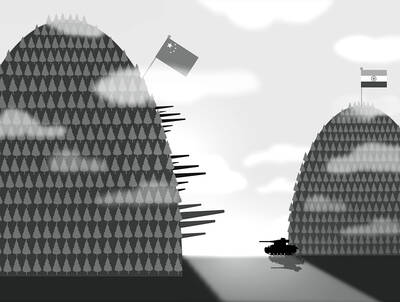
India is not China, and many of its residents fear it never will be. It is hard to imagine a future in which the subcontinent’s manufacturing dominates the world, its foreign investment shapes nations’ destinies, and the challenge of its economic system forces the West to reshape its own policies and principles. However, that is, apparently, what the US administration fears. Speaking in New Delhi last week, US Deputy Secretary of State Christopher Landau warned that “we will not make the same mistakes with India that we did with China 20 years ago.” Although he claimed the recently agreed framework
The Office of the US Trade Representative (USTR) on Wednesday last week announced it is launching investigations into 16 US trading partners, including Taiwan, under Section 301 of the Trade Act of 1974 to determine whether they have engaged in unfair trade practices, such as overproduction. A day later, the agency announced a separate Section 301 investigation into 60 economies based on the implementation of measures to prohibit the importation of goods produced with forced labor. Several of Taiwan’s main trading rivals — including China, Japan, South Korea and the EU — also made the US’ investigation list. The announcements come
Taiwan is not invited to the table. It never has been, but this year, with the Philippines holding the ASEAN chair, the question that matters is no longer who gets formally named, it is who becomes structurally indispensable. The “one China” formula continues to do its job. It sets the outer boundary of official diplomatic speech, and no one in the region has a serious interest in openly challenging it. However, beneath the surface, something is thickening. Trade corridors, digital infrastructure, artificial intelligence (AI) cooperation, supply chains, cross-border investment: The connective tissue between Taiwan and ASEAN is quietly and methodically growing


 RSS
RSS