


On Aug. 1, 1991, a little more than three weeks before Ukraine declared independence from the Soviet Union, then-US president George H.W. Bush arrived in Kyiv to discourage Ukrainians from doing it.
In his notorious “Chicken Kiev” speech in the Ukrainian parliament, Bush lectured the stunned MPs that independence was a recipe for “suicidal nationalism,” “ethnic hatred” and “local despotism.”
The speech was a colossal blunder. Ukraine’s people were being asked to ignore centuries of oppression by decisionmakers in Moscow — at a time when the Holodomor, the Soviet-engineered “terror-famine” that killed millions of Ukrainians in 1932 and 1933, remained embedded in the living memory of many.
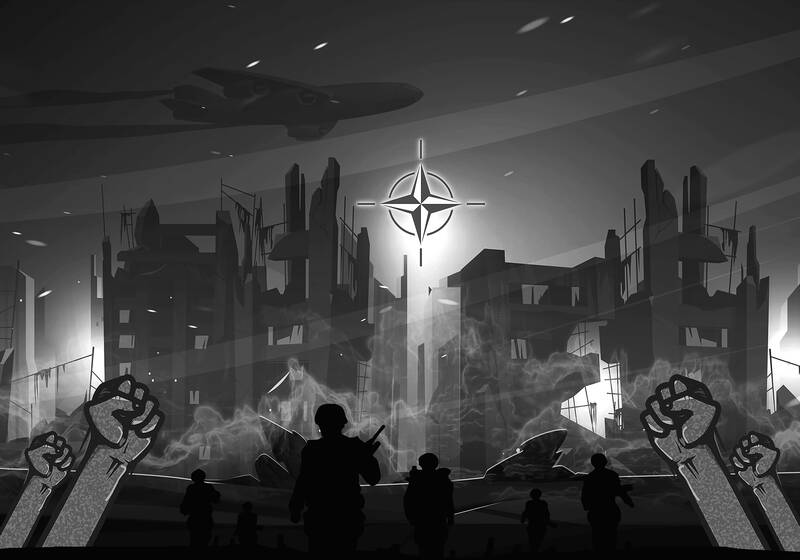
Illustration: Louise Ting
In December that year, Ukraine delivered its answer to Bush: 84.2 percent of eligible voters turned out for the referendum on independence, and 92.3 percent of them said yes.
However, the West’s reluctance to respect Ukraine’s desire for sovereignty was a bad omen, revealing a mindset among US and European leaders that paved the way to Russia’s full-scale invasion in February last year.
The path to war began in 1994, when Ukraine, at the West’s behest, surrendered to Russia the world’s third-largest nuclear arsenal. In exchange, Russia, the UK, and the US promised to ensure Ukraine’s territorial integrity and sovereignty.
However, how was this assurance meant to be realized? Unlike Poland and other ex-communist countries, Ukraine was not given a chance to join the EU in the 1990s, and in 2008 France and Germany blocked its admission to NATO.
When Russia annexed Crimea and occupied parts of the Donbas in 2014, then-US president Barack Obama sent blankets and other non-lethal military equipment to Ukraine. Germany responded by launching the Nord Stream 2 gas pipeline, bypassing Ukraine, even though the Ukrainian pipeline had plenty of spare capacity.
It was all another serving of “Chicken Kiev”: Russia must not be provoked, relations with the Kremlin must be protected and the Russian state must remain stable.
Time after time, Western leaders found it expedient to defer to Russia’s interests, effectively denying Ukraine’s agency as a sovereign state.
It is a mindset that persists to this day, despite the mass graves and torture chambers left behind by Russian forces in Bucha, Irpin, and countless other towns and villages across the country. Tens of thousands of Ukrainians have been killed and millions displaced since February, but Western observers, ranging from Noam Chomsky to Henry Kissinger, blame the West for Russian President Vladimir Putin’s decision to invade, or have urged Western leaders to provide Putin a diplomatic off-ramp by compelling Ukraine to give up territory.
Policymakers also seem to view Ukraine’s self-defense as a bigger problem than Russia’s genocidal aggression. At a joint press conference held during Ukrainian President Volodymyr Zelensky’s recent visit to the US, the key question came last.
Should not the US “give Ukraine all capabilities it needs and liberate all territories rather sooner than later?” Ukrainian journalist Olga Koshelenko asked.
No, US President Joe Biden said, because providing offensive weapons could escalate the conflict, and the US’ European allies are “not looking to go to war with Russia.”
Ukraine could have one Patriot air-defense battery to counter Russia’s attacks on civilians and civilian infrastructure, but not the long-range missiles, Abrams tanks or F-16 jets it needs to stop the attacks at their source.
This approach is morally wrong and strategically counterproductive. It would lead to precisely the escalation that Biden and European leaders say they want to avoid, because it fails to address the core security problem.
Ukraine is not the first victim of Russia’s aggressive, nuclear-armed authoritarian regime — as Syrians, Georgians and Moldovans can attest — and it would not be the last, unless Russia is compelled to abandon imperialism, as were Germany and Japan following their defeat in World War II. Then, as now, territorial concessions led to more war, not less, in Europe and the world.
The main objective is crystal clear: Russia must lose this war and demilitarize.
However, despite the massive material and military support the West has provided to Ukraine, the fateful logic of appeasement lingers, because many Western leaders fear the consequences of Russia’s defeat more than the prospect of a defeated Ukraine.
However, anxiety about Russia’s possible fragmentation is as misplaced as the fear of the Soviet Union’s disintegration was in 1991. Nor should anyone take seriously the claim, made by Chomsky and many others, that Russia has a legitimate fear of further NATO enlargement.
Putin arguably invaded because, six months after the US’ humiliating withdrawal from Afghanistan, and two years after French President Emmanuel Macron called NATO “brain dead,” he thought the alliance was too weak to support Ukraine.
Likewise, if the war was about stopping NATO enlargement, the Russian military would not be executing civilians, looting homes and stores, and the Kremlin would be doing more than shrugging its shoulders at the imminent prospect of Sweden and Finland — with which Russia shares a 1,340km border — joining the alliance.
This war is about the survival of Ukraine and the Ukrainian people. In the words of former Israeli prime minister Golda Meir, who was born in Kyiv, “They say we must be dead. And we say we want to be alive. Between life and death, I don’t know of a compromise.”
Similarly, any compromise that rewards Russia’s aggression would lead to more lives lost. Ukraine’s people would keep fighting, because they know what would happen otherwise. After all, it already has happened in Bucha, Mariupol, Kharkiv, Kherson and countless other towns and cities.
Ukraine’s voice must be heard. Providing the military and economic resources it needs to win is the best investment in global security the world can make. After Ukraine’s victory, power-hungry dictators worldwide would think twice before following Russia’s lead — an outcome that Taiwanese would welcome.
In 1941, when the UK was fighting the Nazis alone, then-British prime minister Winston Churchill asked the US to “give us the tools, and we will finish the job.”
Ukrainian General Valery Zaluzhny makes the same plea: “I know that I can beat this enemy, but I need resources.”
He should have them. Let Ukrainians finish the job.
Yuriy Gorodnichenko is a professor of economics at the University of California, Berkeley. Anastassia Fedyk is an assistant professor of finance at the University of California, Berkeley. Ilona Sologoub, editor of VoxUkraine, is director of political and economic research at the Kyiv School of Economics.
Copyright: Project Syndicate

A recent report concerning a student who is suing his teacher posed the question in its headline: Does failing a student in two subjects constitute bullying? The college student in Chiayi County apparently sought NT$2 million (US$63,603) in state compensation, but a court dismissed the case. The first reaction of many might have been to ask: What has happened to students nowadays? Some say that teachers have lost their authority, while others say students are overindulged. Some even start reminiscing over the days when “whatever the teacher says goes.” However, the real issue might be overlooked if emotional reactions like that are the
When I visited Taiwan last summer, I called on the nation to use its status as a technology superpower to build superweapons. It is obvious to me as I return a year later that Taiwan is now answering that call. By 2030, Taiwan envisions a domestic drone hub, capable of producing large quantities of drones per year. The nation continues to tighten cooperation across the private sector, scientific researchers and the elected government, on creating new and innovative production avenues for defense, while efforts to become central to the “democratic supply chain” are only increasing. Anduril is seeing all of these positive
Singaporean former Prime Minister and current senior minister Lee Hsien- Loong(李顯龍) last month stood on Chinese soil and told Beijing that Singapore cooperates because of “shared interests”, not because of common “ethnic descent,” a significant statement that has upended China’s cognitive warfare tactics of “ethnic nationalism.” Along with using its military buildup and economic growth to expand its international dominance, China has long deployed ethnic politics to promote the idea that all ethnic Chinese around the world, regardless of citizenship, share a tight bond with the Chinese motherland, by which it means the regime of the People’s Republic of China (PRC)
Taiwan’s economic momentum, driven by demand for artificial intelligence (AI) products, remains strong, with booming demand for advanced semiconductors, servers and key components. In the first quarter, GDP expanded 14.55 percent year-on-year, the second consecutive quarter of double-digit percentage growth and accelerating from the 12.95 percent expansion in the previous quarter, the Directorate-General of Budget, Accounting and Statistics (DGBAS) reported on Friday. Net exports remained the dominant driver of growth, contributing 10.33 percentage points to Taiwan’s GDP growth in the first quarter. That came as exports rose 35.76 percent year-on-year in the first quarter, outpacing 26.34 percent growth in imports, the


 RSS
RSS