


Perhaps you have heard of “quiet quitting.” It is telling that the phrase has taken off on social media — but this is the fakest of fake “workplace trends.”
Think of it as the third iteration of dubious COVID-19 pandemic work-related fads. After the original COVID-19 variant, we heard about the “great resignation,” but the data did not support it beyond a few sectors hit hard by lockdowns such as hospitality. Then came the Delta wave and the “lie flat” movement, another trend based largely on anecdata and a catchy phrase. In the aftermath of Omicron, we have got quiet quitting.
The reason for bosses to concern themselves with these trends is not that they are describing real behavior, but that so many people find them appealing. They speak to employees’ fantasies, not their actual career plans.
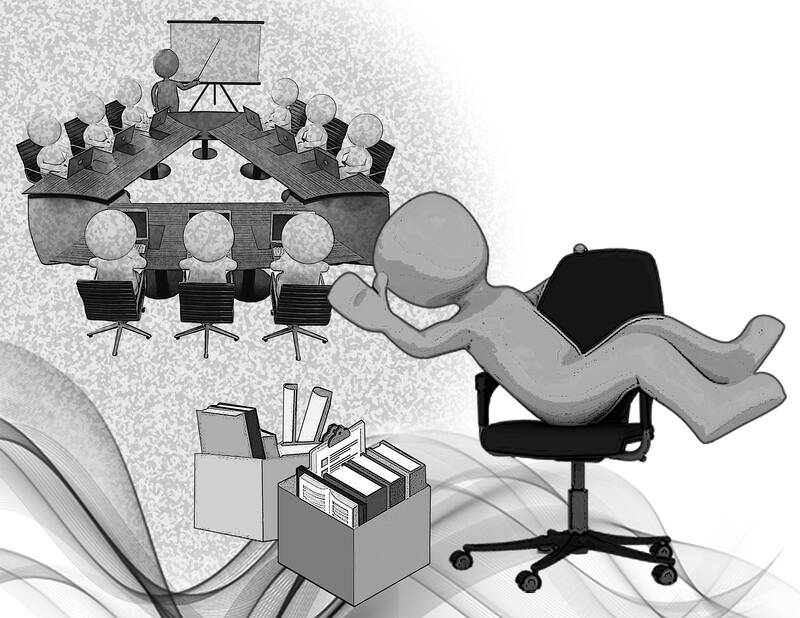
Illustration: Constance Chou
As with all spurious trends, the definition is impossibly broad. Some describe quiet quitting as “doing the bare minimum,” while others say they are “meeting all their obligations.”
Some are “coasting,” while others are “leaving work at 5pm.” Some are just hoping for better work-life balance.
However, these are pretty different from each other. Consider someone who routinely works from 9am to 5pm, but typically avoids putting in overtime. Is that person “doing the bare minimum” or are they just incredibly efficient? Should someone who is meeting all their obligations really be considered a slacker? Is it fair to call any of these a form of “quitting”?
Quiet quitting is also something we are probably talking about more than we are actually carrying out. A recent Axios poll of younger workers found that 15 percent were doing the minimum at work, despite large majorities admitting that it sounded “appealing.”
Even if it is true that some segment of the workforce is mailing it in, this is not new. Workplace engagement has been pretty stable for years. Polling organization Gallup has been tracking it for more than two decades, during which time the percentage of “actively disengaged” employees has held largely steady, at between 13 and 20 percent of employees. The percentage of engaged employees has also been stable for decades, at about 30 percent of employees.
While Gallup recently rebranded the middle — the people who are neither engaged nor disengaged —as “quiet quitters,” that seems like a leap. Lots of people neither love nor hate their jobs, and they are not quitters.
Every company needs some people who are content to do their jobs reasonably well and who do not badger management for bonuses or accolades, people who accept a slower career path as an acceptable price for a lower-stress life. Teams also benefit from long-tenured members who know how things work. If everyone is hustling to move up and out as fast as possible, who is the custodian of the team’s collective knowledge? Who transmits team culture?
Perhaps the TikTokers in Generation Z who coined “quiet quitting” have simply discovered what their elders eventually learned: that for a sizeable number of people, work can be ... work. A job is sometimes just a source of income, not deeper meaning. And to get fired, some people have to be actively bad at their jobs — not just quietly coasting. (Although as my colleague Kami Rieck points out, this is a privilege not everyone gets to enjoy.)
Few of us keep our foot on the gas 100 percent of the time. Those who do may find themselves at a higher risk of burnout or workaholism and its attendant health risks. There is an assumption that the most engaged employees are the least burned out, but that is not always true — sometimes, a high degree of engagement is what makes disconnecting from work so tough. A study at Yale found that one in five employees reported high levels of simultaneous engagement and exhaustion. Lots of engagement can push you into overdrive for too long.
It is also normal for workloads and motivation to ebb and flow. Sometimes, the cause is random, but often it is seasonal. A tax accountant is going to be busier in March than he is in July, for instance — we do not accuse him of quiet quitting just because he has less to do.
I used to feel anxious earlier in my career when I would have a slow day. (What if someone found out and I got fired?) Now I am wise enough to know that a fallow period never lasts long.
Instead of managers worrying about quiet quitting, I think they should take away one lesson: Do not rely so heavily on employees going above and beyond their job description.
It is common for companies to expect employees to take on work outside their normal jobs, but that assumption hurts people who have not gotten the unwritten memo. And it leads to the same people always getting saddled with thankless tasks such as taking notes and scheduling meetings.
Seen from that perspective, quiet quitting is an understandable response to a workplace in which much is silently expected.
Then there are the disgruntled employees taking a much louder route. Cornell’s Labor Action Tracker found roughly 265 major work strikes last year. There have been 273 already this year. Among the major complaints we have seen recently from workers are 24-hour shifts (where workers are only paid for 13 hours); overwork caused by persistent staff shortages; and having to remain on-call for days or weeks at a time, and called to work at a moment’s notice. Those are legitimate grievances and failures of management.
Maybe bosses should worry a little less about quiet quitters and a little more about that.
Ideas such as lying flat and quiet quitting will keep taking off online, even if they are not widespread trends in real life. Perhaps just talking about them is a necessary corrective to an era in which work has often taken on outsized importance — shaping our identities, providing a source of meaning, even reassuring us that we are, in fact, good and virtuous people. In previous eras, it was often religion or family that offered these things, but your family — unlike your job — probably loved you back.
Sarah Green Carmichael is a Bloomberg Opinion editor. Previously, she was managing editor of ideas and commentary at Barron’s and an executive editor at Harvard Business Review, where she hosted HBR IdeaCast.
What began on Feb. 28 as a military campaign against Iran quickly became the largest energy-supply disruption in modern times. Unlike the oil crises of the 1970s, which stemmed from producer-led embargoes, US President Donald Trump is the first leader in modern history to trigger a cascading global energy crisis through direct military action. In the process, Trump has also laid bare Taiwan’s strategic and economic fragilities, offering Beijing a real-time tutorial in how to exploit them. Repairing the damage to Persian Gulf oil and gas infrastructure could take years, suggesting that elevated energy prices are likely to persist. But the most
Taiwan should reject two flawed answers to the Eswatini controversy: that diplomatic allies no longer matter, or that they must be preserved at any cost. The sustainable answer is to maintain formal diplomatic relations while redesigning development relationships around transparency, local ownership and democratic accountability. President William Lai’s (賴清德) canceled trip to Eswatini has elicited two predictable reactions in Taiwan. One camp has argued that the episode proves Taiwan must double down on support for every remaining diplomatic ally, because Beijing is tightening the screws, and formal recognition is too scarce to risk. The other says the opposite: If maintaining
Chinese Nationalist Party (KMT) Chairwoman Cheng Li-wun (鄭麗文), during an interview for the podcast Lanshuan Time (蘭萱時間) released on Monday, said that a US professor had said that she deserved to be nominated for the Nobel Peace Prize following her meeting earlier this month with Chinese President Xi Jinping (習近平). Cheng’s “journey of peace” has garnered attention from overseas and from within Taiwan. The latest My Formosa poll, conducted last week after the Cheng-Xi meeting, shows that Cheng’s approval rating is 31.5 percent, up 7.6 percentage points compared with the month before. The same poll showed that 44.5 percent of respondents
India’s semiconductor strategy is undergoing a quiet, but significant, recalibration. With the rollout of India Semiconductor Mission (ISM) 2.0, New Delhi is signaling a shift away from ambition-driven leaps toward a more grounded, capability-led approach rooted in industrial realities and institutional learning. Rather than attempting to enter the most advanced nodes immediately, India has chosen to prioritize mature technologies in the 28-nanometer to 65-nanometer range. That would not be a retreat, but a strategic alignment with domestic capabilities, market demand and global supply chain gaps. The shift carries the imprimatur of Indian Prime Minister Narendra Modi, indicating that the recalibration is


 RSS
RSS