


Several Chinese provinces, such as Jiangsu and Zhejiang, recently announced power cuts, as record heatwaves pushed peak load demand above maximum power supply capacity, while reduced water flow in the Yangtze River aggravated power shortages in provinces where the fuel mix is dominated by hydropower, Sichuan Province in particular.
The fallout from power rationing in China is likely to undermine its economy and businesses operating there, just as the COVID-19 situation appears to be stabilizing. The forced cuts to factory production in China are also sure to dent the global economy’s already weak growth, as many nations’ fortunes rely on supply chains in the world’s second-largest economy.
There is hope that the power rationing might be lifted, as the China Meteorological Administration has predicted cooler weather and more rainfall in southwestern China in the coming weeks. However, the effects of closing plants in industrial hub Chongqing and Sichuan Province, as well as rising inflationary pressures worldwide, mean that businesses are likely to deplete their inventories slowly, while consumer demand remains weak, financial markets remain volatile and global supply chains continue to encounter disruptions in the short term.
To the global economy and investors, China’s power rationing is like a “black swan” event — something that cannot be predicted, but has profound consequences on markets. Yet it is also like a “gray rhino” event — a threat that is clearly visible to everyone, but ignored until it is too late — as China experienced large-scale power rationing in September last year amid electricity supply issues and a policy push to enforce environmental regulations.
China’s black swan events have been more frequent than usual in recent years. In addition to emergency power cuts, Beijing’s uncompromising “zero COVID” policy, with its strict lockdown measures, and a property crisis engulfing dozens of provinces, have had major impacts on China’s economy.
The Chinese economy grew only 0.4 percent year-on-year in the second quarter and expanded just 2.5 percent in the first half of this year. Unless it achieves 8.5 percent economic growth in the second half, Beijing will miss its target of 5.5 percent growth for the whole of this year, given its poor economic data last month, even though its central bank has over the past few weeks continued to cut key lending rates and urged state-owned lenders to extend more credit to struggling property developers.
Some black swan events in China are natural disasters, such as the heatwave, but more are a result of human intervention, such as Chinese President Xi Jinping’s (習近平) “zero COVID” approach, his “common prosperity” drive and plans to impose greater oversight of the nation’s biggest tech firms. The threat of these manufactured black swan events has hastened the exit of many foreign companies and forced some Taiwanese manufacturers to shift production bases from China. It might be difficult for other Taiwanese businesses to leave in a hurry, but they should still reconsider their global deployment strategy for long-term development.
China’s power cuts do have an impact on certain industries, as Sichuan is home to many producers of lithium, fertilizers and other metals, while Chongqing and Chengdu are manufacturing hubs for flat panels, notebook computers, consumer electronics and semiconductors.
Attention must be paid to whether Beijing can maintain a sufficient power supply to households in affected provinces and to quickly solve the serious power shortage facing industrial users, as China’s economy is expected to slow further.

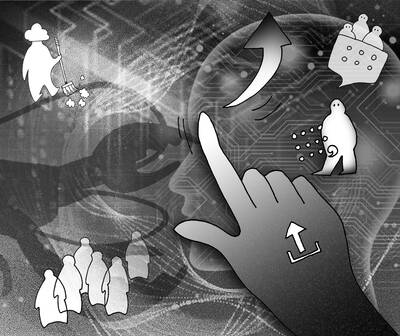
Weeks into the craze, nobody quite knows what to make of the OpenClaw mania sweeping China, marked by viral photos of retirees lining up for installation events and users gathering in red claw hats. The queues and cosplay inspired by the “raising a lobster” trend make for irresistible China clickbait. However, the West is fixating on the least important part of the story. As a consumer craze, OpenClaw — the AI agent designed to do tasks on a user’s behalf — would likely burn out. Without some developer background, it is too glitchy and technically awkward for true mainstream adoption,
On Monday, a group of bipartisan US senators arrived in Taiwan to support the nation’s special defense bill to counter Chinese threats. At the same time, Beijing announced that Chinese President Xi Jinping (習近平) had invited Chinese Nationalist Party (KMT) Chairwoman Cheng Li-wun (鄭麗文) to visit China, a move to make the KMT a pawn in its proxy warfare against Taiwan and the US. Since her inauguration as KMT chair last year, Cheng, widely seen as a pro-China figure, has made no secret of her desire to interact with the Chinese Communist Party (CCP) and meet with Xi, naming it a
A delegation of Chinese Nationalist Party (KMT) officials led by Chairwoman Cheng Li-wun (鄭麗文) is to travel to China tomorrow for a six-day visit to Jiangsu, Shanghai and Beijing, which might end with a meeting between Cheng and Chinese President Xi Jinping (習近平). The trip was announced by Xinhua news agency on Monday last week, which cited China’s Taiwan Affairs Office (TAO) Director Song Tao (宋濤) as saying that Cheng has repeatedly expressed willingness to visit China, and that the Chinese Communist Party (CCP) Central Committee and Xi have extended an invitation. Although some people have been speculating about a potential Xi-Cheng
The ongoing Iran conflict is putting Taiwan’s energy fragility on full display — the island of 23 million people, home to the world’s most advanced semiconductor manufacturing, is highly dependent on imported oil and gas, especially that from the Middle East. In 2025, 69.6 percent of Taiwan’s crude oil and 38.7 percent of liquified natural gas were sourced from the Middle East. In the same year, 62 percent of crude oil and 34 percent of LNG to Taiwan went through the Strait of Hormuz. Taiwan’s state-run oil company CPC Corp’s benchmark crude oil price (70 percent Dubai, 30 percent Brent)


 RSS
RSS