


Chinese Nationalist Party (KMT) Chairman Eric Chu (朱立倫) just finished his visit to the US trying to sell his idea of US-China-Taiwan relations. During his visit, Chu attempted to remind Washington elites that the KMT is here, not only in Taiwan’s political arena, but, more importantly, that the party’s stance aligns with Washington’s position toward Taiwan’s status and cross-strait relations.
The former implies Washington should not underrate the probability of the KMT’s return to power, while the latter suggests KMT is a pro-US party. After all, the mission of Chu’s US visit was to appease skepticism about the KMT in Washington due to the party’s policy of jumping onto the bandwagon of Chinese President Xi Jinping’s (習近平) China since former president Ma Ying-jeou’s (馬英九) second term in office.
To accomplish the mission, Chu’s interpretation is structured along three lines: First, regarding the “1992 consensus,” the KMT’s longstanding position toward cross-strait relations, Chu surprisingly introduced former president Chen Shui-bian’s (陳水扁) term of “non-consensus consensus” to redefine it.
Chu argued that the “1992 consensus” is to the KMT what the “one China” policy is to the US, in that they are both a “non-consensus consensus,” serving as a device to allow for creative ambiguity. In regard to the China challenge in cross-strait relations and in East Asia, the KMT and Washington are two great minds thinking alike, he said.
Second, regarding the KMT’s ideology, Chu openly pledged pursuit of democracy and the fight against communism, two founding principles of the party that still count. Therefore, the KMT and Washington are strategically on the same page, which means that Chu’s KMT is a responsible stakeholder that acts accordingly with the US in safeguarding regional peace and stability.
In Chu’s wishful thinking, he looks to use his interpretation as an icebreaker in search of a breakthrough before the forthcoming presidential campaign. However, he is walking a political tightrope. For instance, Chu is appropriating Chen’s term to rattle the cage of the “1992 consensus,” hoping to rip off the party’s pro-China label that has proven unpopular in Taiwan.
He proclaims the KMT’s fundamental ideology is democracy and anti-communism. In general, the unspoken idea behind Chu’s interpretation suggests his position is a reversion to former president Lee Teng-hui’s (李登輝) position in the 1990s, which was essentially a pro-localization stance, safeguarding democracy in Taiwan, and strongly opposing the mysterious and controversial “1992 consensus,” which embodies the “one China” concept.
In terms of national unity in Taiwan, it is certainly positive to see that the KMT has finally addressed the mainstream demand of Taiwanese and that the KMT is showing its willingness to join the Democratic Progressive Party (DPP) in safeguarding the “status quo” of Taiwan’s de facto sovereignty under the label of the Republic of China (ROC).
However, before Chu’s interpretation is further materialized into a competitive policy for the KMT, his position is highly likely to get him caught in the cross-fire in his party. In terms of KMT politics, the inconvenient truth is that both Lee and Chen have long been recognized as enemies of the party. As long as the KMT retains such antagonism over Lee and Chen, any KMT figure who is suspected of echoing their positions would only be seen as another rebel.
In regard to US-China-Taiwan relations, Chu, on the one hand, proclaims that the KMT will seek “principled engagement” with Beijing. On the other, Chu reaffirms the KMT’s century of being a pro-US party, since the era of the ROC’s founder Sun Yat-sen (孫逸仙). Consequently, in contrast to the cross-strait stalemate under the DPP administration, he is trying to convince Washington that the KMT’s Taiwan will play the role of “stabilizer” to help maintain regional peace and stability.
This is a paradox in realpolitik today. Given that the world is entering an era of US-China strategic competition, Taiwan is actually a player that seeks to maintain the “status quo,” whereas China’s developing assertiveness and aggressive actions in the Taiwan Strait and South China Sea give it a revisionist image as a country seeking to change the “status quo” to speak to its need. Chu’s vision awkwardly shows he might be a yesterday man.
The paradox unmasks more of the structural struggle in the KMT than it does the problematic leadership of Chu. The party has been chasing China since former KMT chairman Lien Chan’s (連戰) China visit and his “five common visions” with then-Chinese president Hu Jintao (胡錦濤) in 2005.
After all, China sentiment is to the KMT what the slavery issue is to the US’ Whig Party in the 19th century: It is the deep-rooted problem destined to split the party. Chu is not the first KMT leader to realize that returning to Taiwan subjectivity is the party’s only way to survive in the Taiwanese political landscape.
The KMT’s last strongman, Lee, was the pioneer of this position, while Chu’s predecessor, former KMT chairman Johnny Chiang (江啟臣), also tried to reposition the KMT during his tenure. However, the KMT repaid Lee and Chiang by throwing them out of office. Chu’s US visit this month might prove to be the biggest gamble of his political career.
Jason Chen is a visiting scholar at the Weatherhead East Asian Institute, Columbia University.
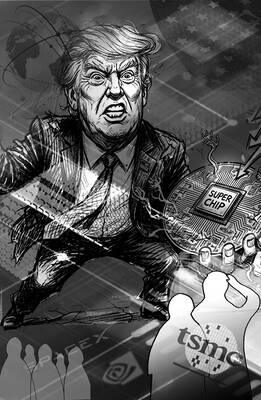
The White House’s decision to take a 9.9 percent stake in Intel Corp is looking like very shrewd business indeed. Since the government bought in at US$20.47 a share last August, the US chipmaker’s surging stock price has delivered the US a US$43 billion return. One of the reasons the investment has so far proved so sound is that the White House has made sure of it. According to The Wall Street Journal, Howard personally pushed deals on Intel’s behalf with some of the most lucrative clients imaginable. They include Nvidia Corp, the company at the heart of the AI
A single photograph can cut through a lot of noise, but it can also be used to misrepresent the truth. At the very least, it can concentrate the mind on something that requires further investigation. On Monday last week, Ma Ying-jeou Foundation CEO Tai Hsia-ling (戴遐齡) and former National Security Council secretary-general King Pu-tsung (金溥聰) held a news conference in which they showed a photograph of former foundation CEO Hsiao Hsu-tsen (蕭旭岑), now Chinese Nationalist Party (KMT) deputy chairman. In the image Hsiao is seated next to Xiamen Taiwan Businessmen Association chairman Han Ying-huan (韓螢煥). The two men were holding
I first met Professor Ray Jiing (井迎瑞) as a film and documentary student at Shih Hsin University’s (SHU) Department of Radio Television and Film in 1988. The following year, he went on to become the director of the Chinese Taipei Film Archive — forerunner of the Taiwan Film and Audiovisual Institute (TFAI). Over his eight-year tenure, Jiing rescued and restored over 200 classic Taiwanese films. In 1997, he established the Graduate Institute of Studies in Documentary and Film Archiving at Tainan National University of the Arts (TNNUA), and I joined the program in his third cohort of students. Beyond a
A recent report concerning a student who is suing his teacher posed the question in its headline: Does failing a student in two subjects constitute bullying? The college student in Chiayi County apparently sought NT$2 million (US$63,603) in state compensation, but a court dismissed the case. The first reaction of many might have been to ask: What has happened to students nowadays? Some say that teachers have lost their authority, while others say students are overindulged. Some even start reminiscing over the days when “whatever the teacher says goes.” However, the real issue might be overlooked if emotional reactions like that are the


 RSS
RSS