


As the number of local COVID-19 cases reported daily has grown from the hundreds to more than 40,000 in the past month, domestic disease prevention and control measures have drastically transformed to adapt to the changing pandemic situation. The government last month shifted its strategy from “zero COVID-19” to “living with the virus,” as the outbreak of the Omicron variant of SARS-CoV-2 seemed unstoppable.
While the Central Epidemic Command Center (CECC) says it makes “rolling adjustments” to policies based on changing situations, many people are having trouble keeping up with the various terms and required measures, such as home care, home quarantine, home isolation, self-health management, self-disease prevention, self-response subjects and so on.
Many frontline administrative and healthcare workers have also found it difficult to continue implementing measures due to their fast-growing caseloads. The CECC had to further ease measures to reallocate labor and resources to deal with an expected rise in moderate and severe cases.
Under the relaxed measures, mild cases are no longer required to be hospitalized or be isolated in centralized facilities. Instead, they can stay at home to recover; home isolation and quarantine periods have been shortened; and the contact registration QR code system and contact tracing by specialized personnel have been abandoned. Confirmed cases only need to use an online self-reporting system for contact tracing.
Minister of Health and Welfare Chen Shih-chung (陳時中), who heads the CECC, on April 19 said people should be responsible and “be responsive to their own needs,” when discussing what people should do upon testing positive for COVID-19 without receiving instructions from the local health department.
Chen’s remark sparked criticism. The fast-changing policies and the shift from “being instructed and cared for” to being “self-guided and responsible for their own conditions” have left many people feeling clueless about what to do when they have had direct contact with a case or test positive for COVID-19.
Moreover, while elderly people are more at risk of developing severe symptoms or dying from COVID-19, the recent changes have left them feeling more vulnerable or excluded, as they have difficulty receiving accurate, up-to-date information, which depends on having an adequate level of digital literacy.
Under the new CECC guidelines, a person who tests positive for COVID-19 using a rapid test is recommended to take a polymerase chain reaction (PCR) test at a community testing station and wait at home for the result — which can be checked on the National Health Insurance Administration’s mobile app (全民健保行動快易通) — and then complete an online contact tracing report if the PCR test is positive.
A person who tests positive using a rapid test during isolation is required to confirm the test result with a doctor through telemedicine videoconferencing, while a confirmed case in isolation at home should see a doctor, also using telemedicine, to receive antiviral drugs or other medication.
These digitized approaches help prevent possible or confirmed COVID-19 cases from crowding at hospitals if they need tests or treatment, and increase the efficiency of medical administration. However, they also limit access to healthcare services for elderly people, leaving those who are not tech-savvy feeling puzzled and helpless.
The CECC and local governments did a good job establishing ways for elderly people to purchase masks and book vaccination appointments with traditional, non-Internet methods. Policymakers should now also consider the health inequities caused by a digital literacy gap, and offer alternative options for the older generation to access COVID-19 information and healthcare services, leaving no one behind.
During the long Lunar New Year’s holiday, Taiwan has shown several positive developments in different aspects of society, hinting at a hopeful outlook for the Year of the Horse, but there are also significant challenges that the country must cautiously navigate with strength, wisdom and resilience. Before the holiday break, Taiwan’s stock market closed at a record 10,080.3 points and the TAIEX wrapped up at a record-high 33,605.71 points, while Taipei and Washington formally signed the Taiwan-US Agreement on Reciprocal Trade that caps US tariffs on Taiwanese goods at 15 percent and secures Taiwan preferential tariff treatment. President William Lai (賴清德) in
As red lanterns adorn street corners and social media feeds teem with zodiac divinations, the Year of the Horse has arrived. In our hyper-accelerated age, the horse is almost exclusively synonymous with the idiom ma dao cheng gong (馬到成功) — “instant success upon arrival.” It is a linguistic shot of adrenaline, fueling the thrilling illusion that once the bell tolls, our lives would screech off into a cloud of dust, leaving all troubles behind. Yet, when examining the millennia-long partnership between humans and this magnificent “biological machine,” a different truth emerges. The true essence of the horse is not merely speed;
Chinese Nationalist Party (KMT) Deputy Chairman Hsiao Hsu-tsen (蕭旭岑) earlier this month led a delegation to Beijing to attend a think tank forum between the KMT and Chinese Communist Party (CCP). After returning to Taiwan, Hsiao spoke at length about “accumulating mutual trust” and letting matters “fall into place,” portraying the forum as a series of discussions focused on cooperation in tourism, renewable energy, disaster prevention, emerging industries, health and medicine, and artificial intelligence (AI). However, when the entire dialogue presupposes the so-called “1992 consensus — the idea that there is only “one China,” with each side of the Taiwan
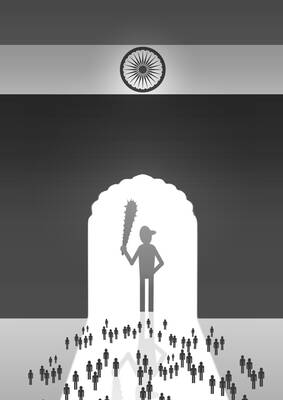
India is getting richer every year, but its cities do not seem to be getting any more livable. Not because the country is too poor, or because leaders lack ambition, but because urban citizens are starved of funds and deprived of representation — and the government is in no hurry to fix it, even though people are dying as a result. Mumbai’s skyline is dotted with opulent glass towers, and it calls itself India’s commercial capital. The civic body, the Brihanmumbai Municipal Corp, is the country’s richest. Yet, residents have lived for years with no say in how their city was


 RSS
RSS