


Chinese Minister of Foreign Affairs Wang Yi (王毅) on Monday attempted to rewrite the narrative on cross-strait tensions by placing the blame on the US and calling Taiwan a “wanderer who will eventually come home.” The US and other countries were trying to use Taiwan as a “chess piece” to upset the “status quo” in Beijing’s relations with Taipei, a Reuters report cited Wang as saying.
Rhetoric from Beijing over its claims over Taiwan is nothing new, but Wang’s statement indicates a change in approach. Referring to Taiwan as a “wanderer” while chastising the US seems to be an attempt to drive a wedge between Taipei and Washington, and to win over Taiwanese with softer language than previously.
The Chinese Communist Party (CCP) is concerned over growing support for Taiwan in the international community — particularly from the US — and believes that it can deflect some of the criticism it is subject to over regional tensions and human rights abuses. The outcome of last week’s referendums might also worry Beijing, as a majority supported the policies of the Democratic Progressive Party, which the CCP calls “separatist.”
Nobody in the international community will buy into Beijing’s rhetoric and see the US as the instigator of tensions in the Taiwan Strait, so Wang’s comments are likely intended for Taiwanese and Chinese audiences.
China has in the past few weeks held a slew of “united front” events, including the Straits Forum on Dec. 11, where the CCP again pushed its failed “one country, two systems” framework for Taiwan. Beijing again threatened “secessionists” and urged Taiwanese who do not subscribe to the idea of unification not to “play with fire.”
Beijing is notorious for its carrot-and-stick tactics, offering incentives to Taiwanese who accept its “one China” policy and threatening consequences to those who do not. Its most recent “carrots” have been a hip-hop dance championship and an Internet entrepreneurship festival — showing that the CCP is well informed about what interests Taiwanese youth.
National Cheng Kung University political science professor Hung Chin-fu (洪敬富) on Monday said that Chinese officials know that young Taiwanese do not identify with China in the same way that their parents and grandparents might have. The efforts the CCP puts into trying to understand and win over young Taiwanese shows that it knows that it cannot take Taiwan by means of a military invasion. However, the results of elections in Taiwan show that the nation will unlikely unify with China willingly.
This has left the CCP with no option but to increase its verbal attacks against those who help Taiwan, such as the US. The government need not respond to Beijing’s desperate actions, but if it does feel compelled to do so, it should take the opportunity to remind the CCP that its rhetoric is counterproductive. The best China can hope for is normalized exchanges with Taiwan, and to achieve that, it needs to recognize Taiwan’s independence.
A source has said that Beijing plans to have Taiwanese athletes appear at the Beijing Winter Olympics’ opening ceremony alongside those from Macau and Hong Kong to create an image of a unified China, and Chinese media would refer to Taiwan’s team not as Chinese Taipei — zhonghua taibei (中華台北) — but as zhongguo taibei (中國台北), indicating that it is part of the same state.
Beijing is clearly holding fast to delusions about an imagined unification with Taiwan. The government’s reaction — if any — should be to remind China not to waste its time.
During the long Lunar New Year’s holiday, Taiwan has shown several positive developments in different aspects of society, hinting at a hopeful outlook for the Year of the Horse, but there are also significant challenges that the country must cautiously navigate with strength, wisdom and resilience. Before the holiday break, Taiwan’s stock market closed at a record 10,080.3 points and the TAIEX wrapped up at a record-high 33,605.71 points, while Taipei and Washington formally signed the Taiwan-US Agreement on Reciprocal Trade that caps US tariffs on Taiwanese goods at 15 percent and secures Taiwan preferential tariff treatment. President William Lai (賴清德) in
Chinese Nationalist Party (KMT) Deputy Chairman Hsiao Hsu-tsen (蕭旭岑) earlier this month led a delegation to Beijing to attend a think tank forum between the KMT and Chinese Communist Party (CCP). After returning to Taiwan, Hsiao spoke at length about “accumulating mutual trust” and letting matters “fall into place,” portraying the forum as a series of discussions focused on cooperation in tourism, renewable energy, disaster prevention, emerging industries, health and medicine, and artificial intelligence (AI). However, when the entire dialogue presupposes the so-called “1992 consensus — the idea that there is only “one China,” with each side of the Taiwan
As red lanterns adorn street corners and social media feeds teem with zodiac divinations, the Year of the Horse has arrived. In our hyper-accelerated age, the horse is almost exclusively synonymous with the idiom ma dao cheng gong (馬到成功) — “instant success upon arrival.” It is a linguistic shot of adrenaline, fueling the thrilling illusion that once the bell tolls, our lives would screech off into a cloud of dust, leaving all troubles behind. Yet, when examining the millennia-long partnership between humans and this magnificent “biological machine,” a different truth emerges. The true essence of the horse is not merely speed;
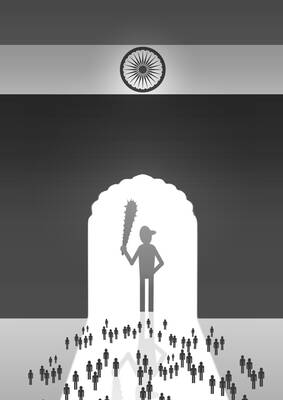
India is getting richer every year, but its cities do not seem to be getting any more livable. Not because the country is too poor, or because leaders lack ambition, but because urban citizens are starved of funds and deprived of representation — and the government is in no hurry to fix it, even though people are dying as a result. Mumbai’s skyline is dotted with opulent glass towers, and it calls itself India’s commercial capital. The civic body, the Brihanmumbai Municipal Corp, is the country’s richest. Yet, residents have lived for years with no say in how their city was


 RSS
RSS