


Chinese President Xi Jinping (習近平) said during an online summit with US President Joe Biden on Monday that attempts at Taiwanese independence were like “playing with fire.”
The remarks were either for Chinese to hear in an attempt to maintain the legitimacy of Xi’s increasing grip on power, or they represent the delusions of a leader who is oblivious to the changing political landscape in Taiwan, as well as the increasing international support for the defense of Taiwan from Chinese aggression.
International media have largely concluded that nothing changed in the US-China relationship as a result of the summit, with both leaders simply reiterating their positions on key issues. Biden reaffirmed Washington’s commitment to Taiwan and its opposition to any unilateral change in the “status quo” of the Taiwan Strait. Similarly, US Department of State spokesman Ned Price last month told a press briefing in Washington that US-Taiwan relations continue to be “guided by the Taiwan Relations Act, by the Three Joint Communiques and the ‘six assurances’ provided to Taipei.”
Although not mentioned by Price, the Taiwan Travel Act — which was introduced during the administration of former US president Donald Trump to allow high-level exchanges between Taipei and Washington — is also a factor in Taiwan’s ties with the US.
On the face of things, it seems that the US is not looking to change its relationship with Taiwan, but its actions over the past year suggest otherwise. US Ambassador to Palau John Hennessey-Niland on March 28 became the first US ambassador to visit Taiwan since 1979, when he arrived with a Palauan delegation. This was followed in April by an “unofficial” delegation sent by Biden made up of former US senator Chris Dodd, and former US deputy secretaries of state Richard Armitage and James Steinberg. On Thursday last week, a US Navy C-40A aircraft brought an unannounced group of six US lawmakers to Taipei via Manila.
Officials last month also confirmed that US marines have been stationed in Taiwan for “at least a year” training local forces, and earlier this month it was confirmed that Taiwanese marines have been training with US marines in Guam.
All of this has clearly been in response to an increase in Chinese military activity in the Taiwan Strait — not the other way around, as Beijing would like to claim — and the US’ response should prompt Beijing to wonder how much more it wants to push the issue. The past year has also seen the formation of a US alliance with the UK and Australia, and Australian Minister for Defence Peter Dutton on Saturday saying that Canberra would defend Taiwan alongside the US were China to invade.
While some people have questioned whether Washington’s actions over the past year have convinced anyone that it would get involved in a Taiwan-China conflict, it is noteworthy that the US’ Indo-Pacific strategy hinges upon the integrity of the first island chain. The fall of Taiwan would put US bases in Japan, South Korea and Guam at risk, and would make US allies in the region question its ability and resolve to protect its interests. Therefore, there should be no question that despite its official stance of maintaining “strategic ambiguity,” the US is exceedingly likely to use its military to defend Taiwan. It would also not be alone in doing so, with Australia, Japan and South Korea likely to join, bolstered by the forces in Taiwan itself, which the US has been training and equipping.
It is impossible that China could take Taiwan through military force without incurring significant casualties to its civilian population and infrastructure, and without destroying its economy, its diplomatic relations and its membership in international organizations. The government should make clear to China that Taiwanese are not intimidated and that Beijing should stop “playing with fire.”
A gap appears to be emerging between Washington’s foreign policy elites and the broader American public on how the United States should respond to China’s rise. From my vantage working at a think tank in Washington, DC, and through regular travel around the United States, I increasingly experience two distinct discussions. This divergence — between America’s elite hawkishness and public caution — may become one of the least appreciated and most consequential external factors influencing Taiwan’s security environment in the years ahead. Within the American policy community, the dominant view of China has grown unmistakably tough. Many members of Congress, as
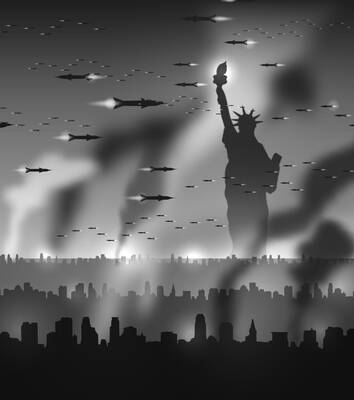
After declaring Iran’s military “gone,” US President Donald Trump appealed to the UK, France, Japan and South Korea — as well as China, Iran’s strategic partner — to send minesweepers and naval forces to reopen the Strait of Hormuz. When allies balked, the request turned into a warning: NATO would face “a very bad” future if it refused. The prevailing wisdom is that Trump faces a credibility problem: having spent years insulting allies, he finds they would not rally when he needs them. That is true, but superficial, as though a structural collapse could be caused by wounded feelings. Something
Former Taipei mayor and Taiwan People’s Party (TPP) founding chairman Ko Wen-je (柯文哲) was sentenced to 17 years in prison on Thursday, making headlines across major media. However, another case linked to the TPP — the indictment of Chinese immigrant Xu Chunying (徐春鶯) for alleged violations of the Anti-Infiltration Act (反滲透法) on Tuesday — has also stirred up heated discussions. Born in Shanghai, Xu became a resident of Taiwan through marriage in 1993. Currently the director of the Taiwan New Immigrant Development Association, she was elected to serve as legislator-at-large for the TPP in 2023, but was later charged with involvement
Out of 64 participating universities in this year’s Stars Program — through which schools directly recommend their top students to universities for admission — only 19 filled their admissions quotas. There were 922 vacancies, down more than 200 from last year; top universities had 37 unfilled places, 40 fewer than last year. The original purpose of the Stars Program was to expand admissions to a wider range of students. However, certain departments at elite universities that failed to meet their admissions quotas are not improving. Vacancies at top universities are linked to students’ program preferences on their applications, but inappropriate admission


 RSS
RSS