


In one of the planet’s coldest places, 130km south of Russia’s Arctic coast, scientist Sergey Zimov can find no sign of permafrost as global warming permeates Siberia’s soil.
As everything from mammoth bones to ancient vegetation frozen inside it for millennia thaws and decomposes, it threatens to release vast amounts of greenhouse gases.
Zimov, who has studied permafrost from his scientific base in the diamond-producing Yakutia region for decades, is seeing the effects of climate change in real time.
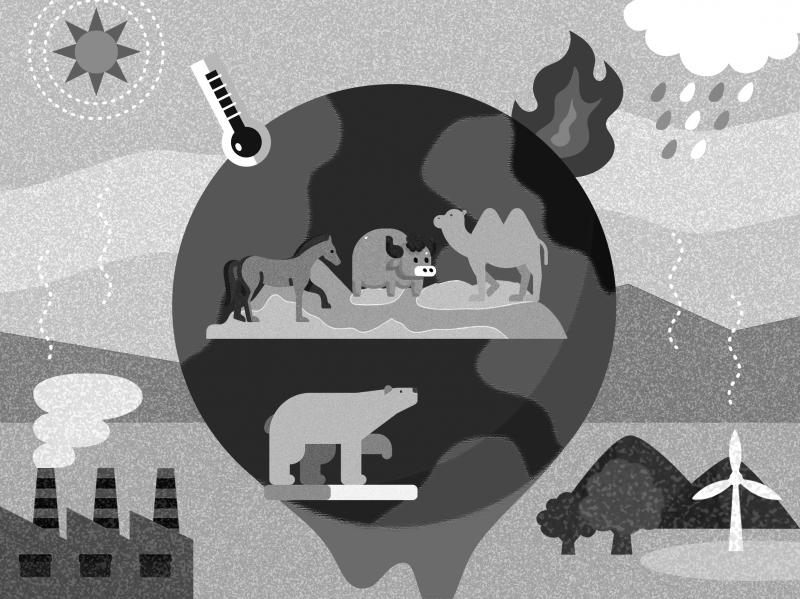
Illustration: Louise Ting
Driving a thin metal pole meters into the Siberian turf, where temperatures are rising at more than three times the world average, with barely any force, the 66-year-old speaks bluntly.
“This is one of the coldest places on Earth and there is no permafrost,” he said. “Methane has never increased in the atmosphere at the speed it is today ... I think this is linked to our permafrost.”
Permafrost covers 65 percent of Russia’s land mass and about a quarter of the northern land mass. Scientists have said that greenhouse gas emissions from its thaw could eventually match or even exceed the EU’s industrial emissions due to the sheer volume of decaying organic matter.
Meanwhile permafrost emissions, which are seen as naturally occurring, are not counted against government pledges aimed at curbing emissions or in the spotlight at UN climate talks.
Zimov, with his white beard and cigarette, ignored orders to leave the Arctic when the Soviet Union collapsed, and instead found funding to keep the Northeast Science Station near the partly abandoned town of Chersky operating.
Citing data from a US-managed network of global monitoring stations, Zimov said he believes that the COVID-19 pandemic has shown that permafrost has begun to release greenhouse gases.
Despite factories scaling back activity worldwide during the pandemic, which also dramatically slowed global transport, Zimov said the concentration of methane and carbon dioxide in the atmosphere has been growing at a faster rate.
Whole cities sit on permafrost, and its thawing could cost Russia US$100 billion in damage by 2050 if the rate of warming continues, scientists have said.
Built on the assumption that the permafrost would never thaw, many homes, pipelines and roads in Russia’s far north and east are sinking and increasingly in need of repair.
Zimov wants to slow the thaw in one area of Yakutia by populating a nature reserve called the Pleistocene Park with large herbivores such as bison, horses and camels.
Such animals trample the snow, making it much more compact and allowing the winter cold to get through to the ground rather than acting as a thick insulating blanket.
Zimov and his son Nikita began introducing animals into the fenced park in 1996 and have so far relocated about 200 of different species, which they said are making the permafrost colder compared with other areas.
Bison were trucked and shipped this summer from Denmark, along the Northern Sea Route, past polar bears and walruses and through weeks-long storms, before their ship finally steered into the mouth of the Kolyma River toward their new home about 6,000km to the east.
The Zimovs’ surreal plan for geo-engineering a cooler future has extended to offering a home for mammoths, which other scientists hope to resurrect from extinction with genetic techniques, in order to mimic the region’s ecosystem during the last Ice Age, which ended 11,700 years ago.
A paper published in Nature Research’s Scientific Reports last year, where both Zimovs were listed as authors, showed that the animals in Pleistocene Park had reduced the average snow depth by half, and the average annual soil temperature by 1.9°C, with an even bigger drop in winter and spring.
More work is needed to determine if such unconventional methods might be an effective climate-change mitigation strategy but the density of animals in Pleistocene Park — 114 individuals per square kilometer — should be feasible on a pan-Arctic scale, the study said.
Global-scale models also suggest that introducing big herbivores onto the tundra could stop 37 percent of Arctic permafrost from thawing, the paper said.
Nikita Zimov, Sergey’s son, was walking in the shallows of the river Kolyma at Duvanny Yar in September when he fished out a mammoth tusk and tooth.
Such finds have been common for years in Yakutia and particularly by rivers where the water erodes the permafrost.
Three hours by boat from Chersky, the riverbank provides a cross-section of the thaw, with a thick sheet of exposed ice melting and dripping below layers of dense black earth containing small grass roots.
“If you take the weight of all these roots and decaying organics in the permafrost from Yakutia alone, you’d find the weight was more than the land-based biomass of the planet,” Nikita said.
Scientists have said that on average, the world has warmed 1°C in the past century, while the temperature in Yakutia has risen 3°C in the past 50 years.
The older Zimov said he has seen for himself how winters have grown shorter and milder, while Alexander Fedorov, deputy director of the Melnikov Permafrost Institute in Yakutsk, said he no longer has to wear fur clothing during the coldest months.
Addressing permafrost emissions, such as fire and other so-called natural emissions, presents a challenge because they are not fully accounted for in climate models or international agreements, scientists have said.
“The difficulty is the quantity,” said Carelton University professor Chris Burn, who is also president of the International Permafrost Association. “One or two percent of permafrost carbon is equivalent to total global emissions for a year.”
Scientists estimate that permafrost in the northern hemisphere contains about 1.5 trillion tonnes of carbon, about twice as much as is in the atmosphere, or about three times as much as in all of the trees and plants on earth.
Nikita said there is no single solution to global warming.
“We’re working to prove that these ecosystems will help in the fight, but, of course, our efforts alone are not enough,” he said.
We are used to hearing that whenever something happens, it means Taiwan is about to fall to China. Chinese President Xi Jinping (習近平) cannot change the color of his socks without China experts claiming it means an invasion is imminent. So, it is no surprise that what happened in Venezuela over the weekend triggered the knee-jerk reaction of saying that Taiwan is next. That is not an opinion on whether US President Donald Trump was right to remove Venezuelan President Nicolas Maduro the way he did or if it is good for Venezuela and the world. There are other, more qualified
This should be the year in which the democracies, especially those in East Asia, lose their fear of the Chinese Communist Party’s (CCP) “one China principle” plus its nuclear “Cognitive Warfare” coercion strategies, all designed to achieve hegemony without fighting. For 2025, stoking regional and global fear was a major goal for the CCP and its People’s Liberation Army (PLA), following on Mao Zedong’s (毛澤東) Little Red Book admonition, “We must be ruthless to our enemies; we must overpower and annihilate them.” But on Dec. 17, 2025, the Trump Administration demonstrated direct defiance of CCP terror with its record US$11.1 billion arms
The immediate response in Taiwan to the extraction of Venezuelan President Nicolas Maduro by the US over the weekend was to say that it was an example of violence by a major power against a smaller nation and that, as such, it gave Chinese President Xi Jinping (習近平) carte blanche to invade Taiwan. That assessment is vastly oversimplistic and, on more sober reflection, likely incorrect. Generally speaking, there are three basic interpretations from commentators in Taiwan. The first is that the US is no longer interested in what is happening beyond its own backyard, and no longer preoccupied with regions in other
As technological change sweeps across the world, the focus of education has undergone an inevitable shift toward artificial intelligence (AI) and digital learning. However, the HundrED Global Collection 2026 report has a message that Taiwanese society and education policymakers would do well to reflect on. In the age of AI, the scarcest resource in education is not advanced computing power, but people; and the most urgent global educational crisis is not technological backwardness, but teacher well-being and retention. Covering 52 countries, the report from HundrED, a Finnish nonprofit that reviews and compiles innovative solutions in education from around the world, highlights a


 RSS
RSS