


Over the past two to three decades, Taiwan’s tepid economy has been routinely compared with China’s rapid growth. Young Taiwanese have been criticized for lacking a “wolf-like spirit” — for being less ambitious than their Chinese peers. China’s continuous growth has led some to think that it would leave its rivals, including the US, far behind.
However, China’s tightening of industry regulations has stunned global players in the financial markets and investment services sector, prompting the need for a re-evaluation. Last week, when the markets were wondering which industry would be next to face Chinese government scrutiny, large-scale power cuts across the country produced new uncertainty regarding the global economy.
About 16 of China’s 31 provinces last week experienced electricity rationing, media reports said, adding that some manufacturers in the economic powerhouses of Jiangsu, Zhejiang and Guangdong provinces had significant disruptions. Over the coming months, businesses in some cities must schedule around rationing of three days on and four days off, or two days on and five days off, while firms in some areas must cope with irregular outages.
In the peak season for manufacturers, Beijing has had to resort to power rationing because of electricity shortages in some parts of China. The Chinese Communist Party has not only implemented energy consumption controls and carbon neutrality in various provinces, but also blocked Australian coal imports earlier this year, which led to soaring thermal coal prices and lower financial incentives for domestic power companies to generate more electricity.
Outbreaks of COVID-19 infections in South and Southeast Asian countries have also increased manufacturing activity in China, which boosted power demand and contributed to its power shortages.
Time and money are required for the Chinese government to meet this energy challenge. By the end of last week, Beijing allowed utilities to raise prices and use more coal-fired power generation, but weeks are needed for the effects to be noticeable. It remains to be seen whether China’s electricity crisis will be the norm over an extended period as the markets fear.
Beijing has been signaling an upcoming industrial transformation. The country plans to shift away from energy-intensive industries — such as the production of chemicals, steel, cement and textiles — to those with low energy consumption to meet emissions targets, but the transformation is raising concern that pressure on private enterprises is to increase and that Beijing is making another attempt to revive its bloated state-owned sector.
Whatever its goals, Beijing’s unexpected power rationing has not only affected Chinese industries, but also foreign companies, including those in Taiwan. Its actions are likely to harm the Chinese economy and damage global supply chains. Over the past few years, inflationary pressures have risen due to increasing freight rates and raw material prices. If manufacturing disruptions and component shortages at Chinese plants persist, price hikes are likely to spread along global supply chains, making China-induced inflationary pressure a new focus for the world.
The business environment in China — from regulatory tightening to Evergrande Group’s financial turmoil to the recent power rationing — is deteriorating, pushing investment risks higher. If Beijing can purge tech giants such as Alibaba Group Holding and Didi Global overnight, how can foreign companies, including Taiwanese firms, escape?
As a result, it is once again time — just as during the peak of US-China trade tensions — for Taiwanese firms to rethink the deployment of their assets around the world and to realign their supply chains in the post-pandemic era.
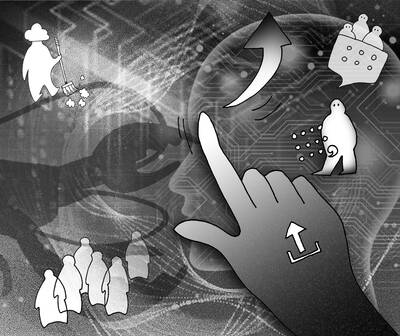
Weeks into the craze, nobody quite knows what to make of the OpenClaw mania sweeping China, marked by viral photos of retirees lining up for installation events and users gathering in red claw hats. The queues and cosplay inspired by the “raising a lobster” trend make for irresistible China clickbait. However, the West is fixating on the least important part of the story. As a consumer craze, OpenClaw — the AI agent designed to do tasks on a user’s behalf — would likely burn out. Without some developer background, it is too glitchy and technically awkward for true mainstream adoption,
Out of 64 participating universities in this year’s Stars Program — through which schools directly recommend their top students to universities for admission — only 19 filled their admissions quotas. There were 922 vacancies, down more than 200 from last year; top universities had 37 unfilled places, 40 fewer than last year. The original purpose of the Stars Program was to expand admissions to a wider range of students. However, certain departments at elite universities that failed to meet their admissions quotas are not improving. Vacancies at top universities are linked to students’ program preferences on their applications, but inappropriate admission
On Monday, a group of bipartisan US senators arrived in Taiwan to support the nation’s special defense bill to counter Chinese threats. At the same time, Beijing announced that Chinese President Xi Jinping (習近平) had invited Chinese Nationalist Party (KMT) Chairwoman Cheng Li-wun (鄭麗文) to visit China, a move to make the KMT a pawn in its proxy warfare against Taiwan and the US. Since her inauguration as KMT chair last year, Cheng, widely seen as a pro-China figure, has made no secret of her desire to interact with the Chinese Communist Party (CCP) and meet with Xi, naming it a
Taiwan People’s Party (TPP) Chairman Huang Kuo-chang (黃國昌) took the stage at a protest rally on Sunday in front of the Presidential Office Building in Taipei in support of former TPP chairman Ko Wen-je (柯文哲), who has been sentenced to 17 years in jail for corruption and embezzlement. Huang told the crowd that Chinese Nationalist Party (KMT) Chairwoman Cheng Li-wun (鄭麗文) had sent a message of support the previous day, saying she would be traveling from the south to Taipei: If the protest continued into the evening, she had said, she would show up. The rally was due to end


 RSS
RSS