


One of the most dangerous greenhouse gases is leaking into the atmosphere relentlessly from the EU’s easternmost edge.
Invisible plumes of methane escape from Romania’s oil fields, gas pipes, rusting storage containers and even a well next to a playground.
The job of finding the leaking gas, with more than 80 times more warming power than carbon dioxide in the short term, falls to James Turitto from the nonprofit Clean Air Task Force. He has found more than 70 leaks using a special infrared camera capable of detecting the odorless gas.
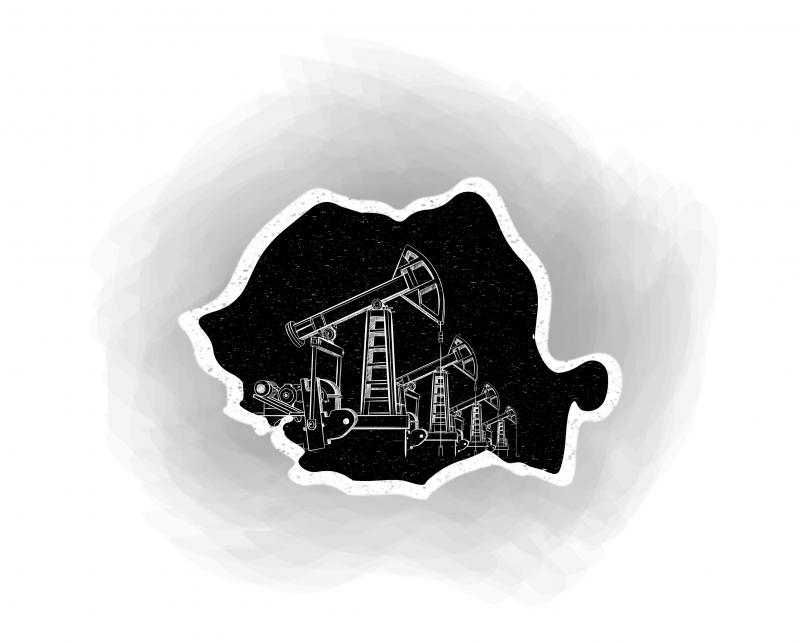
Illustration: June Hsu
“It felt like every well in Romania is leaking,” said Turitto, who is traveling around Europe with the 100,000 euro (US$117,954) camera to track down fugitive releases. “Tanks were rusted out. It was impossible to document all the methane emissions.”
The ubiquity of leaks coming from one of the EU’s top producers of oil and gas highlights a challenge for European policymakers working to cut greenhouse gas emissions 55 percent from 1990 levels by the end of the decade. Methane is the biggest contributor to global warming after carbon dioxide, but has so far faced scant regulation in Europe.
While the bloc proposed a sweeping package of policies to decarbonize its economy earlier this year, it has yet to pass comprehensive laws to tackle methane.
“It’s literally under the radar,” said Antoine Vagneur-Jones, an analyst at research group BloombergNEF. “If the EU wants to push ahead with any kind of strong policy around this, then it also needs to make an effort to clampdown on methane leakage in its own backyard.”
The EU is relatively free of the kinds of large-scale methane leaks that have been detected through satellite imagery in countries from Kazakhstan to Australia. Over the past two years, those bigger plumes — typically with emissions rates in excess of 5 tonnes per hour — have been spotted on only about a dozen occasions in Europe, compared with more than two thousand globally, according to estimates from geoanalytics firm Kayrros. Most European leaks were related to coal production in Poland.
These so-called “super emitters” account for only about 10 to 15 percent of the total methane pollution from the gas and oil industry, while the rest comes from smaller sources, Kayrros said.
Halting both small and large leaks is one of the cheapest and easiest ways to slow the increase in global temperatures. In some places that means stopping intentional venting of excess gas during oil, gas and coal production. In other places it means upgrading pipelines and compressor stations to reduce fugitive emissions.
Turitto said that his experience in Romania shows how easy the problem is to solve, if companies are willing to do so.
For example, after he sounded the alarm on a pipeline leak 75km west of Bucharest, engineers arrived swiftly to fix the problem. With natural gas prices in Europe soaring to record levels this summer, every bit of methane companies can keep in their pipelines means more profit.
Most of the sites where Turitto detected methane are owned by OMV Petrom, the Romanian unit of Vienna-based OMV. Footage shows a number of vents releasing methane straight into the air. Other videos depict rusting storage tanks rippled with holes through which gas is able to escape.
A spokesman said the company has started to investigate the locations highlighted by the footage and would take appropriate action.
Turitto also detected methane at sites operated by companies including Transgaz, Oscar Downstream, Amromco Energy and state-owned Conpet.
Conpet said their testing did not show any methane releases that exceeded legal limits and that Turitto had broken the law by trespassing.
Amromco said the methane did not come from its gas facility, based on the GPS coordinates provided by Turitto. Transgaz said it was not able to immediately answer questions about the leaks because of the complexity of the information. Oscar Downstream did not respond.
Romania’s environment protection agency directed queries to the companies.
Leaks also showed up near residential neighborhoods. In the town of Campina, 97km north of the capital, Bucharest, the camera caught fumes rising up from two wells surrounding a children’s playground in an apartment complex. While methane is not toxic to humans in limited quantities, other gases associated with oil and gas production, such as hydrogen sulfide, can have hazardous effects.
Turitto said that he could smell the fumes; a resident told him that the area had always smelled like that.
The camera Turitto used picks up gases across a range of wavelengths. Two technical experts who reviewed the footage said that the overwhelming share of gases detected was likely to be methane.
The same technology is used by the oil and gas industry to spot leaks at their operations.
“Hydrocarbon emissions, likely including methane, are obvious in the videos,” said Tim Doty, president of Texas-based TCHD Consulting, one of the experts who reviewed some of the footage. “Certainly, the pipelines, wellheads and vents are likely emitting a significant quantity of methane that directly contribute to climate change.”
The race is on to curb methane as a growing number of extreme weather events drive home the dangers of climate change. Floods and wildfires have torn across Europe this summer, and that is with global temperatures having warmed just 1.2°C from pre-industrial levels. Key climate talks at the UN’s COP26 in Glasgow in less than three months’ would determine if the world can keep the increase to 1.5°C.
European policymakers are expected to soon propose laws to force gas companies to monitor and report methane emissions as well as improve the detection and repair of leaks.
An EU spokesperson said that the bloc’s new measures would cover intentional and unintentional leaks within the energy sector, and the proposals would aim to target similar action internationally.
“We’re barreling toward major tipping points in the climate system, things that we don’t want to cross,” said Jonathan Banks, Clean Air Task Force’s international policy lead on methane. “If all we do is try and address CO2 emissions, we will blast right through those tipping points and the climate will be irreversibly altered.”
The saga of Sarah Dzafce, the disgraced former Miss Finland, is far more significant than a mere beauty pageant controversy. It serves as a potent and painful contemporary lesson in global cultural ethics and the absolute necessity of racial respect. Her public career was instantly pulverized not by a lapse in judgement, but by a deliberate act of racial hostility, the flames of which swiftly encircled the globe. The offensive action was simple, yet profoundly provocative: a 15-second video in which Dzafce performed the infamous “slanted eyes” gesture — a crude, historically loaded caricature of East Asian features used in Western
Is a new foreign partner for Taiwan emerging in the Middle East? Last week, Taiwanese media reported that Deputy Minister of Foreign Affairs Francois Wu (吳志中) secretly visited Israel, a country with whom Taiwan has long shared unofficial relations but which has approached those relations cautiously. In the wake of China’s implicit but clear support for Hamas and Iran in the wake of the October 2023 assault on Israel, Jerusalem’s calculus may be changing. Both small countries facing literal existential threats, Israel and Taiwan have much to gain from closer ties. In his recent op-ed for the Washington Post, President William
A stabbing attack inside and near two busy Taipei MRT stations on Friday evening shocked the nation and made headlines in many foreign and local news media, as such indiscriminate attacks are rare in Taiwan. Four people died, including the 27-year-old suspect, and 11 people sustained injuries. At Taipei Main Station, the suspect threw smoke grenades near two exits and fatally stabbed one person who tried to stop him. He later made his way to Eslite Spectrum Nanxi department store near Zhongshan MRT Station, where he threw more smoke grenades and fatally stabbed a person on a scooter by the roadside.
Taiwan-India relations appear to have been put on the back burner this year, including on Taiwan’s side. Geopolitical pressures have compelled both countries to recalibrate their priorities, even as their core security challenges remain unchanged. However, what is striking is the visible decline in the attention India once received from Taiwan. The absence of the annual Diwali celebrations for the Indian community and the lack of a commemoration marking the 30-year anniversary of the representative offices, the India Taipei Association and the Taipei Economic and Cultural Center, speak volumes and raise serious questions about whether Taiwan still has a coherent India


 RSS
RSS