


It was a week in which two spacefaring billionaires tussled again in their futuristic game of cosmic oneupmanship — and this time, for once, Elon Musk was not at the party.
The declaration that Jeff Bezos, Amazon.com’s founder and the world’s richest individual, was heading into space next month on the first crewed launch of his Blue Origin New Shepard rocket was followed quickly by an apparent leak from within Richard Branson’s Virgin Galactic empire that the British tycoon might look to upstage him with a Fourth of July Independence Day spectacular of his own.
Branson’s team was quick to downplay the possibility, saying that a date for his first spaceflight had yet to be determined.
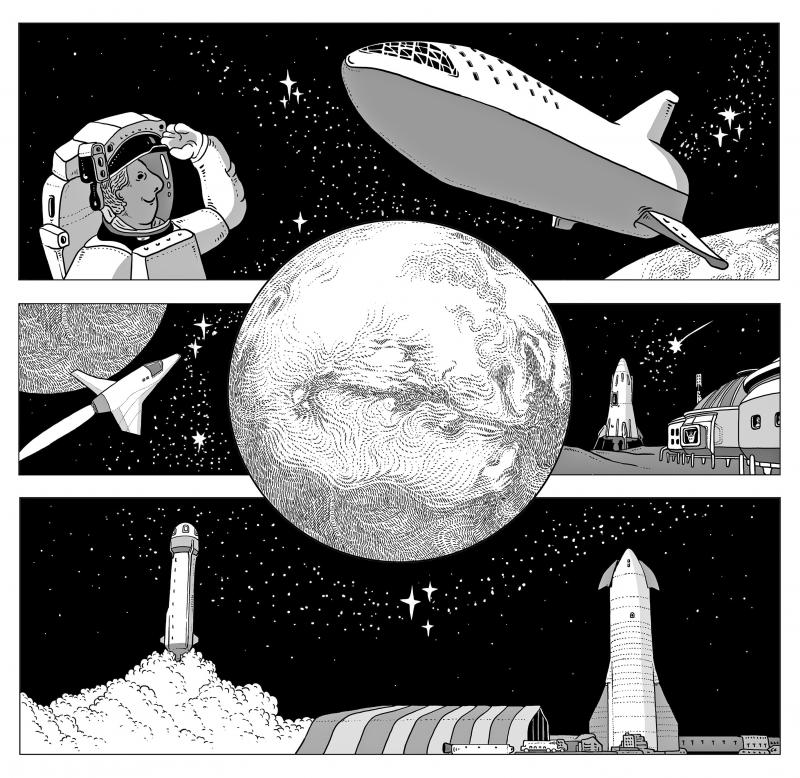
Illustration: Mountain People
However, beyond what some might see as vain billionaires using real-life rockets as playthings, the episode underscores how close the lucrative yet still fledgling commercial space industry has come to routinely launching paying passengers into outer space and achieving a goal two decades in the making.
“Many congratulations to Jeff Bezos & his brother Mark on announcing spaceflight plans,” Branson wrote on Twitter. “Jeff started building @blueorigin in 2000, we started building @virgingalactic in 2004 & now both are opening up access to Space - how extraordinary! Watch this space...”
Absent from Branson’s tweet was any mention of Musk, whose nonconformist Space Exploration Technologies Corp — better known as SpaceX — has grown from a shaky start in 2002 to become the dominant player in the commercial space sector, and a key partner of NASA.
The company is already regularly flying astronauts to the International Space Station, and is renting out its Dragon space capsule this fall for its first private spaceflight, taking a crew of four on a three-day orbital odyssey.
DIFFERENT GOALS
With differing longer-term ambitions and goals, the three billionaires have collectively upended the traditional government-funded and directed model for human spaceflight and are shaping a thriving new commercial space era, said Matthew Weinzierl, a Harvard Business School professor and an expert in the economics of space.
“SpaceX’s recent achievements, as well as upcoming efforts by Boeing, Blue Origin and Virgin Galactic to put people in space sustainably and at scale, mark the opening of a new chapter of spaceflight led by private firms,” he said.
“They have both the intention and capability to bring private citizens to space as passengers, tourists and eventually settlers, opening the door for businesses to start meeting the demand those people create over the next several decades,” he added.
Weinzierl expects there to be a gradual shift from money spent in space to benefit Earth, such as investments in telecommunications and Internet satellites and infrastructure, to the so-called space-for-space economy, including mining asteroids or the moon for materials that would be necessary to support human habitat and fuel deeper-space missions to Mars or beyond.
Bezos and Musk always had loftier goals in mind, even as they were taking their first tentative steps in the space industry, experts said.
However, their visions diverge beyond flying humans in low Earth orbit, or even suborbital flight, as Bezos’ brief venture next month would be.
“Musk is totally about Mars. His passion is to get people to Mars as a backup plan to Earth, and to make humanity a multiplanet species,” said Marcia Smith, founder and senior analyst of spacepolicyonline.com.
“Bezos is interested in the moon, and in the space between Earth and the moon. He wants to move all of the heavy industry off Earth and into cislunar space. He talks about rezoning Earth for light industry and habitation,” Smith said.
“So they both are interested in trying to save Earth because of all the problems Earth is having, but they have very different visions as to how that’s going to happen,” she added.
NASA has embraced both billionaires as it pursues its own exploration programs. In April, the agency chose SpaceX to build the spacecraft to return humans to the moon for the first time since 1972, a decision Blue Origin has challenged.
The enigmatic Musk reacted in typically bellicose fashion, posting on Twitter: “Can’t get it up (to orbit) lol,” in reference to Bezos’ so far unsuccessful efforts to launch a crew into space.
Blue Origin is developing a separate, reusable heavy-lift launch vehicle, New Glenn, under a NASA contract to supply satellite delivery capability, although the project has stalled.
The operations of both companies have the potential to attract billions of dollars of investment to the US through commercial clients, and Weinzierl sees space as the “ultimate industry of the future,” although he said it might take longer than this century to reach its potential.
“The sector has changed a great deal over the last two decades, largely in that there are new competitors seeking to serve private customers in addition to governments,” he said.
“At the same time, NASA and other public agencies are still the dominant sources of funding and specific plans for space beyond low Earth orbit, where the private satellite market has long been active. Even SpaceX, for all its success, wouldn’t be where it is without NASA’s partnership,” he added.
PIONEER
Smith said that Musk has created his own luck to position SpaceX as the leading pioneer in the new private space market.
“Musk has really transformed the business, and brought commercial business back to the United States, by lower prices and reusability. He has really made a change,” she said. “Bezos is trying to build this New Glenn rocket and is having setbacks with the engine.”
John Logsdon, the respected professor emeritus at George Washington University and founder of the Space Policy Institute, phrased the differences between the two tycoons another way, in a 2018 interview with the Guardian: “Musk’s style is to brag about things and then do them. Bezos’ style is to do things and then brag about them.”
“I’d call it competition, and competition is the American way of life,” he said.
As for Branson, the Virgin founder scored a major success last month when his SpaceShipTwo rocketplane reached an altitude of 89km, either in space or at the edge of it, depending on which calculation of the Karman Line, the perceived boundary of outer space, is being used.
It brings his long-awaited, but much-delayed aspiration of a profitable space tourism business a significant step closer to realization.
How relevant the Bezos brothers’ flight aboard New Shepard, his rocket named as a tribute to Alan Shepard, the first American in space, will be to Blue Origin’s wider ambitions is open to question, although Weinzierl sees it as more than a publicity stunt.
“It’s about demonstrating in the most powerful way he can that he trusts in the technology,” he said.
Taiwanese pragmatism has long been praised when it comes to addressing Chinese attempts to erase Taiwan from the international stage. “Taipei” and the even more inaccurate and degrading “Chinese Taipei,” imposed titles required to participate in international events, are loathed by Taiwanese. That is why there was huge applause in Taiwan when Japanese public broadcaster NHK referred to the Taiwanese Olympic team as “Taiwan,” instead of “Chinese Taipei” during the opening ceremony of the Tokyo Olympics. What is standard protocol for most nations — calling a national team by the name their country is commonly known by — is impossible for

India is not China, and many of its residents fear it never will be. It is hard to imagine a future in which the subcontinent’s manufacturing dominates the world, its foreign investment shapes nations’ destinies, and the challenge of its economic system forces the West to reshape its own policies and principles. However, that is, apparently, what the US administration fears. Speaking in New Delhi last week, US Deputy Secretary of State Christopher Landau warned that “we will not make the same mistakes with India that we did with China 20 years ago.” Although he claimed the recently agreed framework
The Office of the US Trade Representative (USTR) on Wednesday last week announced it is launching investigations into 16 US trading partners, including Taiwan, under Section 301 of the Trade Act of 1974 to determine whether they have engaged in unfair trade practices, such as overproduction. A day later, the agency announced a separate Section 301 investigation into 60 economies based on the implementation of measures to prohibit the importation of goods produced with forced labor. Several of Taiwan’s main trading rivals — including China, Japan, South Korea and the EU — also made the US’ investigation list. The announcements come
Taiwan is not invited to the table. It never has been, but this year, with the Philippines holding the ASEAN chair, the question that matters is no longer who gets formally named, it is who becomes structurally indispensable. The “one China” formula continues to do its job. It sets the outer boundary of official diplomatic speech, and no one in the region has a serious interest in openly challenging it. However, beneath the surface, something is thickening. Trade corridors, digital infrastructure, artificial intelligence (AI) cooperation, supply chains, cross-border investment: The connective tissue between Taiwan and ASEAN is quietly and methodically growing


 RSS
RSS