


Taipei Mayor Ko Wen-je (柯文哲) said that Taipei is ugly, that it can no longer compare with the most advanced cities in China and, therefore, it is time for the city to speed up its urban renewal.
Would urban renewal solve the ugliness problem? Urban renewal in Taiwan is only about replacing old buildings with new ones or applying to build new skyscrapers, but it is not certain that these buildings would be better.
As for the ugliness, old structures are sometimes prettier than new ones: Zhongshan Bridge, which was dismantled in 2002, is just one example. What is missing is a landscape law, but a proposed bill has little to say about regulating the aesthetics of buildings.
Beginning in 1930, the UK restricted the height of buildings around historical sites to allow them to be seen from every direction. As a result, the height of buildings around St Paul’s Cathedral in London was restricted so that they would not destroy the skyline. Rome, in its master plan from 1970, restricted the location, materials, size and lighting of advertising, billboards and shop windows.
To protect certain sites, private property rights might be restricted, and anyone altering or destroying such properties would be required to restore them to their original condition at their own expense. Although this is constitutionally controversial and there have been many protests against it, judicial precedent focuses on restricting private rights to preserve certain sites, and authorities think this is only natural.
Such precedent is the opposite of a controversy surrounding Zhishanyan (芝山岩) in Taipei’s Shilin District (士林), which has been going on for more than 20 years. Restrictions on the height of buildings have triggered a strong backlash from some residents who are keen to profit from urban renewal. Two 14-floor buildings have been built next to a historical site at Zhishanyan, and in March, a court ruled in favor of the residents.
Even worse, an application has been filed to “renew” a building adjacent to the yard in front of Huiji Temple (惠濟宮), which the city has designated as a historical site, and replace it with a 60m-tall building, which would be 20m taller than the temple. Is this what Ko means when he talks about urban renewal?
The trend in Taiwan seems to be that wherever there is a well-known attraction, a tall building will be next to it. There is, for example, the Taipei Dome across the street from Sun Yat-sen Memorial Hall. It sticks out, and it is also a bit frightening, as it looks like a mushroom cloud that follows the detonation of an atomic bomb, and it destroys the memorial hall skyline.
When entering the memorial hall grounds from Renai Road, there is no way to avoid seeing the silvery dome, and it is jarring to the eye. An official has said that trees would be planted along the road to block out the dome: Is this what is meant by improving the urban landscape? It is just a matter of hiding the ugliness.
This kind of building should be in the outskirts of a city, but this is what happens when there is no landscape law: We now have a “Taipei tumor.”
Ko’s urban renewal might not be able to make the city more beautiful; instead, it could cause an even greater loss to the skyline and make the city even uglier.
Lu Ching-fu is a professor in Fu Jen Catholic University’s applied arts department.
Translated by Perry Svensson

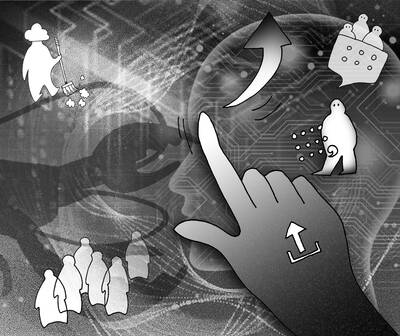
Weeks into the craze, nobody quite knows what to make of the OpenClaw mania sweeping China, marked by viral photos of retirees lining up for installation events and users gathering in red claw hats. The queues and cosplay inspired by the “raising a lobster” trend make for irresistible China clickbait. However, the West is fixating on the least important part of the story. As a consumer craze, OpenClaw — the AI agent designed to do tasks on a user’s behalf — would likely burn out. Without some developer background, it is too glitchy and technically awkward for true mainstream adoption,
On Monday, a group of bipartisan US senators arrived in Taiwan to support the nation’s special defense bill to counter Chinese threats. At the same time, Beijing announced that Chinese President Xi Jinping (習近平) had invited Chinese Nationalist Party (KMT) Chairwoman Cheng Li-wun (鄭麗文) to visit China, a move to make the KMT a pawn in its proxy warfare against Taiwan and the US. Since her inauguration as KMT chair last year, Cheng, widely seen as a pro-China figure, has made no secret of her desire to interact with the Chinese Communist Party (CCP) and meet with Xi, naming it a
Taiwan People’s Party (TPP) Chairman Huang Kuo-chang (黃國昌) took the stage at a protest rally on Sunday in front of the Presidential Office Building in Taipei in support of former TPP chairman Ko Wen-je (柯文哲), who has been sentenced to 17 years in jail for corruption and embezzlement. Huang told the crowd that Chinese Nationalist Party (KMT) Chairwoman Cheng Li-wun (鄭麗文) had sent a message of support the previous day, saying she would be traveling from the south to Taipei: If the protest continued into the evening, she had said, she would show up. The rally was due to end
A delegation of Chinese Nationalist Party (KMT) officials led by Chairwoman Cheng Li-wun (鄭麗文) is to travel to China tomorrow for a six-day visit to Jiangsu, Shanghai and Beijing, which might end with a meeting between Cheng and Chinese President Xi Jinping (習近平). The trip was announced by Xinhua news agency on Monday last week, which cited China’s Taiwan Affairs Office (TAO) Director Song Tao (宋濤) as saying that Cheng has repeatedly expressed willingness to visit China, and that the Chinese Communist Party (CCP) Central Committee and Xi have extended an invitation. Although some people have been speculating about a potential Xi-Cheng


 RSS
RSS