


With the Chinese Nationalist Party (KMT) scheduled to hold a chairperson election in July, the party is embroiled in a phony war, as party members slowly come out of the woodwork to sound out support, while holding short of making a formal declaration of interest.
So far, only KMT Chairman Johnny Chiang (江啟臣) has committed to the race, announcing in February that he would seek re-election. Other party members who have so far either dodged the question, “not ruled it out” or are “seriously considering” throwing their hats into the ring include former KMT chairman Eric Chu (朱立倫), vice chairman of the KMT-affiliated National Policy Foundation Sean Lien (連勝文), former Kaohsiung mayor Han Kuo-yu (韓國瑜) and Broadcasting Corp of China chairman Jaw Shaw-kong (趙少康).
Whoever wins the election — whether it is Han or Jaw, who represent the hardcore, pro-China faction of the KMT; or Chiang or Chu, both of whom purport to be the standard-bearers of the party’s reformist, pro-localization wing — the KMT’s problems run much deeper than who is in the hot seat as chairperson, as the party is gripped by a fundamental identity crisis.
After losing the Chinese Civil War and retreating to Taiwan, then-president Chiang Kai-shek (蔣介石) set the party up as an anti-communist stronghold on the opposite side of the Taiwan Strait. Flying the flag of “free China,” the KMT had a clear mission to “retake the mainland” and restore the Republic of China. During the catastrophic Mao Zedong (毛澤東) era, culminating in the national psychosis of the Cultural Revolution, the KMT party-state performed a function similar to that of Hong Kong: It was a capitalist citadel on the hill that provided an alternative, albeit undemocratic, vision for China.
However, after then-president Lee Teng-hui (李登輝) dragged the party kicking and screaming toward the process of localization and democratization through the 1990s — and with China appearing to be liberalizing, having embraced market capitalism — the KMT split into two camps.
The divide was exacerbated by then-president Ma Ying-jeou (馬英九), who flirted with his party’s former sworn enemy, apparently believing that the KMT could somehow engineer unification with the Chinese Communist Party (CCP) on its terms, and in the process milk the riches of China’s vast economy.
However, everything has changed under Chinese President Xi Jinping (習近平). China is today a totalitarian genocidal state on the cusp of becoming an international pariah, while economic reforms have stalled and Xi has detonated Hong Kong’s “one country, two systems” model, intended by former Chinese president Deng Xiaoping (鄧小平) as a blueprint for Taiwan. “Peaceful unification” is no longer on the cards; if ever it was.
As the KMT prepares to elect its next chairperson, it is faced with a dilemma: It could continue to cozy up to the CCP, which would be guaranteed electoral suicide. Alternatively, it could go the other way and rediscover its anti-communist roots, perhaps stating a future aspiration to unify with China, but pledging only to do so in the event that the country democratizes first.
However, with opinion polls consistently showing that a clear majority of the public identify as Taiwanese rather than Chinese — a trend that will only grow with each passing generation — such a policy is likely to end in electoral failure, too.
The KMT is caught between the devil and the deep blue sea. There is a third way of course: to completely shed its skin and metamorphose into a fully localized, Taiwanese party. However, given the party’s historical baggage, this seems, at least at present, too steep a hill for the party to climb.
On March 22, 2023, at the close of their meeting in Moscow, media microphones were allowed to record Chinese Communist Party (CCP) dictator Xi Jinping (習近平) telling Russia’s dictator Vladimir Putin, “Right now there are changes — the likes of which we haven’t seen for 100 years — and we are the ones driving these changes together.” Widely read as Xi’s oath to create a China-Russia-dominated world order, it can be considered a high point for the China-Russia-Iran-North Korea (CRINK) informal alliance, which also included the dictatorships of Venezuela and Cuba. China enables and assists Russia’s war against Ukraine and North Korea’s
After thousands of Taiwanese fans poured into the Tokyo Dome to cheer for Taiwan’s national team in the World Baseball Classic’s (WBC) Pool C games, an image of food and drink waste left at the stadium said to have been left by Taiwanese fans began spreading on social media. The image sparked wide debate, only later to be revealed as an artificially generated image. The image caption claimed that “Taiwanese left trash everywhere after watching the game in Tokyo Dome,” and said that one of the “three bad habits” of Taiwanese is littering. However, a reporter from a Japanese media outlet
Taiwanese pragmatism has long been praised when it comes to addressing Chinese attempts to erase Taiwan from the international stage. “Taipei” and the even more inaccurate and degrading “Chinese Taipei,” imposed titles required to participate in international events, are loathed by Taiwanese. That is why there was huge applause in Taiwan when Japanese public broadcaster NHK referred to the Taiwanese Olympic team as “Taiwan,” instead of “Chinese Taipei” during the opening ceremony of the Tokyo Olympics. What is standard protocol for most nations — calling a national team by the name their country is commonly known by — is impossible for
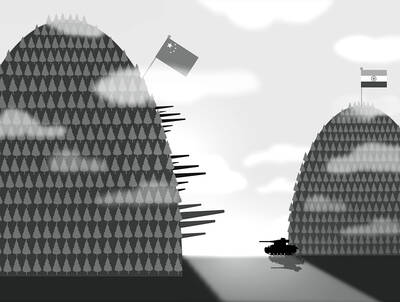
India is not China, and many of its residents fear it never will be. It is hard to imagine a future in which the subcontinent’s manufacturing dominates the world, its foreign investment shapes nations’ destinies, and the challenge of its economic system forces the West to reshape its own policies and principles. However, that is, apparently, what the US administration fears. Speaking in New Delhi last week, US Deputy Secretary of State Christopher Landau warned that “we will not make the same mistakes with India that we did with China 20 years ago.” Although he claimed the recently agreed framework


 RSS
RSS