


The United Arab Emirates (UAE) is scaling back its role in foreign conflicts, accelerating a shift from policies it pursued after the 2011 Arab Spring, with the new administration in the US a key factor.
The oil-rich nation has significantly reduced arms and logistical support for Libyan National Army Commander Marshall Khalifa Haftar, five people familiar with the matter said, as a UN-led process to unify the North African country gathers momentum.
It is also dismantling parts of its military base in Eritrea’s port of Assab, vacating troops and hardware used to support the Saudi Arabia-led coalition’s war in Yemen, said two of the people, who spoke on condition of anonymity.
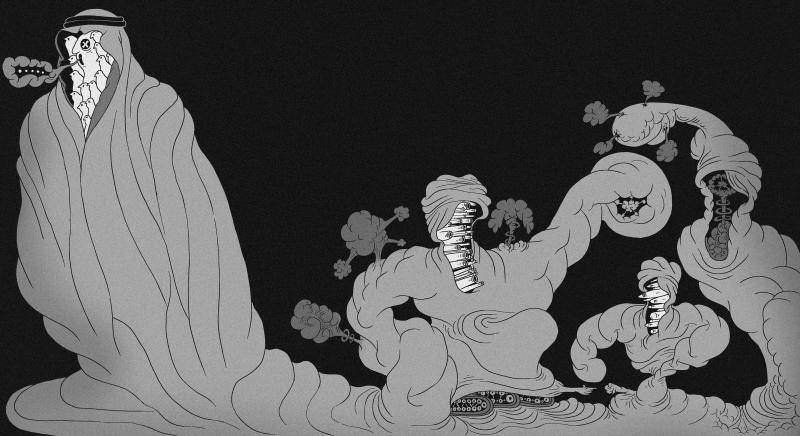
Illustration: Mountain People
The UAE did not respond to a request for comment, but has previously denied supplying arms to Haftar.
It welcomed in January the UN Security Council’s call for foreign forces to withdraw from Libya and declared support for a new leadership elected last month.
The move comes as US President Joe Biden’s arrival in the White House prompts a recalibration among Persian Gulf allies. They had enjoyed particularly close ties with former US president Donald Trump and welcomed his decision to abandon the 2015 nuclear deal with Iran.
Biden has already sought to re-engage the Islamic Republic and reboot coordination with NATO and Europe.
He has also signaled that he would be less tolerant of US allies engaging in conflicts that undermine Washington’s objectives.
The UAE’s moves accelerate a rollback of its military footprint that began under Trump, when tensions in the Gulf repeatedly threatened to tip into conflict with implications for global oil supplies and the UAE business hub, Dubai.
COVID-19 and low oil prices further exposed the fragility of the small OPEC member state that punches above its weight internationally. The IMF in October last year said it expects the Emirati economy to grow by 1.3 percent this year after a 6.6 percent contraction last year.
When popular uprisings swept the region in 2011, the UAE sought to neutralize the influence of political Islam and its enthusiasts in Ankara, Doha and Tehran. It sees such movements as destabilizing and a threat to dynastic rule.
While it has not seen abandoning such strategic goals, diplomats and analysts have said Abu Dhabi has been refocusing its methods.
It is leaning more toward politics, working through local proxies, and avoiding the negative attention risked by direct and costly intervention.
“There is a new administration in the US and the Emiratis need to get the optics right,” said Tarek Megerisi, policy fellow at the European Council on Foreign Relations, adding that even with a scaling back of flights to eastern Libya, some appear to have continued in the past few months, indicating a continuing relationship there.
“They need to be careful with their image, especially in a year when they’re looking to join the UN’s Security Council,” Megerisi said, referring to Abu Dhabi’s candidacy to secure an elected, non-permanent seat for the 2022-2023 term.
The shift coincides with a change of personnel. Anwar Gargash, a former minister of state for foreign affairs who was the most visible spokesperson for UAE interventions, stepped down to take on a diplomatic advisory role. The UAE promoted Khalifa Shaheen al-Marar to minister of state. He has served as ambassador to Turkey, Iran and Syria, indicating a possible shift toward mending ties with rivals.
“The risk calculation has changed for the UAE,” said David Roberts, an associate professor at King’s College London. “There will be more potential for blowback from this administration on several files, whether in regards to Yemen or sanctions-busting in Libya. This is really the de-risking of the more risky aspects of UAE foreign policy.”
The most obvious shift has come in Yemen, where the UAE joined a Saudi Arabia-led campaign to oust Iranian-backed Houthi rebels from the capital, Sana’a. Six years on, the war has failed to achieve that aim while contributing to the world’s worst humanitarian disaster, prompting Biden to demand an end to fighting, while putting weapons sales to the UAE and Saudi Arabia on hold.
The UAE began withdrawing from Yemen in late 2019, but maintained support for southern separatist fighters. It is now scaling back in the Horn of Africa, where it had spent the past few years building a military and diplomatic presence — even helping to broker a peace deal between Ethiopia and Eritrea — as part of its broader competition for influence.
The involvement has come at a cost. The New York Times last month reported that a foiled attack on the UAE embassy in Ethiopia was orchestrated by an Iranian sleeper cell seeking targets in response to the US assassination of a high-profile spymaster last year.
“The UAE’s regional assertiveness along with Saudi has been a major failure,” said David Wearing, researcher at Royal Holloway, University of London. “Wiser heads in the UAE would accept that they don’t have the capacity for this and, therefore, Biden might be pushing an open door.”
In Libya, where a confidential UN report found in May last year that the UAE had been operating a covert air bridge to supply Haftar with weapons in contravention of a UN arms embargo, the pivot is more recent.
The UAE is completely out of Libya militarily, two people with knowledge of the matter said.
The UAE had expressed frustration with Haftar after Turkish intervention last year helped to end his offensive to overthrow the internationally recognized government in Tripoli.
A third person with knowledge of the matter said that UAE flights to eastern Libya had fallen significantly, although that might be because they had already deployed enough equipment for any future battle.
Two others said it had reduced its military footprint, although all said there was no evidence it has severed contact with Haftar or Sudanese and other mercenaries involved in the fight.
Mercenaries deployed by the Kremlin-linked Wagner Group to support Haftar remain in Libya.
Meanwhile, the Watiya airbase southwest of Tripoli, seized from Haftar by Turkish-backed government forces last year, has been expanded, its runway extended to allow for larger aircraft and the potential use of advanced fighter jets, one of the people said.
Although that would largely preclude further airstrikes by Haftar on western Libya, Turkey might have little appetite to take the fight to his eastern stronghold, resulting in the current stalemate.
However, the UAE’s regional rethink does not amount to an automatic win for Turkey, which is recalibrating its own approach, switching to diplomacy with Europe in the dispute over Cyprus and gas exploration in the eastern Mediterranean.
“All sides seem to be getting tired of these forever wars,” said Mohamed Anis Salem, a former ambassador and UN official, now with the Egyptian Council for Foreign Affairs.
“They’re realizing that they’re better off reorienting those expensive and politically fraught strategies,” he said.
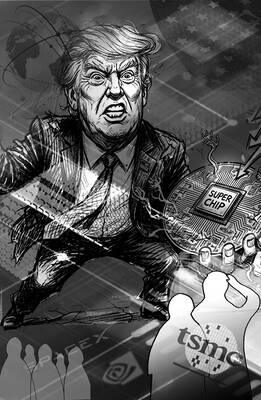
The White House’s decision to take a 9.9 percent stake in Intel Corp is looking like very shrewd business indeed. Since the government bought in at US$20.47 a share last August, the US chipmaker’s surging stock price has delivered the US a US$43 billion return. One of the reasons the investment has so far proved so sound is that the White House has made sure of it. According to The Wall Street Journal, Howard personally pushed deals on Intel’s behalf with some of the most lucrative clients imaginable. They include Nvidia Corp, the company at the heart of the AI
The Ministry of the Interior, working with the navy and coast guard, is organizing Taiwan’s first joint exercise simulating escort tankers carrying liquefied natural gas (LNG) and oil through a Chinese blockade. The drills simulate fuel transport along three maritime corridors leading toward Japan, the Philippines and the US. Deputy Minister of the Interior Sawyer Mars (馬士元) said that a blockade of the Taiwan Strait would amount to “almost a 100 percent blockade of the regional energy supply.” Minister of National Defense Wellington Koo said planning to counter a blockade is standard practice in Taipei. While the exercise is limited in
A single photograph can cut through a lot of noise, but it can also be used to misrepresent the truth. At the very least, it can concentrate the mind on something that requires further investigation. On Monday last week, Ma Ying-jeou Foundation CEO Tai Hsia-ling (戴遐齡) and former National Security Council secretary-general King Pu-tsung (金溥聰) held a news conference in which they showed a photograph of former foundation CEO Hsiao Hsu-tsen (蕭旭岑), now Chinese Nationalist Party (KMT) deputy chairman. In the image Hsiao is seated next to Xiamen Taiwan Businessmen Association chairman Han Ying-huan (韓螢煥). The two men were holding
I first met Professor Ray Jiing (井迎瑞) as a film and documentary student at Shih Hsin University’s (SHU) Department of Radio Television and Film in 1988. The following year, he went on to become the director of the Chinese Taipei Film Archive — forerunner of the Taiwan Film and Audiovisual Institute (TFAI). Over his eight-year tenure, Jiing rescued and restored over 200 classic Taiwanese films. In 1997, he established the Graduate Institute of Studies in Documentary and Film Archiving at Tainan National University of the Arts (TNNUA), and I joined the program in his third cohort of students. Beyond a


 RSS
RSS