


On Jan. 6, supporters of US President Donald Trump forced their way into the US Capitol. One of the invaders was shot dead by Capitol Police and others were arrested.
Mainstream US opinion and the majority of international figures have condemned the occupation, and many figures from Taiwan’s pan-blue camp have been keen to have their say.
Former premier Jiang Yi-huah (江宜樺) and others have used the occasion to criticize and satirize the 2014 Sunflower movement’s occupation of the Legislative Yuan.
Supporters of the Sunflower movement have not said much in response.
Consider the similarities and differences between the two incidents and whether they were lawful or unlawful, violent or nonviolent, rational or irrational.
Both involved protesters forcibly invading and occupying their respective legislatures, which is without doubt an unlawful act.
Furthermore, one of the principles of civil disobedience is that protesters must accept the consequences of their unlawful actions, and that it is a price to be paid to achieve a movement’s ideals and aims.
Media reported that some of those who invaded the Capitol attacked police officers with fire extinguishers, one of which was thrown and hit an officer on the head, leading to his death. Even if this was done by left-wing extremists who mingled with the crowd, as some people claim, the protesters must still bear responsibility for ineffective leadership.
In contrast, there were no violent attacks by protesters during the Sunflower movement, thus no loss of legitimacy.
The final aspect to consider is whether these actions were rational. This can be decided by whether the movements exhausted all available remedies within the system, and whether the unlawful acts helped achieve their aims.
This is the most important difference between what happened in Taiwan and what happened in the US.
In the Sunflower movement, when the Chinese Nationalist Party (KMT) caucus, fronted by then-legislator Chang Ching-chung (張慶忠), tried to force through ratification of the cross-strait service trade agreement, it signaled that the possibility of opponents achieving their demands through representative politics was already remote, which provided justification for unlawful protests.
In the US, the Congress was still in the process of certifying the election results. Furthermore, it was known that numerous senators wanted to question the results in some swing states. This means that, with regard to the protesters who claimed that the election process was unfair, the remedies available to them within the system had not been exhausted, so there was no need to resort to unlawful protest.
The Sunflower movement brought about a stalemate that forced executive authorities to allow renewed deliberation on the articles of the trade deal. In contrast, the Trump supporters’ invasion of the congressional buildings while proceedings were under way, without any clear plan of action, could not possibly succeed. On the contrary, it allowed the anti-Trump bloc to take the moral high ground and gave them pretext to suppress Trump’s supporters. It also put senators who had planned to question the election results under political pressure, forcing them to withdraw their complaints.
The Trump supporters’ occupation of the Capitol was therefore irrational from moral and utilitarian points of view, which makes it very different from the Sunflower movement.
Chiu Yi-ting took part in the Sunflower movement and is now a doctoral candidate in public policy at George Mason University in Virginia.
Translated by Julian Clegg
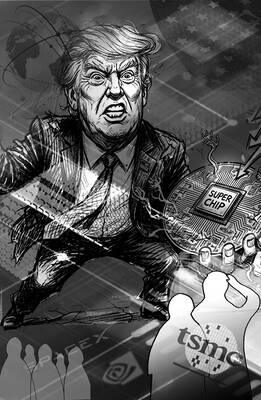
The White House’s decision to take a 9.9 percent stake in Intel Corp is looking like very shrewd business indeed. Since the government bought in at US$20.47 a share last August, the US chipmaker’s surging stock price has delivered the US a US$43 billion return. One of the reasons the investment has so far proved so sound is that the White House has made sure of it. According to The Wall Street Journal, Howard personally pushed deals on Intel’s behalf with some of the most lucrative clients imaginable. They include Nvidia Corp, the company at the heart of the AI
A single photograph can cut through a lot of noise, but it can also be used to misrepresent the truth. At the very least, it can concentrate the mind on something that requires further investigation. On Monday last week, Ma Ying-jeou Foundation CEO Tai Hsia-ling (戴遐齡) and former National Security Council secretary-general King Pu-tsung (金溥聰) held a news conference in which they showed a photograph of former foundation CEO Hsiao Hsu-tsen (蕭旭岑), now Chinese Nationalist Party (KMT) deputy chairman. In the image Hsiao is seated next to Xiamen Taiwan Businessmen Association chairman Han Ying-huan (韓螢煥). The two men were holding
I first met Professor Ray Jiing (井迎瑞) as a film and documentary student at Shih Hsin University’s (SHU) Department of Radio Television and Film in 1988. The following year, he went on to become the director of the Chinese Taipei Film Archive — forerunner of the Taiwan Film and Audiovisual Institute (TFAI). Over his eight-year tenure, Jiing rescued and restored over 200 classic Taiwanese films. In 1997, he established the Graduate Institute of Studies in Documentary and Film Archiving at Tainan National University of the Arts (TNNUA), and I joined the program in his third cohort of students. Beyond a
A recent report concerning a student who is suing his teacher posed the question in its headline: Does failing a student in two subjects constitute bullying? The college student in Chiayi County apparently sought NT$2 million (US$63,603) in state compensation, but a court dismissed the case. The first reaction of many might have been to ask: What has happened to students nowadays? Some say that teachers have lost their authority, while others say students are overindulged. Some even start reminiscing over the days when “whatever the teacher says goes.” However, the real issue might be overlooked if emotional reactions like that are the


 RSS
RSS