


Seven years ago, rhinology surgeon Peter Andrews found himself performing an operation that would go on to change the course of his career.
Andrews was operating on a man who had broken his nose many decades earlier after being struck by a cricket ball. The procedure was delicate: straightening the septum — the thin wall of cartilage that separates the nostrils — and in the process improving his breathing, which had become more labored in later life.
Yet it had a surprising outcome. As well being able to breathe more freely, Andrews’ patient found he could smell again for the first time in 40 years, a remarkable turn of events that provided the medical community with a new insight into the sense of smell and its capacity to regenerate.
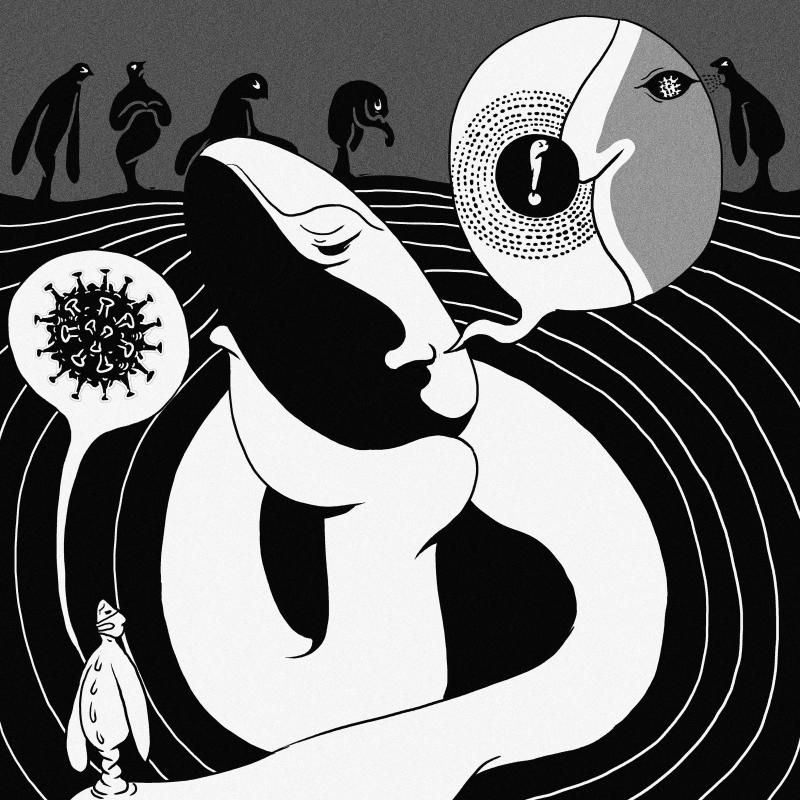
Illustration: Mountain People
Being able to smell is actually a result of a complex neurological process. Smell-specific nerve cells known as olfactory neurons, located high in the nasal cavity, detect molecules in the air such as those released by a perfume, or smoke particles from something burning. They then convey this information via a long nerve fiber running up through the skull, to a part of the brain that makes sense of it all.
This network is one of the most adaptable in the entire central nervous system. To keep functioning, it completely regenerates every six weeks, shedding existing olfactory neurons and creating new ones from scratch.
“That’s quite a feat in itself, because those neurons then have to reconnect up into the brain tissue,” Andrews said.
However, sometimes things can happen that impair its ability to regenerate.
An estimated 5 percent of the general population is believed to have anosmia, the medical term for temporary or permanent smell loss. Anosmia can occur as part of the aging process, but also in those of all ages due to factors ranging from broken noses to viral infections.
In the case of Andrews’ patient, the corrective surgery had enabled the olfactory neurons to regenerate and reconnect to the central nervous system.
Curious as to whether surgical interventions could help more people with anosmia, Andrews began researching the condition in more depth, but until recently his efforts were hampered by limited funding.
This is because anosmia has traditionally been overlooked by the medical community — smell has been called “the Cinderella of the senses” — despite its effect on people’s lives.
As the ability to smell is also linked to taste, people with anosmia often suffer from dwindling appetite, as well as higher rates of depression.
“Loss of smell can be life-changing; it removes an important part of your sense of self,” said Chrissi Kelly, founder of the UK-based charity AbScent, which supports people who have lost the ability to smell.
“Smell signals give depth to our social interactions. Erase all that, and your experience of the world is two-dimensional,” Kelly said.
Yet over the past eight months, traditional medical perceptions of anosmia have changed. COVID-19 has proved particularly adept at knocking out the sense of smell, and for the first time, the plight of people with smell loss has been thrust into the spotlight.
John Hayes, director of the Sensory Evaluation Center at Pennsylvania State University, said that between 44 percent and 77 percent of people with COVID-19 experience complete loss of smell during the acute stage of their illness.
Many make a full recovery within the first couple of months, with one study of 100 people hospitalized with COVID-19 finding that about two-thirds recovered normal smell function within six to eight weeks.
However, looking beyond hospitalized patients, others believe that a significant proportion continue to experience either partial or complete smell loss, several months down the line.
“What we know today is that after two months, about half the people who lost their sense of smell with COVID-19 still have impairments, and about 5 to 10 percent of those people have a serious impairment, so total or near-total loss of smell,” said Danielle Reed, associate director at the Monell Chemical Senses Center in Philadelphia, Pennsylvania.
Since April, scientists have been racing to figure out just why COVID-19 has such an impact on the ability to smell, and why some people seem more severely affected than others.
Viral load appears to be a key factor, meaning that people who work in industries where they are more likely to be exposed to greater amounts of the virus are probably more susceptible to long-term anosmia.
Andrews has conducted a survey of 114 healthcare workers at hospitals in north London and Italy who had tested positive for COVID-19, and found that 70 percent had experienced smell and taste dysfunction.
Of those, 60 percent were continuing to experience problems 52 days after the original infection, a higher rate than the general population.
However, while other viruses — such as the coronaviruses that cause the common cold — can also lead to smell loss, COVID-19 anosmia is unusual because it often happens immediately and without any accompanying congestion.
“The smell loss we traditionally get with a common cold is typically because we have lots of congestion, and the odour-active molecules can’t get to the top of the nasal cavity,” Hayes said.
“With COVID-19, it seems like something different is happening,” he added.
In July, an international collaboration led by the Harvard Medical School identified the first clues as to what might be going on.
While the angiotensin-converting enzyme 2 receptor — the keyhole that the SARS-CoV-2 virus uses to enter the body — is not expressed by olfactory neurons themselves, it is present in high levels in the surrounding cells of the upper nasal cavity, which exert their own influence on a person’s ability to smell by providing metabolic and structural support to these neurons. When SARS-CoV-2 invades these cells, it causes a rush of inflammation that knocks out smell function.
This helps explain the spectrum of anosmia related to COVID-19. For many people, the recovery time simply depends on how long it takes for these surrounding cells to heal, but in some cases, the inflammation is so severe that it also damages the nearby olfactory neurons, something scientists call splash damage.
For these people, recovery time is much slower, because the neurons need time to regenerate from the supply of stem cells within the lining of the nose. In some rare cases, it could be that the olfactory neurons are completely destroyed, meaning that recovery is unlikely.
As this system tries to heal, it can lead to a strange condition known as parosmia, in which smell returns, but in a bizarrely distorted fashion.
In one Facebook group, some people recovering from COVID-19 reported their favorite foods smelling like dead fish or a musty room.
Kelly said that while this might sound amusing, it can cause great distress, as people can even find that their partner or family suddenly smell repulsive.
Scientists believe it happens because the olfactory neurons misconnect with the brain areas responsible for smell as they regenerate, but it is not understood why some people experience this symptom more than others.
“Parosmia is often a sign of recovery. There will be some people who are, unfortunately, left with varying degrees of parosmia, but this is hard to quantify,” said Jane Parker, a chemist in the University of Reading’s Department of Food and Nutritional Sciences who is conducting a study of post-COVID-19 parosmia.
“We know this from other post-infectious cases of parosmia, but for post-COVID parosmics, it is too early to tell,” Parker said.
Can anosmia and parosmia be treated? One treatment that might help some people is smell training. This involves actively sniffing four essential oils — rose, lemon, clove and eucalyptus — for approximately 20 seconds every day, and acts as a form of physiotherapy for the nose.
Scientists say that this is unlikely to help people with the most severe forms of smell loss, but might be beneficial for parosmics and those with partial anosmia, although the evidence is limited.
“I would say the strongest evidence supports some benefit for those with a partial loss of smell. The mechanism may be to help train the patient to focus on that ability they have left, basically maximizing their remaining functional capacity,” said Steven Munger, director of the University of Florida’s Center for Smell and Taste.
The sheer prevalence of COVID-19-induced anosmia has led to some trials of completely new therapies.
Andrews has obtained permission to take biopsies of injured cells from the noses of healthcare workers who have lost their smell due to COVID-19, and examine them to see whether transplanting new cells into the damaged area might help it regenerate and reconnect to the central nervous system.
At Mount Sinai Hospital in New York, otolaryngology specialist Alfred Iloreta is leading a trial treating patients who have lost their sense of smell due to COVID-19 with omega-3 fatty acids in the form of fish oil.
He believes this could help accelerate the healing process in the nasal cells damaged by the virus and the olfactory neurons.
“Omega-3 supplementation could help in two ways,” Iloreta said. “The first would be through an anti-inflammatory pathway, reversing the damage done by viral infection in the supporting cells or the neurons.”
“Omega-3 fatty acids have also been shown to have both regenerative and neuroprotective effects on damaged neurons in patients with peripheral nerve injury,” he added.
For many of these proposed treatments, only time will tell if they are effective, but in the short term, some scientists are calling for anosmia to be utilized more widely as an additional COVID-19 diagnostic tool, to help national test-and-trace systems become more effective.
Tim Spector, who launched the COVID Symptom Study app back in March, said that signs of anosmia are a much more accurate predictor of whether someone will test positive for COVID-19, compared with a fever.
“The data from the app showed that 65 percent of people who tested positive for COVID-19 reported a loss of sense of smell, with a significant proportion of them never experiencing a raised temperature,” Spector said.
“Just over 40 percent of people testing positive had a fever. On top of this, for around 16 percent of people who tested positive, anosmia was the only symptom they had,” he said.
For those who have already endured many months of smell loss or distortion, scientists say there is still hope that it will return to normal. Regeneration is a slow process and can take some time.
“You can’t truly say someone’s lost their sense of smell until we’re 12 to 18 months down the line. This is a very plastic system which can heal itself, so it’s still very early days,” Andrews said.
Chinese actor Alan Yu (于朦朧) died after allegedly falling from a building in Beijing on Sept. 11. The actor’s mysterious death was tightly censored on Chinese social media, with discussions and doubts about the incident quickly erased. Even Hong Kong artist Daniel Chan’s (陳曉東) post questioning the truth about the case was automatically deleted, sparking concern among overseas Chinese-speaking communities about the dark culture and severe censorship in China’s entertainment industry. Yu had been under house arrest for days, and forced to drink with the rich and powerful before he died, reports said. He lost his life in this vicious
A recent trio of opinion articles in this newspaper reflects the growing anxiety surrounding Washington’s reported request for Taiwan to shift up to 50 percent of its semiconductor production abroad — a process likely to take 10 years, even under the most serious and coordinated effort. Simon H. Tang (湯先鈍) issued a sharp warning (“US trade threatens silicon shield,” Oct. 4, page 8), calling the move a threat to Taiwan’s “silicon shield,” which he argues deters aggression by making Taiwan indispensable. On the same day, Hsiao Hsi-huei (蕭錫惠) (“Responding to US semiconductor policy shift,” Oct. 4, page 8) focused on

George Santayana wrote: “Those who cannot remember the past are condemned to repeat it.” This article will help readers avoid repeating mistakes by examining four examples from the civil war between the Chinese Communist Party (CCP) forces and the Republic of China (ROC) forces that involved two city sieges and two island invasions. The city sieges compared are Changchun (May to October 1948) and Beiping (November 1948 to January 1949, renamed Beijing after its capture), and attempts to invade Kinmen (October 1949) and Hainan (April 1950). Comparing and contrasting these examples, we can learn how Taiwan may prevent a war with
In South Korea, the medical cosmetic industry is fiercely competitive and prices are low, attracting beauty enthusiasts from Taiwan. However, basic medical risks are often overlooked. While sharing a meal with friends recently, I heard one mention that his daughter would be going to South Korea for a cosmetic skincare procedure. I felt a twinge of unease at the time, but seeing as it was just a casual conversation among friends, I simply reminded him to prioritize safety. I never thought that, not long after, I would actually encounter a patient in my clinic with a similar situation. She had


 RSS
RSS