


Developing green energy is one of the major industry policies that President Tsai Ing-wen (蔡英文) pledged when she started her first term in office in 2016. Based on the Tsai administration’s guidelines, renewable energy is to make up 20 percent of the nation’s total power generation in 2025 and solar power is to have the lion’s share with a contribution of 20 gigawatts (GW).
The goal of building 3GW of rooftop solar panels was reached last year, ahead of schedule, as panels have been installed on roofs of schools, government agencies, factories and houses.
However, projects involving ground-mount solar panels and solar arrays built on top of fish farms have hit a wall: Only 20 percent of newly installed solar power last year was ground-mount systems. The main reason for that is a shortage of land.
“It would be more than satisfactory to see as much as 1.5GW — same with last year — of ground-mount solar power installed,” Sharon Chen (陳君盈), a solar industry analyst who used to work for TrendForce Corp, told an industry forum last week.
The Bureau of Energy had planned for 2.2GW of ground-mount solar energy to come online this year to bring the total ground-mount solar power generation capacity to 6.5GW. However, it has lowered the target.
Due to land scarcity, the bureau said it has to set a more “practical” target and reduced the ground-mount solar power installation target to 14GW, from 17GW, by 2025.
The government has not come up with any substantial solutions. Land availability remains the biggest hurdle faced by solar power developers. It took three-and-a-half years to connect the nation’s first solar power plant on 25 hectares of fish farms to Taiwan Power Co’s grid, with much of the time spent on obtaining approval from numerous fish farm owners, United Renewable Energy Co solar business group president Andy Shen (沈維鈞) said last week.
Compounding the issue, the Council of Agriculture in July barred renewable energy developers from placing solar panels on farmland — known as agrivoltaics — over concerns that the crops would not receive sufficient sunlight, resulting in lower yields. However, a growing number of international studies show that agrivoltaics can benefit crop yields as well as solar energy developers, but the council turned a deaf ear to the findings and insisted that solar energy developers focus on rooftop solar panels and fish farm arrays, instead of agrivoltaics, going directly against the Cabinet’s renewable energy policy.
The council’s inflexibility significantly reduces the amount of land that can be used for solar power generation and jeopardizes the government’s goal of substituting 20GW of electricity derived from coal with solar power by 2025, the Taiwan Photovoltaic Industrial Association has said.
The Cabinet has promised to help overcome the inconsistencies among government agencies and the Ministry of Economic Affairs has said farmland should be utilized “smartly.”
However, no progress has been made. Solar power developers are still facing the challenge of finding plots of land to erect ground-mount solar panels.
“Some council officials are playing tricks to hinder solar energy development,” United Renewable chairman Sam Hong (洪傳獻) said last week.
It is clear that conflicts between government agencies is the main obstacle to the nation’s energy transformation. To speed up its development, the government needs to resolve the conflicts, while making sure renewable energy does not come at the expense of farmers’ livelihoods and the environment.
On March 22, 2023, at the close of their meeting in Moscow, media microphones were allowed to record Chinese Communist Party (CCP) dictator Xi Jinping (習近平) telling Russia’s dictator Vladimir Putin, “Right now there are changes — the likes of which we haven’t seen for 100 years — and we are the ones driving these changes together.” Widely read as Xi’s oath to create a China-Russia-dominated world order, it can be considered a high point for the China-Russia-Iran-North Korea (CRINK) informal alliance, which also included the dictatorships of Venezuela and Cuba. China enables and assists Russia’s war against Ukraine and North Korea’s
After thousands of Taiwanese fans poured into the Tokyo Dome to cheer for Taiwan’s national team in the World Baseball Classic’s (WBC) Pool C games, an image of food and drink waste left at the stadium said to have been left by Taiwanese fans began spreading on social media. The image sparked wide debate, only later to be revealed as an artificially generated image. The image caption claimed that “Taiwanese left trash everywhere after watching the game in Tokyo Dome,” and said that one of the “three bad habits” of Taiwanese is littering. However, a reporter from a Japanese media outlet
Taiwanese pragmatism has long been praised when it comes to addressing Chinese attempts to erase Taiwan from the international stage. “Taipei” and the even more inaccurate and degrading “Chinese Taipei,” imposed titles required to participate in international events, are loathed by Taiwanese. That is why there was huge applause in Taiwan when Japanese public broadcaster NHK referred to the Taiwanese Olympic team as “Taiwan,” instead of “Chinese Taipei” during the opening ceremony of the Tokyo Olympics. What is standard protocol for most nations — calling a national team by the name their country is commonly known by — is impossible for
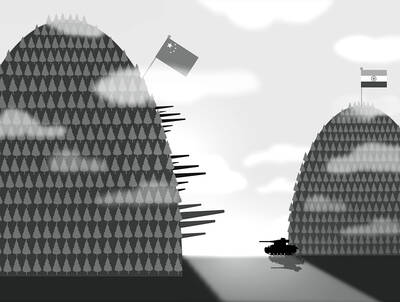
India is not China, and many of its residents fear it never will be. It is hard to imagine a future in which the subcontinent’s manufacturing dominates the world, its foreign investment shapes nations’ destinies, and the challenge of its economic system forces the West to reshape its own policies and principles. However, that is, apparently, what the US administration fears. Speaking in New Delhi last week, US Deputy Secretary of State Christopher Landau warned that “we will not make the same mistakes with India that we did with China 20 years ago.” Although he claimed the recently agreed framework


 RSS
RSS