


The Legislative Yuan on Tuesday unanimously passed two Chinese Nationalist Party (KMT) resolutions in a rare example of cross-party agreement.
The first resolution urges the government to encourage the US help Taiwan in the event of aggression by the Chinese Communist Party (CCP). The second calls on the government to endeavor toward re-establishing diplomatic ties with Washington.
The resolutions are eminently practical, given the heightened tensions in the Taiwan Strait and the CCP’s increased saber-rattling. It should not be surprising that all parties are willing to unite in the face of displays of aggression from a hostile nation.
However, Taiwan’s situation is far from normal, and below this simulacrum of unity lies a squirming nest of political calculation.
The unity was the surprising element. The nature of the resolutions themselves should not be. They passed with the support of the Democratic Progressive Party (DPP) caucus, because they are consistent with the DPP’s long-standing political trajectory.
Even though they do not at first seem consistent with the KMT’s trajectory, this is only because the party, especially under the leadership of former president Ma Ying-jeou (馬英九), has strayed from its original course to one more pro-China, putting Taiwan’s sovereignty at risk for temporary cross-strait peace.
However, the resolutions are consistent with KMT Chairman Johnny Chiang’s (江啟臣) vision of party reform, which seeks to return the KMT to its earlier spirit.
During the time of former presidents Chiang Kai-shek (蔣介石) and Chiang Ching-kuo (蔣經國), the KMT welcomed the US’ patronage and protection.
The second resolution proposes working toward re-establishing ties between the Republic of China (ROC), not Taiwan, and the US. That, too, is consistent with the KMT’s position.
The DPP would not object, as President Tsai Ing-wen (蔡英文) has said that she has no intention, for the time being, to change the official name of the nation.
The CCP’s displays of aggression are ostensibly the reason for proposing the first resolution. The reason for proposing the second was to score political points against Minister of Foreign Affairs Joseph Wu (吳釗燮), who in an interview with Washington-based National Public Radio last month said that the government is “not seeking full diplomatic relations with the US at this moment.”
With the resolutions, the KMT is trying to reclaim the ground it has lost to the DPP, with regards to being the party with the closest relationship to the US.
On Sept. 24, two days after Wu’s interview was broadcast, KMT caucus whip Lin Wei-chou (林為洲) said that the US could best support Taiwan by resuming formal ties and signing a mutual defense treaty, something the nation enjoyed when Taiwan-US relations were “at their best,” referring to the ROC under Chiang Kai-shek, in what the KMT sees as its heyday.
In the current political climate, the KMT needs to remind the electorate of its anti-CCP — as opposed to anti-China — roots if it is to stop its slide into insignificance as a political force.
In a post-vote news release, the KMT caucus — disingenuously — said that it was surprised the DPP caucus supported the resolutions. It also goaded Tsai and Wu to follow through on them.
It knows that the government straying from its cautious approach when the US is not ready to comply would leave Tsai and Wu vulnerable to accusations of inciting war with China. The KMT could then present itself as being committed to stability and peaceful cross-strait development, but one that is willing to push back against the CCP.
However, it also risks leaving itself open to blowback if it continues to stymie the government’s attempts to strengthen ties with the US.
On March 22, 2023, at the close of their meeting in Moscow, media microphones were allowed to record Chinese Communist Party (CCP) dictator Xi Jinping (習近平) telling Russia’s dictator Vladimir Putin, “Right now there are changes — the likes of which we haven’t seen for 100 years — and we are the ones driving these changes together.” Widely read as Xi’s oath to create a China-Russia-dominated world order, it can be considered a high point for the China-Russia-Iran-North Korea (CRINK) informal alliance, which also included the dictatorships of Venezuela and Cuba. China enables and assists Russia’s war against Ukraine and North Korea’s
After thousands of Taiwanese fans poured into the Tokyo Dome to cheer for Taiwan’s national team in the World Baseball Classic’s (WBC) Pool C games, an image of food and drink waste left at the stadium said to have been left by Taiwanese fans began spreading on social media. The image sparked wide debate, only later to be revealed as an artificially generated image. The image caption claimed that “Taiwanese left trash everywhere after watching the game in Tokyo Dome,” and said that one of the “three bad habits” of Taiwanese is littering. However, a reporter from a Japanese media outlet
Taiwanese pragmatism has long been praised when it comes to addressing Chinese attempts to erase Taiwan from the international stage. “Taipei” and the even more inaccurate and degrading “Chinese Taipei,” imposed titles required to participate in international events, are loathed by Taiwanese. That is why there was huge applause in Taiwan when Japanese public broadcaster NHK referred to the Taiwanese Olympic team as “Taiwan,” instead of “Chinese Taipei” during the opening ceremony of the Tokyo Olympics. What is standard protocol for most nations — calling a national team by the name their country is commonly known by — is impossible for
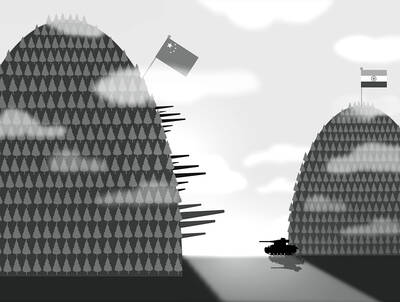
India is not China, and many of its residents fear it never will be. It is hard to imagine a future in which the subcontinent’s manufacturing dominates the world, its foreign investment shapes nations’ destinies, and the challenge of its economic system forces the West to reshape its own policies and principles. However, that is, apparently, what the US administration fears. Speaking in New Delhi last week, US Deputy Secretary of State Christopher Landau warned that “we will not make the same mistakes with India that we did with China 20 years ago.” Although he claimed the recently agreed framework


 RSS
RSS