


In the Kaohsiung mayoral by-election in August, Kaohsiung City Councilor Jane Lee (李眉蓁) — the Chinese Nationalist Party’s (KMT) candidate — stirred controversy for having plagiarized her master’s thesis.
Although her degree was revoked and the case seems to have ended, the underlying problem remains. It is time to look into what structural flaws lead to repeated occurrence of such incidents.
As a local politician, Lee tried to leverage her political capital to obtain a postgraduate degree. When her plagiarism was exposed, she quickly renounced her degree as her survival instinct kicked in.
However, things would look different if somebody with a strong academic background obtained their qualifications in ways that violated academic ethics and were exposed after having attaining a powerful position.
Since the 1990s, Taiwan has not only undergone liberalization and democratization, but also a process of academic standardization. The problem is that since the authoritarian rulers of the 1970s had almost complete control of academia, standardization has been a means for the remaining fragments of the authoritarian era to preserve their power. A lack of academic transitional justice has turned academia into an arena for power games.
With control of the National Science Council — now the Ministry of Science and Technology — those in power used it to approve or deny research projects to nurture their own academic power bases.
Using improvement of academic standards as an excuse, they rated academic journals based on their own criteria to gain complete control of academia.
It is often said that the truth becomes clearer the more it is debated, but in democratic Taiwan, academic debate is becoming increasingly difficult.
In the field of history, for example, debate and refutations are even rarer than during the Martial Law era. It is not that historians are no longer willing to engage in debate, but rather that dissenting views often have been silenced by those in power.
Academic debates are communication and exchanges of opinion among people who have reached a high standard. They promote academic progress.
However, debate is not given full protection, which is concerning for Taiwan’s academic development.
Those who breach academic ethics do not pay much attention to academic standards, but unfortunately, people who uncover abuses are often regarded by those in power as traitors — leading to oppression and marginalization.
This situation is no different from the treatment of the dangwai (黨外, “outside the party”) dissidents who questioned the legitimacy of the then-KMT regime.
Without proper supervision, those in power can act as they please, so how can anyone say that there is academic freedom in Taiwan?
Academia must push for thorough reform — such as decentralization, public governance, a balance between power and responsibility, and abolishing the rating system for academic journals — and encourage open and transparent debate, while establishing a mechanism to revoke degrees or publications of people who violate academic ethics.
If this is not done and if those in power retain the authority to decide who succeeds while covering each other’s back, academic freedom will continue to be suppressed and eventually disappear altogether.
Chen Chun-kai is a professor of history at Fu Jen Catholic University.
Translated by Eddy Chang
On March 22, 2023, at the close of their meeting in Moscow, media microphones were allowed to record Chinese Communist Party (CCP) dictator Xi Jinping (習近平) telling Russia’s dictator Vladimir Putin, “Right now there are changes — the likes of which we haven’t seen for 100 years — and we are the ones driving these changes together.” Widely read as Xi’s oath to create a China-Russia-dominated world order, it can be considered a high point for the China-Russia-Iran-North Korea (CRINK) informal alliance, which also included the dictatorships of Venezuela and Cuba. China enables and assists Russia’s war against Ukraine and North Korea’s
After thousands of Taiwanese fans poured into the Tokyo Dome to cheer for Taiwan’s national team in the World Baseball Classic’s (WBC) Pool C games, an image of food and drink waste left at the stadium said to have been left by Taiwanese fans began spreading on social media. The image sparked wide debate, only later to be revealed as an artificially generated image. The image caption claimed that “Taiwanese left trash everywhere after watching the game in Tokyo Dome,” and said that one of the “three bad habits” of Taiwanese is littering. However, a reporter from a Japanese media outlet
Taiwanese pragmatism has long been praised when it comes to addressing Chinese attempts to erase Taiwan from the international stage. “Taipei” and the even more inaccurate and degrading “Chinese Taipei,” imposed titles required to participate in international events, are loathed by Taiwanese. That is why there was huge applause in Taiwan when Japanese public broadcaster NHK referred to the Taiwanese Olympic team as “Taiwan,” instead of “Chinese Taipei” during the opening ceremony of the Tokyo Olympics. What is standard protocol for most nations — calling a national team by the name their country is commonly known by — is impossible for
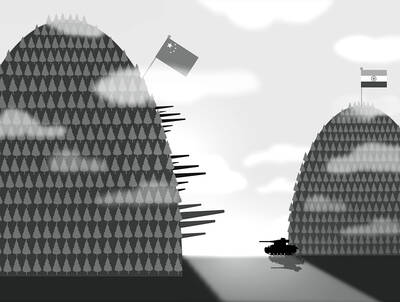
India is not China, and many of its residents fear it never will be. It is hard to imagine a future in which the subcontinent’s manufacturing dominates the world, its foreign investment shapes nations’ destinies, and the challenge of its economic system forces the West to reshape its own policies and principles. However, that is, apparently, what the US administration fears. Speaking in New Delhi last week, US Deputy Secretary of State Christopher Landau warned that “we will not make the same mistakes with India that we did with China 20 years ago.” Although he claimed the recently agreed framework


 RSS
RSS