


The Ministry of Education’s inclusion of a book depicting homosexuality in its recommended reading list for first-graders sparked a backlash from groups opposed to same-sex marriage, which came as no surprise.
The book in question is the Dutch King & King (國王與國王), which was the world’s first children’s book to show a drawing of two men kissing — albeit with a red heart covering their lips — when it was published in 2000.
While the book has sparked debate over the past week in Taiwan, many in the US have been trying to have it banned in schools for the past two decades. It also ranks 20th among the American Library Association’s most challenged books from 2000 to 2009.
One high-profile case was a 2006 federal lawsuit filed by parents in Massachusetts, where same-sex marriage was legalized in 2004. The judge dismissed the lawsuit, saying: “Diversity is a hallmark of our nation.”
“There is no evidence of systemic indoctrination. There is no allegation that [the student] was asked to affirm gay marriage,” the judge said.
Even as Taiwan becomes increasingly diverse on many fronts, discrimination remains rife and the only way to overcome this is by educating the next generation. However, many people still believe that shielding children from the world is the right thing to do.
It is absurd that people still believe that learning about and understanding homosexuality could make a child gay. Still, it seems like the only tired argument that anti-LGBTQ groups can think of to plead their case.
Not only do they allege that the book’s selection is a “plot by the ministry to make children gay,” they also maintain that if the practice continues, Taiwan would become a “homosexualized country,” whatever that means.
The arguments are effective in playing to the fears of many parents, but unless the groups come up with something new, they will be stuck talking to a niche crowd.
However, that does not mean that their comments are not hurtful toward the LGBTQ community and a human rights violation.
As sexual diversity becomes more visible and mainstream in Taiwan following the legalization of same-sex marriage, the banning of books will not shield children from reality.
Given the history of King & King, the ministry’s selection of the title is a bold move and congratulations are in order for the officials who chose it instead of taking the safe route.
“The essence of love is understanding. It is not something you can control or force,” the ministry said regarding the controversy, sending the right message.
Also encouraging is the number of groups who have defended the book. Groups advocating LGBTQ rights and gender equality, as well as parents’ groups, held a news conference on Wednesday last week defending the selection and chanting: “Only understanding can replace discrimination.”
Yesterday, the Taiwan Obasan Political Equality Party, comprised mostly of mothers, also held a rally in support of the book alongside a number of human rights and child welfare groups.
The opposing groups’ efforts to ban the book has ironically led to more public awareness and discussion about the issue.
While the stance of anti-LGBTQ groups is no surprise, it is upsetting that some have even tried to ban the book Butterfly Duo Duo (蝴蝶朵朵), which teaches children to remain vigilant about sexual assault by people they know and to inform people they trust.
This is an important topic and children need all the resources they can access to protect themselves. If sexual assault can happen to children, they are not too young to learn about it.

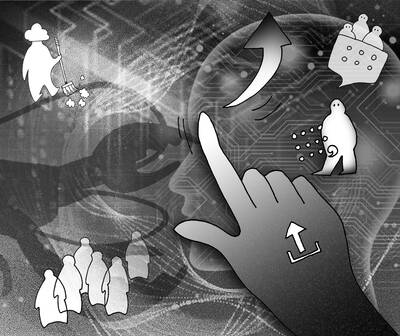
Weeks into the craze, nobody quite knows what to make of the OpenClaw mania sweeping China, marked by viral photos of retirees lining up for installation events and users gathering in red claw hats. The queues and cosplay inspired by the “raising a lobster” trend make for irresistible China clickbait. However, the West is fixating on the least important part of the story. As a consumer craze, OpenClaw — the AI agent designed to do tasks on a user’s behalf — would likely burn out. Without some developer background, it is too glitchy and technically awkward for true mainstream adoption,
On Monday, a group of bipartisan US senators arrived in Taiwan to support the nation’s special defense bill to counter Chinese threats. At the same time, Beijing announced that Chinese President Xi Jinping (習近平) had invited Chinese Nationalist Party (KMT) Chairwoman Cheng Li-wun (鄭麗文) to visit China, a move to make the KMT a pawn in its proxy warfare against Taiwan and the US. Since her inauguration as KMT chair last year, Cheng, widely seen as a pro-China figure, has made no secret of her desire to interact with the Chinese Communist Party (CCP) and meet with Xi, naming it a
A delegation of Chinese Nationalist Party (KMT) officials led by Chairwoman Cheng Li-wun (鄭麗文) is to travel to China tomorrow for a six-day visit to Jiangsu, Shanghai and Beijing, which might end with a meeting between Cheng and Chinese President Xi Jinping (習近平). The trip was announced by Xinhua news agency on Monday last week, which cited China’s Taiwan Affairs Office (TAO) Director Song Tao (宋濤) as saying that Cheng has repeatedly expressed willingness to visit China, and that the Chinese Communist Party (CCP) Central Committee and Xi have extended an invitation. Although some people have been speculating about a potential Xi-Cheng
The ongoing Iran conflict is putting Taiwan’s energy fragility on full display — the island of 23 million people, home to the world’s most advanced semiconductor manufacturing, is highly dependent on imported oil and gas, especially that from the Middle East. In 2025, 69.6 percent of Taiwan’s crude oil and 38.7 percent of liquified natural gas were sourced from the Middle East. In the same year, 62 percent of crude oil and 34 percent of LNG to Taiwan went through the Strait of Hormuz. Taiwan’s state-run oil company CPC Corp’s benchmark crude oil price (70 percent Dubai, 30 percent Brent)


 RSS
RSS