


Australian journalists Bill Birtles in Beijing and Mike Smith in Shanghai in the middle of the night on Wednesday last week received simultaneous knocks on the door of their homes. Outside were groups of state security officers, there to inform the journalists they were needed for questioning over a matter of national security.
In case they were thinking of leaving, they had also been placed under exit bans.
Smith had already packed his bags, while Birtles that night had hosted a farewell party, having been warned by Australian government officials of an increased risk to their safety after the detention of another Australian journalist, Cheng Lei (成蕾), on Aug. 14.
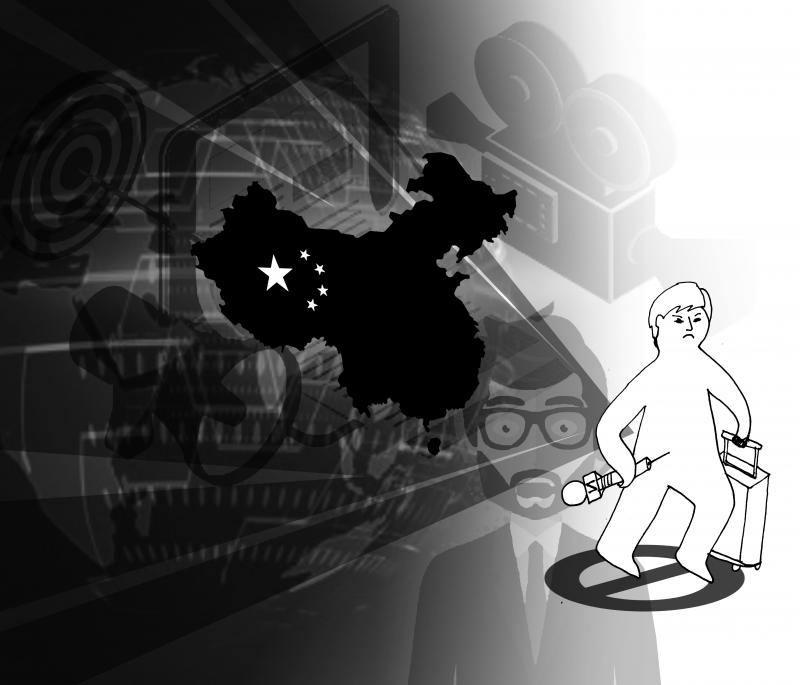
Illustration: Tania Chou
Foreign reporting in China has historically been difficult, but under the increasingly hardline rule of Chinese President Xi Jinping (習近平) and amid growing antagonism against the US, Australia and other nations, the situation has markedly deteriorated.
The treatment of Birtles, Smith and Cheng under the guise of “national security” has also added to fears that Beijing has broken a tacit understanding to at least give the appearance of respecting the freedom of the foreign press — that it is willing to not only expel people, but also use them as bargaining chips in hostage diplomacy.
The Foreign Correspondents Club of China (FCCC) said that the “appalling intimidatory tactics” of China against foreign reporters now amount to circumstances that make it “untenable to remain in the country.”
“The effort to keep foreign journalists in China against their will marks a significant escalation of an ongoing, sustained Chinese government assault on media freedoms,” it said.
Last month, a Los Angeles Times journalist was violently detained and interrogated by Chinese authorities while she attempted to report on protests in Inner Mongolia.
In the first half of this year, 17 journalists were expelled from the nation, including those employed by US outlets the New York Times, the Washington Post and the Wall Street Journal, collectively holding decades of experience and expertise.
This month, several more US journalist were told they could not renew their press cards.
The FCCC said that Beijing is using visas as a weapon “like never before.”
The exit bans placed on Birtles and Smith are a relatively widespread measure used by Beijing to prevent people — often lawyers and dissidents — leaving China, but their use against foreign journalists represents a significant escalation.
Birtles told reporters that he felt the questioning — agreed to in return for a lifting of the exit bans — was harassment amid a “diplomatic tussle,” rather than a legitimate part of an investigation.
There appear to be at least two elements driving Beijing’s new tack, experts say.
One is retaliation.
Beijing says that the visa cancelations and delays were in response to the US government tightening restrictions on Chinese journalists and news outlets, and it has threatened further countermeasures.
The day after the Australians returned home, Chinese state media published coordinated reports on claims that Chinese journalists in Australia were raided by the authorities in June, amid investigations into foreign interference.
The second factor is Xi’s growing intolerance for the presence of foreign journalists.
“The pesky thing about foreign reporters is we don’t stick to the playbook,” Washington Post Beijing bureau chief Anna Fifield told a Lowy Institute panel in April.
Foreign journalists were once useful to the Chinese Communist Party (CCP), when they provided something of a link to global businesses and investors. However, that has changed and China eventually getting rid of all foreign correspondents is “not out of the realms of possibility,” Fifield said.
China watcher Bill Bishop echoed her comments.
“The PRC/CCP cares far more about its ability to disseminate its messaging globally — key to its long-held goal of increasing China’s global discourse power — than it does about visas for its journalists in the US, and there are forces inside China that would be happy to throw out all the foreign reporters,” Bishop said.
Foreign journalists report what the local press is unable to, including the mass human rights abuses in Xinjiang, corruption allegations in the senior ranks of the CCP, the internationally unlawful intervention in Hong Kong, increasing surveillance of people’s daily lives and the attempt to cover up the COVID-19 outbreak.
Xi has overseen a much tighter hold on Chinese society and crackdowns on potential dissent.
Birtles echoed the concerns of many journalists when he said that it had become increasingly difficult to get people to go on the record in China.
The FCCC annual report last year included dozens of anecdotes from correspondents of intimidation, violence and surveillance in the field, and said that 70 percent of correspondents had reported the cancelation or withdrawal of interviews, for reasons they knew or believed to be related to the authorities.
Interviewees who did speak to correspondents risked significant reprisals, including detention, interrogations and exit bans, the report said.
New York Times journalist Chris Buckley, who was among those expelled this year, said the situation is “pretty bleak,” but he wants to return.
“It has become tougher, there’s no doubt about that. Without understating the difficulties, it’s important to understand it’s an amazing story and can be a very rewarding place to be reporting as well,” Buckley said.
Foreign correspondents and human rights groups are quick to point out that the situation is far more dangerous for Chinese journalists and employees of media outlets.
China is the leading jailer of journalists in the world, according to the Committee to Protect Journalists, with at least 48 in prison.
Beijing says that Cheng is suspected of national security offenses, but her case is being compared to those of Canadians Michael Kovrig and Michael Spavor, who were targeted after Huawei Technologies chief financial officer Meng Wanzhou (孟晚舟) was arrested in Canada, and the detention of Australian writer Yang Hengjun (楊恆均) after Australia banned Huawei from its 5G networks.
The US “should not be surprised to have a Kovrig/Spavor-like situation in the PRC very soon,” Bishop said.
Richard McGregor, a former foreign correspondent and leading expert on China at the Lowy Institute in Australia, said that other nations grappling with Beijing should take note of the treatment of the Australian journalists.
“If their bilateral relationship deteriorates, then their own nationals will be in the firing line as well,” McGregor said.
From the Iran war and nuclear weapons to tariffs and artificial intelligence, the agenda for this week’s Beijing summit between US President Donald Trump and Chinese President Xi Jinping (習近平) is packed. Xi would almost certainly bring up Taiwan, if only to demonstrate his inflexibility on the matter. However, no one needs to meet with Xi face-to-face to understand his stance. A visit to the National Museum of China in Beijing — in particular, the “Road to Rejuvenation” exhibition, which chronicles the rise and rule of the Chinese Communist Party — might be even more revealing. Xi took the members
A Pale View of Hills, a movie released last year, follows the story of a Japanese woman from Nagasaki who moved to Britain in the 1950s with her British husband and daughter from a previous marriage. The daughter was born at a time when memories of the US atomic bombing of Nagasaki during World War II and anxiety over the effects of nuclear radiation still haunted the community. It is a reflection on the legacy of the local and national trauma of the bombing that ended the period of Japanese militarism. A central theme of the movie is the need, at
The Chinese Nationalist Party (KMT) and the Taiwan People’s Party (TPP) on Friday used their legislative majority to push their version of a special defense budget bill to fund the purchase of US military equipment, with the combined spending capped at NT$780 billion (US$24.78 billion). The bill, which fell short of the Executive Yuan’s NT$1.25 trillion request, was passed by a 59-0 margin with 48 abstentions in the 113-seat legislature. KMT Chairwoman Cheng Li-wun (鄭麗文), who reportedly met with TPP Chairman Huang Kuo-chang (黃國昌) for a private meeting before holding a joint post-vote news conference, was said to have mobilized her
Before the Chinese Communist Party (CCP) and its People’s Liberation Army (PLA) can blockade, invade, and destroy the democracy on Taiwan, the CCP seeks to make the world an accomplice to Taiwan’s subjugation by harassing any government that confers any degree of marginal recognition, or defies the CCP’s “One China Principle” diktat that there is no free nation of Taiwan. For United States President Donald Trump’s upcoming May 14, 2026 visit to China, the CCP’s top wish has nothing to do with Trump’s ongoing dismantling of the CCP’s Axis of Evil. The CCP’s first demand is for Trump to cease US


 RSS
RSS