


Chung Yuan ChristiaN University is clearly in bed with the People’s Republic of China.
This can be the only explanation why the school’s authorities have done their utmost to shield a student, who lodged a complaint against an associate professor, and then used thuggish tactics to compel the teacher to issue two separate apologies to China.
The original complaint, filed by an unnamed Chinese student, was for remarks by associate professor Chao Ming-wei (招名威) during a class on the origin of COVID-19.
A second complaint was filed by the same student after Chao, during an apology, stated that he was a teacher from the “Republic of China [ROC], Taiwan.”
The incident was exposed by Democratic Progressive Party (DPP) Legislator Mark Ho (何志偉) at a news conference with Chao on May 11.
DPP Legislator Chen Ting-fei (陳亭妃) publicly expressed support for Chao, while other members of the legislature began to intervene, too.
The Ministry of Education and the Mainland Affairs Council have announced the formation of a joint working group to investigate the affair.
As Minister of Education Pan Wen-chung (潘文忠) put it: “We must uphold freedom by means of the academy and the teaching profession, otherwise we might as well give up on our democracy.”
Chao’s employers treated him incredibly badly, exerting pressure on him before the affair hit the headlines, then sitting on their hands during the ensuing media storm. The school has said one thing in public and another in private, and behaved in a thoroughly duplicitous manner that does not stand up to the slightest scrutiny.
The entirety of the university’s administrative apparatus was brought down on Chao to force him to apologize.
According to video footage of the lesson released online, Chao says: “Yep, I’m talking about you.”
Out of context, it appears as if Chao was referring to the class’ only Chinese student when in fact he was referring to the Chinese authorities.
The school’s administrators went to war with one of their own teachers and forced him to get down on his knees and grovel, not because of a perceived jibe at a Chinese student, but because he dared criticize China’s government during class.
In an audio recording of a disciplinary meeting between Chao and the university’s dean of studies Hsia Cheng-hwa (夏誠華), Hsia upbraids Chao, initially accusing him of “bias.”
During the Martial Law era, the Taiwan Garrison Command would routinely accuse dissidents of holding “extreme” or “biased” views.
It seems the specter of the Taiwan Garrison Command still lives on at the university.
Referring to Chao’s statement on being from the ROC, Hsia says on the same tape: “Today, when you made your apology to the mainland student, why on earth did you feel the need to emphasize this?”
No one from the pan-blue pro-unification camp dares say “the Republic of China” when they are in China. For example, Taipei City Councilor Wang Hung-wei (王鴻薇) on Phoenix Television — a Chinese-owned media company — did not dare emphasize “Taiwan’s president,” but instead said “Taiwan’s leader.”
After the university’s underhanded manipulation was revealed to the public, the school issued a four-point statement to protect itself, trying to cover up its nasty behavior.
First, the school criticized Chao for “extremely unprofessional behavior and expressing opinions unrelated to the course curriculum.”
On the other side of the Taiwan Strait, Chinese security officials on May 10 arrested former law professor Zhang Xuezhong (張雪忠).
Zhang’s employment at the East China University of Political Science and Law had been terminated for “spreading personal political opinions to teachers and staff, using his position to disseminate political views to students and seriously transgressing the standards of the higher education teaching profession.”
The offense that Chung Yuan Christian University slapped on Chao was not different in substance from that of its Chinese counterpart.
Second, the school stated that it is located in the ROC, so it did not clamp down on Chao for emphasizing that he is a “professor of the Republic of China, Taiwan.” This is rather embarrassing for Hsia.
In March 2017, the school signed a “one China” pledge with the Chinese authorities to qualify for participation in exchange programs with Chinese universities. The “one China” wording certainly did not refer to the ROC, so the second point does not make sense.
Furthermore, during an interview with the Chinese-language online network CRNTT, published on Aug. 23, 2018, Hsia declared that, “those ‘nativists’ will split Taiwanese society ... Isn’t it better to make use of the giant’s [China’s] broad shoulders?”
It appears that Chao’s real crime was to offend Hsia’s pro-Beijing sensibilities.
During the 2015 student movement against changes to the high-school curriculum, the university’s president Samuel Chang (張光正) tried to intimidate a protesting high-school student, saying that if this kind of protest became a habit, “companies probably will not want to employ you.”
Chang’s reaction contradicts his claim that the school is founded on the principle of “guaranteeing students’ right to learn.”
Third, the university accused Chao of causing offense to the Chinese student: “We protect the right of students from any country and any region to learn.”
“Any country and any region” is clearly a reference to China. By using “the right to learn” to override the “right to teach,” the university suppressed the right to lecture that academia in Taiwan has worked so hard to obtain simply to toady to Beijing.
Chao’s statement angered China, but it did not infringe upon the Chinese student’s right to learn.
Finally, the school accused Chao of “disregarding teaching quality standards and using one-sided information to incite social division and create misconceptions” and also stated that it reserves the right to take legal action against Chao.
Nothing that Chao said could be interpreted as having brought his employer into disrepute, but the school does not say that it might take legal action on behalf of China.
Furthermore, the school claims the right to decide what constitutes inadequate “teaching quality” or “one-sided information” and criticized Chao for “bias,” yet it appears blind to its own bias and one-sidedness.
The university has sunk to the level of a Confucius Institute. As Chen put it: The government must step in to save the school from the “campus thugs.”
Chin Heng-wei is a political commentator.
Translated by Edward Jones
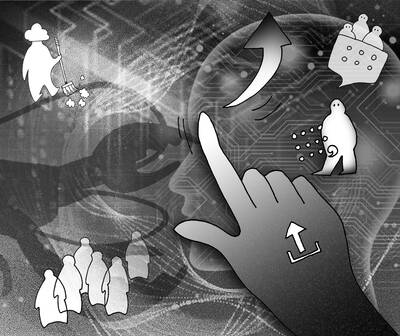
Weeks into the craze, nobody quite knows what to make of the OpenClaw mania sweeping China, marked by viral photos of retirees lining up for installation events and users gathering in red claw hats. The queues and cosplay inspired by the “raising a lobster” trend make for irresistible China clickbait. However, the West is fixating on the least important part of the story. As a consumer craze, OpenClaw — the AI agent designed to do tasks on a user’s behalf — would likely burn out. Without some developer background, it is too glitchy and technically awkward for true mainstream adoption,
Out of 64 participating universities in this year’s Stars Program — through which schools directly recommend their top students to universities for admission — only 19 filled their admissions quotas. There were 922 vacancies, down more than 200 from last year; top universities had 37 unfilled places, 40 fewer than last year. The original purpose of the Stars Program was to expand admissions to a wider range of students. However, certain departments at elite universities that failed to meet their admissions quotas are not improving. Vacancies at top universities are linked to students’ program preferences on their applications, but inappropriate admission
On Monday, a group of bipartisan US senators arrived in Taiwan to support the nation’s special defense bill to counter Chinese threats. At the same time, Beijing announced that Chinese President Xi Jinping (習近平) had invited Chinese Nationalist Party (KMT) Chairwoman Cheng Li-wun (鄭麗文) to visit China, a move to make the KMT a pawn in its proxy warfare against Taiwan and the US. Since her inauguration as KMT chair last year, Cheng, widely seen as a pro-China figure, has made no secret of her desire to interact with the Chinese Communist Party (CCP) and meet with Xi, naming it a
Taiwan People’s Party (TPP) Chairman Huang Kuo-chang (黃國昌) took the stage at a protest rally on Sunday in front of the Presidential Office Building in Taipei in support of former TPP chairman Ko Wen-je (柯文哲), who has been sentenced to 17 years in jail for corruption and embezzlement. Huang told the crowd that Chinese Nationalist Party (KMT) Chairwoman Cheng Li-wun (鄭麗文) had sent a message of support the previous day, saying she would be traveling from the south to Taipei: If the protest continued into the evening, she had said, she would show up. The rally was due to end


 RSS
RSS