


Barely a month ago, China was in the grip of COVID-19. Thousands of new infections were confirmed every day.
Hospitals were overwhelmed. People were dying by the hundreds and they could not leave their homes.
The draconian lockdown seems to have worked — China’s outbreak appears to be under control — but China’s leaders are apparently ignoring the outbreak’s most essential lessons. A review of their handling of the crisis bears this out.
Upon learning of a new coronavirus that had emerged in Hubei Province’s Wuhan, local authorities’ first instinct was to suppress the information. Police reprimanded whistle-blowers such as the Wuhan doctor Li Wenliang (李文亮), who subsequently died of the disease. (Wuhan police have apologized to Li’s family.)
This should have motivated Chinese leaders to weigh the costs of censorship and reconsider the appointment of unqualified party members to key public health positions. The head of the Hubei Provincial Health Commission, dismissed during the crisis, had no medical training or experience in public health.
Moreover, some other nations, especially Taiwan and Singapore, managed to contain the coronavirus without incurring the high costs that China did when it placed at least 760 million people under varying degrees of residential lockdown.
China’s leaders should be looking to these nations for lessons on a smarter crisis response.
However, far from learning from past mistakes, China’s leaders are trying to cover them up. As virtually the entire global economy effectively shuts down to contain the China-born virus and deaths in Italy — the pandemic’s new epicenter — exceed 13,000, the Chinese Communist Party (CCP) has shifted its propaganda machine into high gear, as it aims to change the narrative of the crisis.
At home, this has meant touting the CCP’s leadership in mobilizing the nation to “win the war” against the coronavirus. It has also meant encouraging the spread on Chinese social media of exaggerated or outright false stories about Western democracies’ “inept” responses to the pandemic.
Abroad, China’s propaganda machine is trumpeting declining infection rates as evidence that strong centralized leadership is more effective than democratic governance and Beijing is sending humanitarian assistance — including healthcare workers and medical supplies — to hard-hit nations such as Iran, Italy and the Philippines.
However, if Chinese leaders hope to use the pandemic to build and project soft power, they are likely to be disappointed. For starters, the world is nowhere near ready to forget the role that its initial cover-up played in allowing the coronavirus to spread.
The prevailing view outside China today is that, had the nation’s leaders taken decisive action immediately and transparently, the pandemic might have been contained. The CCP can challenge that narrative all it wants, but it cannot force international media to do the same.
Chinese propaganda has never gotten much purchase in the free marketplace of ideas. Most of the CCP’s previous attempts to influence international public opinion have fallen flat.
Few are tempted by a Chinese-style containment strategy. Shutting down the entire nation has cost China dearly in economic terms, with first-quarter GDP expected to plunge 9 percent. If a second wave of infections strikes, as is likely, repeating the same strategy would lead to economic ruin.
Of course, if this were the only way to save lives, people might be on board, but Taiwan, Hong Kong and Singapore all seem to have struck a better balance between protecting public health and sustaining economic activity.
Against this backdrop, China’s humanitarian efforts are likely to do little to repair its reputation. It is better than offering no help at all, but the nation could do a lot more to bolster public health globally — beginning with sharing the massive amounts of data and knowledge it has gathered on the coronavirus.
Beijing could scale up production of protective equipment, especially protective suits and masks. China made half the world’s masks before COVID-19 and it has since expanded production nearly 12-fold. If it really does have the coronavirus under control, there is nothing stopping it from donating this life-saving equipment to hard-hit nations, which are facing severe shortages.
In particular, China should make a major donation, perhaps about 1 billion masks and 1 million suits — a 10-day supply for 50,000 healthcare workers — to the US. This could ease tensions between the two nations just enough to enable them — together with the EU and Japan — to pursue a coordinated response to the pandemic, including action to shore up the global financial system and stimulus packages to stave off a depression.
When the pandemic is finally over, people would remember what China did, not what it said. It can go down in history either as the reason the COVID-19 crisis began, or as one of the reasons it ended.
Pei Minxin is a professor of government at Claremont McKenna College and a nonresident senior fellow at the German Marshall Fund of the United States.
Copyright: Project Syndicate

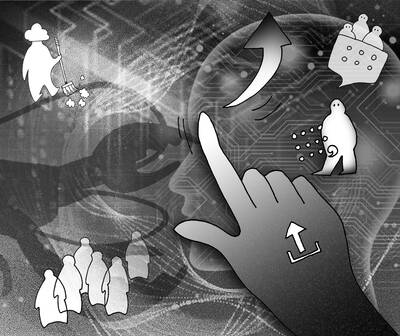
Weeks into the craze, nobody quite knows what to make of the OpenClaw mania sweeping China, marked by viral photos of retirees lining up for installation events and users gathering in red claw hats. The queues and cosplay inspired by the “raising a lobster” trend make for irresistible China clickbait. However, the West is fixating on the least important part of the story. As a consumer craze, OpenClaw — the AI agent designed to do tasks on a user’s behalf — would likely burn out. Without some developer background, it is too glitchy and technically awkward for true mainstream adoption,
On Monday, a group of bipartisan US senators arrived in Taiwan to support the nation’s special defense bill to counter Chinese threats. At the same time, Beijing announced that Chinese President Xi Jinping (習近平) had invited Chinese Nationalist Party (KMT) Chairwoman Cheng Li-wun (鄭麗文) to visit China, a move to make the KMT a pawn in its proxy warfare against Taiwan and the US. Since her inauguration as KMT chair last year, Cheng, widely seen as a pro-China figure, has made no secret of her desire to interact with the Chinese Communist Party (CCP) and meet with Xi, naming it a
A delegation of Chinese Nationalist Party (KMT) officials led by Chairwoman Cheng Li-wun (鄭麗文) is to travel to China tomorrow for a six-day visit to Jiangsu, Shanghai and Beijing, which might end with a meeting between Cheng and Chinese President Xi Jinping (習近平). The trip was announced by Xinhua news agency on Monday last week, which cited China’s Taiwan Affairs Office (TAO) Director Song Tao (宋濤) as saying that Cheng has repeatedly expressed willingness to visit China, and that the Chinese Communist Party (CCP) Central Committee and Xi have extended an invitation. Although some people have been speculating about a potential Xi-Cheng
The ongoing Iran conflict is putting Taiwan’s energy fragility on full display — the island of 23 million people, home to the world’s most advanced semiconductor manufacturing, is highly dependent on imported oil and gas, especially that from the Middle East. In 2025, 69.6 percent of Taiwan’s crude oil and 38.7 percent of liquified natural gas were sourced from the Middle East. In the same year, 62 percent of crude oil and 34 percent of LNG to Taiwan went through the Strait of Hormuz. Taiwan’s state-run oil company CPC Corp’s benchmark crude oil price (70 percent Dubai, 30 percent Brent)


 RSS
RSS