


National Taiwan Normal University president Wu Cheng-chih (吳正己) in an opinion piece published in the Chinese-language Liberty Times (sister newspaper of the Taipei Times) on Monday last week said that the tech sector might have taken all the computer teachers.
Wu said that teacher education is no longer popular, adding that there are now only two “pure” teacher education universities left in Taiwan, and that only 15 percent of National Taiwan Normal University (NTNU) graduates work as teachers.
Wu also said that the 12-year Basic Education Curriculum Guidelines should teach students computational thinking, but that there is a shortage of teachers in the area of basic information studies, and not even 10 NTNU graduates per year want to teach computer studies.
Wu suggested that instructors in fields with an excess of teachers should receive a second specialty, as there is a need to integrate smaller schools in remote areas and they are addressing this problem by jointly hiring teachers and sharing them.
In response to the new political situation and new social demands, the Teacher Education Act (師資培育法) promulgated in February 1994 differs from the earlier Teacher Education Law (師範教育法) of 1978, according to which students were given teacher qualifications on graduation, together with the right and obligation to receive and accept a position as teacher.
The problem is that graduates with an information technology background are unwilling to work as teachers.
Young graduates cannot be blamed for not wanting to teach information technology in elementary schools and high schools, because doing so means having to first go through several levels of tests and evaluations.
Furthermore, the tests include written and oral tests, as well as live teaching trials.
In addition to being meticulous in their preparation, they must also familiarize themselves with the culture of public education and memorize the test questions, which many see as a perilous undertaking.
All this makes it difficult for young people with educational ideals to put those ideals into practice.
After going through numerous resumes, one business leader enamored with talented people realized that a young candidate who had announced his intent to show up for an interview never arrived.
The business leader called the job applicant and asked when he would be coming around for “some fun.” With just a few encouraging words, the young jobseeker’s worries faded away.
Could a similar scene play out in educational circles?
In addition, having a reserve of trained teachers should also be required.
For example, with the COVID-19 outbreak wreaking havoc in China, elementary schools and high schools have delayed returning to school, but cram schools are running as normal and students have to attend classes.
Some school presidents have expressed concern, but all they can do is to urge schools to take all the necessary prevention measures.
Another example is English-language classes in elementary schools: Many teachers agree that cram schools are more helpful to students’ English-language skills, because the language is only taught a couple of hours per week in elementary school, which is far from adequate.
Some students attend cram school, while others do not, and if there are not enough chances to study at school, the results are catastrophic.
If it were possible to move in tandem with what is happening in society and offer teacher training to cram school teachers, the overall quality of education could be raised.
Article 8-1 of the Teacher Education Act (師資培育法), which was amended last year, states: “In the light of policy requirements, and after the teacher education review committee has reviewed the matter and given approval, the central competent authority may coordinate the teacher education universities to organize pre-service teacher education courses and recruit university graduates who meet specific eligibility criteria to take those courses for at least one year.”
However, the phrase “university graduates who meet specific eligibility criteria” must be defined by the competent authority.
As Wu said, there is a severe shortage of information technology teachers, and perhaps graduate students with a background in information technology who still have not obtained teacher qualifications should be allowed to quickly go through a teacher training program. A shortage of English-language teachers could be handled in the same way.
To resolve the problem, civil servants must be given encouragement to demonstrate the courage required to innovate, and not be overly concerned about being charged with breaking the law while doing so.
Above all, the nation must not focus only on security: Only by increasing the nation’s teacher reserve in accordance with the law will it have access to a never-ending pool of teachers.
Chang Huey-por is a former president of National Changhua University of Education.
Translated by Perry Svensson
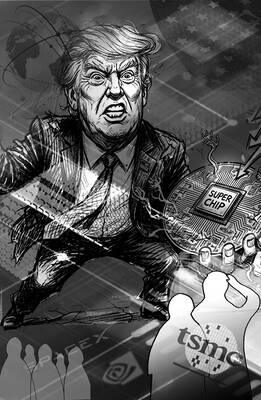
The White House’s decision to take a 9.9 percent stake in Intel Corp is looking like very shrewd business indeed. Since the government bought in at US$20.47 a share last August, the US chipmaker’s surging stock price has delivered the US a US$43 billion return. One of the reasons the investment has so far proved so sound is that the White House has made sure of it. According to The Wall Street Journal, Howard personally pushed deals on Intel’s behalf with some of the most lucrative clients imaginable. They include Nvidia Corp, the company at the heart of the AI
A single photograph can cut through a lot of noise, but it can also be used to misrepresent the truth. At the very least, it can concentrate the mind on something that requires further investigation. On Monday last week, Ma Ying-jeou Foundation CEO Tai Hsia-ling (戴遐齡) and former National Security Council secretary-general King Pu-tsung (金溥聰) held a news conference in which they showed a photograph of former foundation CEO Hsiao Hsu-tsen (蕭旭岑), now Chinese Nationalist Party (KMT) deputy chairman. In the image Hsiao is seated next to Xiamen Taiwan Businessmen Association chairman Han Ying-huan (韓螢煥). The two men were holding
I first met Professor Ray Jiing (井迎瑞) as a film and documentary student at Shih Hsin University’s (SHU) Department of Radio Television and Film in 1988. The following year, he went on to become the director of the Chinese Taipei Film Archive — forerunner of the Taiwan Film and Audiovisual Institute (TFAI). Over his eight-year tenure, Jiing rescued and restored over 200 classic Taiwanese films. In 1997, he established the Graduate Institute of Studies in Documentary and Film Archiving at Tainan National University of the Arts (TNNUA), and I joined the program in his third cohort of students. Beyond a
President William Lai Ching-te’s (賴清德) May 20 second-anniversary address was not just a routine policy review; it was damage control. US President Donald Trump’s remarks — that he did not want to see anyone move toward independence and that the delivery of a major Taiwan arms package could depend on the progress of US-China relations — unsettled Taiwan’s public and created an opening for opposition parties to question whether Taiwan was being treated as a bargaining chip in Washington’s dealings with Beijing. Lai’s speech was designed to close that opening. The address covered the expected ground: sovereignty, cross-strait relations, defense spending,


 RSS
RSS