


When Julie Brown of the Miami Herald in 2017 approached a former police chief of Palm Beach, Florida, hoping to get him to open up about his investigation of the child sex crimes for which the wealthy financier Jeffrey Epstein had been fleetingly jailed a decade earlier, she was surprised by how unresponsive he was.
Michael Reiter told Brown he had been down this road many times and was sick of it.
As Brown recalled in a [radio station] WNYC interview last month, Reiter said he had talked to many reporters and told them precisely where to find damning evidence against Epstein, but nothing ever came of it.
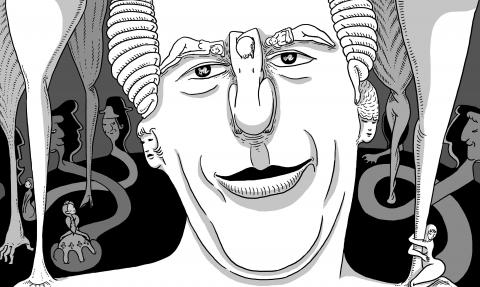
Illustration: Mountain People
“He was convinced that a lot of media had squashed the story and he was fed up,” she said.
Reiter warned Brown what would happen were she to continue digging: “Somebody’s going to call your publisher and the next thing you know you are going to be assigned to the obituaries department.”
Brown did not heed his warning. She flung herself at the investigation and eventually persuaded Reiter to go on record.
Her result was an award-winning three-part series in November last year that exposed a vast operation in which 80 potential victims were identified, some as young as 13 at the time of the alleged abuse. She persuaded eight to tell their stories.
Brown also exposed a government cover-up in which Epstein got away with an exceptionally light sentence that saw him serve only 13 months in jail.
She discovered that a “non-prosecution agreement” had been negotiated secretly in 2008 by the then top federal prosecutor in Miami, Alexander Acosta, that gave Epstein and his coconspirators immunity from federal prosecution.
In 2017, Acosta was appointed by US President Donald Trump as the US secretary of labor, a post that ironically is responsible for combating sex trafficking.
The media’s handling — or mishandling — of the Epstein affair is a story of extremes.
It is a heartwarming success story, of how one intrepid reporter pierced the veil of secrecy and found the truth.
Brown’s coverage has had consequences: Epstein was arrested on July 6 and indicted on new sex trafficking charges by New York prosecutors who praised her work. In the fallout, Acosta was forced to resign.
However, there is also a less cheerful narrative. Why did the police chief’s appeals to the media fall on deaf ears? Why would so many years pass before the shocking extent of Epstein’s crimes and Acosta’s sweetheart deal were revealed by a local newspaper with severely limited resources?
In fact, the two extremes of the story are directly linked: Brown told WNYC that one of the reasons she began looking into Epstein was that she was puzzled about the public silence surrounding him.
“There really was nobody pursuing this at all,” she said. “That was one of the things that intrigued me about this case. Why isn’t anyone standing up and screaming?”
That silence stretches back to 2003, when Vicky Ward wrote a profile of Epstein for Vanity Fair. During her reporting, she was introduced to a mother and her two daughters from Phoenix, Arizona, who alleged that Epstein assaulted the girls, one of whom was 16 at the time.
Ward told the Guardian she spent a lot of time with the family discussing whether they should go public.
“They were frightened,” she said. “The mother told me that every night when she walked the dog she looked over her shoulder.”
Eventually, the women agreed to go on the record, and when Epstein was told about their accounts he went “berserk,” Ward said.
Epstein had already threatened to get a witch doctor to put a curse on Ward’s unborn children — she was pregnant with twins at the time — and now he campaigned to stop Vanity Fairpublishing the allegations, even turning up unannounced at the office of then-editor Graydon Carter.
Publication was delayed, then Ward was told the paragraphs on the abuse of the women had been deleted.
“I was extraordinarily upset,” she said. “I asked the women what they were going to do and they said they would lick their wounds and retreat, as this was exactly what they feared would happen.”
Ward believes Carter caved under Epstein’s pressure. She recalls confronting the editor about the excised paragraphs and said she has a note in her archives that has Carter saying: “I believe him... I’m Canadian.”
Carter remembers events very differently. In his account there were legal issues around the women’s stories that prevented publication, most significantly that the women themselves were unwilling to go on the record.
In a statement to the Guardian, Carter said: “I respected the work Vicky Ward did at Vanity Fair, but unfortunately her recounting of the facts around the Epstein article is inaccurate. There were not three sources on the record and therefore this aspect of the story did not meet our legal and editorial standards.”
Ward said she has documentary evidence that shows the women were emphatically prepared to go public, including fact-checkers’ and legal e-mails to Epstein from Vanity Fair asking for his response to the allegations made by both sisters.
The Guardian spoke to the mother of the girls, Janice Farmer. She said all three did speak to Ward in 2003 and told her on the record what Epstein had done, including allegations he had invited her youngest daughter, then 16, to his New Mexico ranch and molested her.
“I was hesitant to go public because I was worried about the safety of my daughters — by that point I didn’t trust Jeffrey at all,” Farmer said. “But I did want him to be exposed.”
She said she vividly recalls agreeing with Ward along with her daughters for their stories to be told in her Vanity Fair profile. She also said she vividly recalls her reaction when she learned that part of the piece was not to be published.
“I felt angry,” she said. “I felt like Jeffrey’s money, power, connections — whatever — had been put into play.”
There is another complicating element to the story. In 2011, after Epstein had gone to jail, Ward wrote a blog post for Vanity Fair. In it she used language that was strikingly uncritical of Epstein, referring to him as “not without humor” and praising him for being highly knowledgable.
She referenced Epstein’s sex crimes as “sexual peccadilloes” and referred to her 2003 Vanity Fair profile of him, saying it had alluded to his sexual relationships with young women, but “didn’t really go there, focusing instead on ... how Jeffrey made his money.”
“This is not to say I didn’t hear stories about the girls. I did. But, not knowing quite whom to believe, I concentrated on the intriguing financial mystery instead,” she wrote.
The Guardian put this blog post to Ward and she said she regretted writing it. At that point, the victims she had interviewed were not willing to talk, she said.
Nonetheless, “this blog did not need to be written — here I am toeing the Vanity Fair party line,” she added.
Fast forward to 2007, when Acosta reached his bizarrely lenient plea deal with Epstein. By then, investigators had identified 35 potential victims who said they had been lured into Epstein’s Palm Beach mansion and sexually assaulted.
However, records obtained by the Miami Herald showed that prosecutors led by Acosta worked with Epstein’s attorneys to minimize media coverage.
One of Acosta’s prosecutors wrote in an e-mail to Jay Lefkowitz, an Epstein lawyer: “On an ‘avoid the press’ note ... I can file the charge in district court in Miami which will hopefully cut the press coverage significantly. Do you want to check that out?”
That Acosta felt that he had to resign on Friday last week was an indication that the collective failure of US media to grapple with a story of serial sex trafficking and abuse that had been hiding in plain sight for years no longer holds true.
In the wake of Brown’s exemplary reporting, the rest of the US media has fallen in line. Acosta paid the price.
That might in part be thanks to the #MeToo movement that had not erupted when Brown began her investigation, but did draw attention to her work when it was published.
As she told MSNBC after Epstein’s arrest: “My journalism benefited from #MeToo as we [started] giving these cases much more scrutiny.”
Mary Angela Bock, an associate professor in the University of Texas at Austin’s School of Journalism, said that #MeToo has dented the prevailing patriarchy that has existed in newsrooms for decades and had led to sexual crimes being overlooked as merely “the way of the world.”
“#MeToo has led to greater awareness among journalists that this is not OK,” she said. “This is not ‘boys being boys.’ This is rape and sexual exploitation of children.”
Taiwanese pragmatism has long been praised when it comes to addressing Chinese attempts to erase Taiwan from the international stage. “Taipei” and the even more inaccurate and degrading “Chinese Taipei,” imposed titles required to participate in international events, are loathed by Taiwanese. That is why there was huge applause in Taiwan when Japanese public broadcaster NHK referred to the Taiwanese Olympic team as “Taiwan,” instead of “Chinese Taipei” during the opening ceremony of the Tokyo Olympics. What is standard protocol for most nations — calling a national team by the name their country is commonly known by — is impossible for
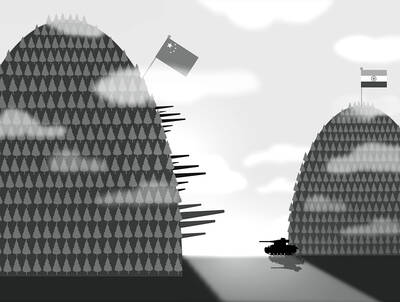
India is not China, and many of its residents fear it never will be. It is hard to imagine a future in which the subcontinent’s manufacturing dominates the world, its foreign investment shapes nations’ destinies, and the challenge of its economic system forces the West to reshape its own policies and principles. However, that is, apparently, what the US administration fears. Speaking in New Delhi last week, US Deputy Secretary of State Christopher Landau warned that “we will not make the same mistakes with India that we did with China 20 years ago.” Although he claimed the recently agreed framework
The Office of the US Trade Representative (USTR) on Wednesday last week announced it is launching investigations into 16 US trading partners, including Taiwan, under Section 301 of the Trade Act of 1974 to determine whether they have engaged in unfair trade practices, such as overproduction. A day later, the agency announced a separate Section 301 investigation into 60 economies based on the implementation of measures to prohibit the importation of goods produced with forced labor. Several of Taiwan’s main trading rivals — including China, Japan, South Korea and the EU — also made the US’ investigation list. The announcements come
Taiwan is not invited to the table. It never has been, but this year, with the Philippines holding the ASEAN chair, the question that matters is no longer who gets formally named, it is who becomes structurally indispensable. The “one China” formula continues to do its job. It sets the outer boundary of official diplomatic speech, and no one in the region has a serious interest in openly challenging it. However, beneath the surface, something is thickening. Trade corridors, digital infrastructure, artificial intelligence (AI) cooperation, supply chains, cross-border investment: The connective tissue between Taiwan and ASEAN is quietly and methodically growing


 RSS
RSS