


Four decades ago, in September 1979, when I entered duty on the State Department’s “Taiwan Coordination Staff,” my departing predecessor pointed me to a stack of black loose-leaf binders in the political officer’s massive Mosler safe. They contained the Kissinger China transcripts and, at the time, were labeled “top secret.” I was to educate myself on all the airy promises and vague commitments about Taiwan which American and Chinese leaders had more-or-less pledged to each other since 1971. I was to return the binders to the China desk when I had finished with them. Although my previous post was the US Liaison Office in “Peking,” I had never been privy to the Kissinger transcripts before. They were a revelation.
I had never read top secret documents larded with such humor and wry punch lines as the October 21, 1975 “memorandum of conversation” between American Secretary of State Henry A. Kissinger and China’s “Chairman Mao Tse-tung” (毛澤東). It has, therefore, always stuck in my memory. The funniest parts dealt with Taiwan. [https://history.state.gov/historicaldocuments/frus1969-76v18/d124]
So, to set the scene, I should explain that Chairman Mao literally was on his deathbed, his voice frail, his movements weak, he would succumb within a year; and he was mindful of mortality, heaven, and God.
At 6:25pm that evening, as Secretary Kissinger and Vice Premier Deng Xiaoping (鄧小平) entered his chamber with small entourages and a photographer, the Chairman unsteadily assumed a standing pose. When the flashbulbs ceased, he allowed himself to be eased into an overstuffed armchair. A White House stenographer, Ms. Anne Boddicker, recorded that “The Chairman would either speak with great difficulty,” with his two top interpreters first repeating Mao’s exact Chinese words for his nod before rendering them to English, “or he would write down his remarks on a note pad held by his nurse.” There is no doubt then, that the words Ms. Boddicker heard were Mao’s own and were interpreted with precision. Mao seemed able even to correct the interpreters; at one point, the Chairman jotted down “we have common opponents” in English, a linguistic feat that so astounded Secretary Kissinger that he asked to have the handwritten note. The Chairman obliged, “(He hands over the note he had written out)” writes Ms. Boddicker.
The Chairman had started off the exchange by disclosing, “You know I have various ailments all over me. I am going to heaven soon.” Secretary Kissinger hoped “not soon.” “Soon,” Mao insisted, “I’ve already received an invitation from God.” After a few minutes of badinage, Mao accused Kissinger of seeking to get to Moscow on China’s “shoulders.” Kissinger protested, “we have nothing to gain in Moscow.” Mao countered, “you can gain Taiwan of China.” Ms. Boddicker noted parenthetically: “(He begins coughing and the nurse comes in to help him.)”
For a few minutes, it was a dialogue of the deaf before Mao sharply exclaimed, “it’s better for it [Taiwan] to be in your hands, if you were to send it back to me now, I would not want it, because it is not wantable. There are a bunch of counter-revolutionaries there.” Mao opined that it may take a century, but thereafter “we will want it.”
Kissinger didn’t seem prepared for this expostulation and tried to interject “not a hundred years.” The Chairman cut him off. “It’s hard to say.” According to Ms. Boddicker, the Chairman then pointed toward the ceiling, and blurted “And when I go to heaven to see God, I’ll tell him it’s better to have Taiwan under the care of the United States now.”
Ok, here’s the first punch line.
Kissinger responded, “He’ll be very astonished to hear that from the Chairman.”
Now, I chuckled when I first read this and I expected Ms. Boddicker to have recorded some reaction. She had, after all, recorded every other meaningful gesture. But, evidently, Kissinger did not think it funny. Perhaps instead he saw it as a problem. Kissinger seemed eager to resolve the Taiwan issue; to get an American Embassy in Peking. But, the Chairman was dismissing it as inessential to good ties with America; so, no “(laughter)” noted by Ms. Boddicker.
The exchange immediately raised in my mind the question: Why did Mao feel secure with Taiwan “under the care of the United States”? The answer: Chairman Mao averred, “No, because God blesses you, not us. God does not like us (waves his hands) because I am a militant warlord, also a communist. That’s why he doesn’t like me. (Pointing to the three Americans) He likes you, and you, and you.”
So, here comes the second punchline: Secretary Kissinger says “I’ve never had the pleasure of meeting him, so I’m not sure.”
The first time I first read this in 1979, I smiled at the contrast between the 51-year-old irreligious American secretary of state’s impatience with the ancient Chairman’s incongruous deistic metaphors. Yet, there was no hint of humor in Ms. Boddicker’s transcript.
Here, I will jump ahead to a personal experience from December 1978, the coldest winter in Peking, for a clue to the deceased Chairman’s sentiments.
It was shortly after the “victorious conclusion” of the “Third Plenum of the Eleventh Party Congress.” Vice Premier Deng Xiaoping’s (鄧小平) new “Reform and Opening” movement had unleashed a new wave of “big character posters” demanding an end to Maoist oppression and new reforms for the Chinese people. Multitudes of hand-written manifestos on large sheets of pink, yellow, blue and white posters were pasted on the long street-front wall at Xidan Avenue. On the smoggy, frigid Thursday evening of December 7, dark and dimly lit by anemic streetlamps, battalions of bicycle commuters dismounted to read a series of freshly-pasted wall-posters entitled, “An Open Letter to President Carter.” To me, this was a shock. Why would Chinese workers address a message to the US president? How had they heard of him? What gave them hope President Carter even cared?
This was a full week before the surprise announcement of US-China “normalization” and this new poster clearly was not authorized by any of the communist factions competing for political supremacy in the “Third Plenum.” The poster praised President Carter’s “sympathy for [Soviet dissidents] Sakharov, Scharansky and Ginsburg,” but called on the American leader, not a Chinese one, nor a European one, nor the United Nations, to protest against the “successful oppression … even more fearful and detestable than unsuccessful oppression,” of the Chinese people. One young worker in thickly padded clothing spoke aloud above the crowd, reading from the poster, amid heckling from Chinese plainclothesmen. The poster was torn down by 11pm. A few days later, posters penned by a humble electrician from Beijing zoo, Wei Jingsheng (魏京生), called for the “Fifth Modernization — Democracy.” For the next several months, “Democracy Wall” at Xidan was a symbol of a China that should have been, before it was itself walled off from view, and Wei Jingsheng himself imprisoned.
China in 1978 was a grim, impoverished nation, terrorized for decades by self-described “warlord” Mao Zedong. By 1975, Chairman Mao could admit to Secretary Kissinger “when I go to heaven to see God, I’ll tell him it’s better to have Taiwan under the care of the United States now.” But it was a sentiment Kissinger was unable to process and therefore he made light of it.
In the 1970s, Taiwan was not “democratic,” but at least “under the care of the United States,” the repression of the old regime (Mao called them “counter-revolutionaries”) was restrained; in the 1980s America nurtured Taiwan’s liberalization. By the 1990s, Taiwan was Asia’s most vibrant and dynamic constitutional democracy, and remains so until this day. China, on the other hand, has slipped back into Maoist warlordism. The only “Quotation of Chairman Mao” I have ever agreed with is “it’s better to have Taiwan under the care of the United States.”
John J. Tkacik, Jr. is a retired US foreign service officer who has served in Taipei and Beijing and is now director of the Future Asia Project at the International Assessment and Strategy Center.
A gap appears to be emerging between Washington’s foreign policy elites and the broader American public on how the United States should respond to China’s rise. From my vantage working at a think tank in Washington, DC, and through regular travel around the United States, I increasingly experience two distinct discussions. This divergence — between America’s elite hawkishness and public caution — may become one of the least appreciated and most consequential external factors influencing Taiwan’s security environment in the years ahead. Within the American policy community, the dominant view of China has grown unmistakably tough. Many members of Congress, as
The Hong Kong government on Monday gazetted sweeping amendments to the implementation rules of Article 43 of its National Security Law. There was no legislative debate, no public consultation and no transition period. By the time the ink dried on the gazette, the new powers were already in force. This move effectively bypassed Hong Kong’s Legislative Council. The rules were enacted by the Hong Kong chief executive, in conjunction with the Committee for Safeguarding National Security — a body shielded from judicial review and accountable only to Beijing. What is presented as “procedural refinement” is, in substance, a shift away from
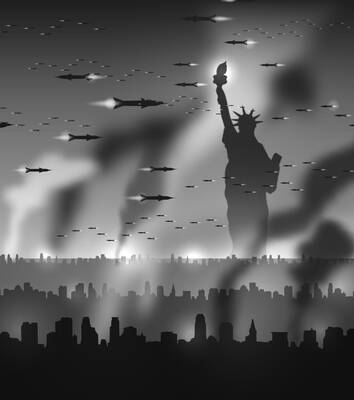
After declaring Iran’s military “gone,” US President Donald Trump appealed to the UK, France, Japan and South Korea — as well as China, Iran’s strategic partner — to send minesweepers and naval forces to reopen the Strait of Hormuz. When allies balked, the request turned into a warning: NATO would face “a very bad” future if it refused. The prevailing wisdom is that Trump faces a credibility problem: having spent years insulting allies, he finds they would not rally when he needs them. That is true, but superficial, as though a structural collapse could be caused by wounded feelings. Something
The shifting geopolitical tectonic plates of this year have placed Beijing in a profound strategic dilemma. As Chinese President Xi Jinping (習近平) prepares for a high-stakes summit with US President Donald Trump, the traditional power dynamics of the China-Japan-US triangle have been destabilized by the diplomatic success of Japanese Prime Minister Sanae Takaichi in Washington. For the Chinese leadership, the anxiety is two-fold: There is a visceral fear of being encircled by a hardened security alliance, and a secondary risk of being left in a vulnerable position by a transactional deal between Washington and Tokyo that might inadvertently empower Japan


 RSS
RSS