


“A lot of people design spaces in Hong Kong and then consult a feng shui master afterward, but for us it was very important to consult one right from the beginning,” said Philippa Wong (黃宇弘), cofounder of M.int Academy, a learning center in Hong Kong’s Aberdeen area that teaches music.
Philippa and her sister, Andrea Wong (黃宇恆), opened the center in August last year.
Like many business owners in the territory, they wanted to start off on the right foot and ensure optimal luck and a harmonious environment for their business to flourish, so they hired local feng shui master John Choi (蔡偉雄) to advise on the most auspicious layout and design for their center.
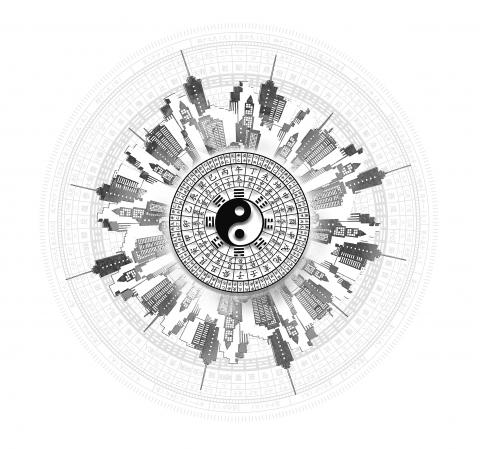
Illustration: June Hsu
“He advised us on the best places to locate different areas; the best position for the classrooms, our offices and performance spaces,” Andrea said. “He also calculated the exact time that the main entrance door needed to be installed. This is very significant in feng shui.”
“The building management thought we were a bit crazy, but we ended up having to install the door at a very specific time, like 4:01pm. It was very precise. Even all of the lights in the building, every placement, were calculated by John,” she said.
The feng shui influence at the center even extends beneath the carpets.
“John divided the school into a few sections and in certain [ones] we have three types of stickers: We have a blue sticker, a gold sticker and a blue-and-white-striped sticker,” Philippa said. “They help to boost the flow of energy that is coming through the door, so the gold sticker helps to boost money, and the other stickers represent other types of fortune that all combine to help boost our luck as a business and keep the good energy flowing.”
Almost a year after the center opened, the sisters are convinced of the benefits.
“We found the feng shui working for us,” Andrea said. “We have a 98 percent conversion rate when the customer actually comes to our center, so feng shui has definitely played a huge role in that. It’s good energy.”
According to Raymond Lo (盧恆立), vice president of the International Feng Shui Association and one of only five people to earn the title of “grand master,” feng shui is an ancient Chinese practice focused on how the environment affects people’s well-being.
“In ancient China, they discovered that there are different kinds of energies existing in our environment,” Lo said. “Therefore, feng shui tells us where the good and bad energy is and how to maximize the benefit of the prosperous energy and reduce the negative energy.”
In the past, Chinese emperors designed entire cities according to feng shui principles. Today, official adherence in places such as Hong Kong is less explicit, but the practice still influences urban design and architecture through the choices of individual developers, architects and the population.
One such example are the indigenous villagers in Hong Kong’s New Territories. After being forced to move to make way for new housing developments, over the past decade, the villagers have received HK$10 million (US$1.27 million) of public funds to spend on feng shui rituals for their new homes.
“When the government has to take land from villages, the authorities have to respect the local people’s claims that the new developments will destroy their feng shui,” Lo said.
Lo on average does 60 feng shui consultations a year in Hong Kong and said it is not just villagers who are still influenced by the ancient practice.
“From my experience, the bigger the building or the development in Hong Kong, the more likely it is that they will consult a feng shui practitioner,” he said. “I have many clients at big companies and they usually keep it confidential, because they don’t want the public to know which part of their building has bad feng shui.”
Lo said he is consulted by people behind offices and new developments for advice on whether the space is suitable, how to decorate, where to situate the boss, where to put the entrance and reception area, and more.
“Businesses in Hong Kong are very much concerned about their luck and prosperity,” Lo said. “So they want to make sure the boss is sitting in the right place in order to receive the prosperous energy.”
Although some skeptics write off feng shui as pure superstition, there is no disputing that it runs through the architectural veins of Hong Kong.
In 2005, Hong Kong’s City University became the first in the world to offer a feng shui course as part of its building and engineering master’s degree.
The Hong Kong Tourism Board offers feng shui tours three times a week that explain feng shui’s influence on notable landmark buildings.
Stories abound that there is a feng shui battle occurring in the central business district in which well-known skyscrapers use the practice in their architectural design to increase luck and ward off bad feng shui from neighboring buildings.
“The HSBC headquarters building in Hong Kong is a classic example of feng shui at work,” said Manuela Madeddu, an architect and senior lecturer on urban environment at London South Bank University.
“The building has a garden in front of it, an empty space where the energy is collected, and then the water beyond that, which is wealth, according to feng shui,” she said. “Two buildings at its side, representing the hills of the Azure Dragon on the east side and the hills of the White Tiger on the west side, protect the building, and mountains at its back support the building. This scheme reflects the ideal feng shui model of the formal school.”
It is also believed that the HSBC building has cannons on its rooftop — actually service winches — to represent a defense against the negative energy of the building in front of it, the Bank of China Tower, which is famous for going against good feng shui principles.
“The Bank of China Tower in Hong Kong has sharp angles in its design, which is creating what we call sha qi (殺氣) or ‘killing energy,’” Lo said. “Sha qi is inauspicious energy to the environment, because a sharp angle can damage — it’s like a blade for attack.”
Other feng shui experts believe the blade-like shape of the tower has had a negative effect, cutting the fortune of surrounding buildings.
Months after the completion of the Bank of China Tower in 1989, HSBC’s share price dropped to a historical low of £3.74. To counter the negative energy, HSBC supposedly placed the two cannon-shaped objects on top of the building pointed directly at the Bank of China.
Ever since, the legend says, HSBC’s performance has improved.
Choi said there are numerous other examples of well-known buildings in the territory that have been influenced by feng shui in their design.
“If you see the architecture of the new Hong Kong Government Complex in Admiralty, it’s a square shape with a hollow middle,” he said. “In feng shui, this hollow middle represents a mouth. This means lots of gossips. So inside that building, they are arguing all the time. In my opinion, this is a disaster design.”
Rocco Yim (嚴迅奇), the architect who designed Hong Kong’s Central Government Complex, which opened in 2011, said his firm’s works are not guided by specific feng shui principles, but he does not rule out feng shui altogether.
“If we treat feng shui as an ‘environmental science,’ then the issues that we prioritize in our designs, such as the fluidity of people’s movement within and around our buildings, the enhancement of lighting and ventilation through the buildings, and more importantly, the relationship of balance and harmony we create between our buildings and their settings are actually, in my understanding, the essence of feng shui principles,” he said.
Similar to the design of the government complex, high-rises with holes in the middle have become a common feature in a number of buildings in the territory and often pique the curiosity of the public.
A well-known example is the Repulse Bay development. The gaping hole in the center of the building is often believed to have been designed for feng shui purposes: A feature known as a “dragon gate,” which legend has it allows the energy of the nearby mountain — or “dragon” — to pass through toward the sea.
However, Lo is quick to dispel this belief as pure myth.
“This is nothing to do with feng shui. Those holes in the buildings are just gimmicks,” Lo said. “When we are talking about dragons in feng shui, the dragon is the energy of the land. The energy of the land passes through the mountains, it passes through from underground — it doesn’t pass through any holes. A lot of people don’t actually understand feng shui and they just make up stories.”
However, in separating fact from fiction, there is one common claim that Lo believes is true, and it is that Hong Kong has the best feng shui on Earth.
“That’s very true. In fact, the Hong Kong feng shui has a name — it’s called ‘the dragon turns its head to greet the ancestors,’” Lo said. “The reason we call it feng shui is because feng (風) means ‘wind’ and shui (水) means water.”
“With its mountains and harbor, where all the energy collects, Hong Kong is the only place in the world that exactly matches with the best feng shui principle of wind and water,” he added. “I have traveled to many places in the world and I haven’t seen such good feng shui as [that which] exists in Hong Kong.”
A recent report concerning a student who is suing his teacher posed the question in its headline: Does failing a student in two subjects constitute bullying? The college student in Chiayi County apparently sought NT$2 million (US$63,603) in state compensation, but a court dismissed the case. The first reaction of many might have been to ask: What has happened to students nowadays? Some say that teachers have lost their authority, while others say students are overindulged. Some even start reminiscing over the days when “whatever the teacher says goes.” However, the real issue might be overlooked if emotional reactions like that are the
When I visited Taiwan last summer, I called on the nation to use its status as a technology superpower to build superweapons. It is obvious to me as I return a year later that Taiwan is now answering that call. By 2030, Taiwan envisions a domestic drone hub, capable of producing large quantities of drones per year. The nation continues to tighten cooperation across the private sector, scientific researchers and the elected government, on creating new and innovative production avenues for defense, while efforts to become central to the “democratic supply chain” are only increasing. Anduril is seeing all of these positive
Singaporean former Prime Minister and current senior minister Lee Hsien- Loong(李顯龍) last month stood on Chinese soil and told Beijing that Singapore cooperates because of “shared interests”, not because of common “ethnic descent,” a significant statement that has upended China’s cognitive warfare tactics of “ethnic nationalism.” Along with using its military buildup and economic growth to expand its international dominance, China has long deployed ethnic politics to promote the idea that all ethnic Chinese around the world, regardless of citizenship, share a tight bond with the Chinese motherland, by which it means the regime of the People’s Republic of China (PRC)
President William Lai Ching-te’s (賴清德) May 20 second-anniversary address was not just a routine policy review; it was damage control. US President Donald Trump’s remarks — that he did not want to see anyone move toward independence and that the delivery of a major Taiwan arms package could depend on the progress of US-China relations — unsettled Taiwan’s public and created an opening for opposition parties to question whether Taiwan was being treated as a bargaining chip in Washington’s dealings with Beijing. Lai’s speech was designed to close that opening. The address covered the expected ground: sovereignty, cross-strait relations, defense spending,


 RSS
RSS