


A dozen years ago, the largest Internet company in China was not Alibaba or Tencent, but game developer Shanda Interactive Entertainment. Its founder was a young man named Chen Tianqiao (陳天橋), who became a billionaire at 30.
Chen was more prominent than Alibaba chairman Jack Ma (馬雲) for much of the past decade — then he disappeared. He left China, dropping out of public view almost completely. He took his NASDAQ-listed company private in 2012.
Chen is finally ready to talk publicly again. Now 44, he is living in Singapore with plans for his next act.
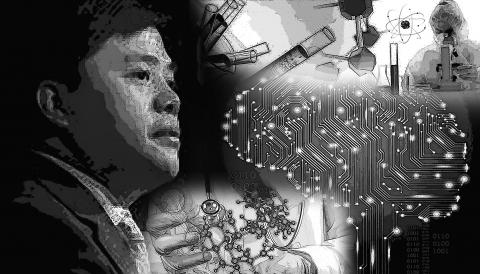
Illustration: Louise Ting
During a visit to his office there, he explained what led him to give up his life’s work and cede the market to Alibaba Group Holding and Tencent Holdings, whose founders are now the nation’s two richest men.
It started with panic attacks in his 30s, then escalated amid the rising stress of competition and government regulations. He eventually decided he had to salvage his own health.
“As I watched the sunset every night, I thought I would never wake up,” Chen said, sitting near the painting of a swirling dancer with his wife in a two-story colonial house that serves as their office.
His experience ultimately led him to a new path. The struggles with his own mental condition, combined with his Buddhist beliefs, convinced him to focus on research of the human brain.
He has set aside US$1 billion for the effort out of a personal fortune of at least US$2.4 billion, according to the Bloomberg Billionaires Index. That includes US$115 million that Chen and his wife have already given to the California Institute of Technology to establish the Tianqiao and Chrissy Chen Institute for Neuroscience. The rest is to be used to directly fund young scientists and set up Chen University somewhere in the US.
The concept for the school is unusual to say the least: It is to bring together academics in everything from neuroscience, biology and psychiatry to philosophy and divinity studies, and encourage them to work together. Chen thinks it is time to focus on improving humans’ emotional well-being after centuries of effort to increase living standards.
“This will be a university whose mission is to try to answer who we are and where we come from,” he said. “For thousands of years, we improved our happiness through changing the physical world. We now have to solve this problem by exploring inward.”
Chen was born in 1973 in Zhejiang Province, south of Shanghai and grew up as the nation began to embrace capitalism in the aftermath of the Cultural Revolution. He graduated from Fudan University a year early with a degree in economics. He met his future wife, Chrissy (雒芊芊), while the two of them were working at a securities firm. They were married within six months, then soon quit to start Shanda in 1999.
At the time, many Chinese entrepreneurs were rushing to create Internet portals, directories of Web sites similar to Yahoo. Chen, then 26, went his own way — he created an online gaming company with Chrissy, his younger brother and savings of about US$60,000.
Their first big break came in buying distribution rights to the South Korean role-playing game Legend of Mir II. Revenue surged, giving Shanda enough money to begin developing its own games, including the World of Legend.
As online game-playing in Internet cafes became a craze among China’s teenagers, profit doubled from 2002 to 2003. The company raised US$152 million in a NASDAQ initial public offering in May 2004.
Life as a public company proved tumultuous. Shares soared the first year, then plunged the second as fickle users defected to other games.
Chen diversified, proclaiming he wanted to become the Disney of China, then doubled down on games and saw his stock rise again. In 2009, he spun off the games unit Shanda Games in a US$1 billion offering — the biggest initial public offering in the US that year.
“One of the obvious differences between Chen Tianqiao and other entrepreneurs was that he had a very good financial backing and a solid revenue model,” GGV Capital managing partner Jixun Foo (符績勛) said.
However, the pressure was taking its toll. In 2004, while Chen was on a flight from Shanghai to Beijing, he felt excruciating pain in his chest. Convinced he was suffering a heart attack, he rushed to a hospital after landing. The doctors told him his heart was in perfect condition. He was suffering a panic attack.
That afternoon, he sat alone on a bench in China’s capital, thinking he would never do business again.
“It was so stressful, so painful,” he said.
However, once he went on medication and recovered, he went back to work.
As Chen’s ambitions grew, he expanded into home entertainment. He cut a partnership with Intel Corp and Microsoft Corp to create a new set-top box that would allow television viewers to go online, play Shanda games and buy music and films.
However, government officials objected. They were reluctant to cede control over television screens to anyone beyond the government, Chen said.
The project floundered. Chen said he could never talk about the reasons for the failure until now.
“Some 10 years have passed,” he said.
He suffered his second attack in 2009, this time it was more severe and longer lasting. That is when he hit bottom emotionally, so shaky that he often felt like he could not move.
“When you are lying down, you cannot sit down. When you are sitting down, you cannot get up. You cannot breathe,” he said.
At first, he came to Singapore to take a break. As he watched Tencent, Alibaba and Baidu filling the void he had left behind, he planned to return, but his wife cautioned against it, telling him there were different opportunities ahead.
“Many people spend their whole life to climb a mountain. Maybe you can climb several mountains,” she said.
A devout Buddhist who studied ways to transcend suffering, Chen decided to change course for good. The family relocated to Singapore in 2010 and began to withdraw from the business. In 2011, they offered to take Shanda Interactive private for US$2.3 billion. They later sold off their stock in Shanda Games and Chen resigned from its board.
Shanda ultimately could not make the leap to become China’s answer to Disney and lost ground in games as players shifted to smartphones.
“It is a formidable challenge,” said Serkan Toto, founder of Tokyo consultant Kantan Games Inc. “Games are a totally different vertical from a lot of things that Disney has been doing.”
For three years, the couple explored what they should dive into next. Eventually, they zeroed in on the brain.
The realization that “there is something more important than selfish you started when I became a mom,” Chrissy said.
It is not all altruism. The Chens see enormous business potential in decoding the human brain.
Among other projects, they plan to fund research into debilitating diseases such as Alzheimer’s and Parkinson’s. They have already backed ElMindA, an Israeli start-up that is developing tools for detecting the early stages of brain diseases.
His Singapore-based investment firm, Shanda Group, has invested in more than 100 advanced technology ventures in China and around the world.
Virtual reality (VR) is a focus in part because of opportunities to connect the technology with neuroscience. He has backed The Void LLC, a US entertainment company that is trying to create a VR theme park; Los Angeles-based VR game maker Survios; and Iceland’s Solfar Studios ehf, a VR travel adventure app developer.
Chen’s obsession has rubbed off on his daughters, 13 and eight. They now talk about growing up to be neuroscientists. “I have brainwashed them,” Chen said.
He has used his assets to make investments well beyond the cerebral. He is the largest shareholder in peer-to-peer giant LendingClub Corp and in the rural US hospital chain Community Health Systems Inc. He also holds chunky stakes in Legg Mason Inc and KKR & Co. He has even bought up more than 283,280 hectares of timberland in the US and Canada.
Chen’s influence in China endures. Several of his lieutenants have gone on to become stars in their own right, including Daniel Zhang (張勇), who was Shanda’s former chief financial officer and is now Alibaba’s chief executive officer.
Former Shanda employees gather for a reunion every year, an event the founder never attends. This year though, Chen surprised the 1,700 attendees in Shanghai on July 30 with a 10-minute video. Many of them got up to take photographs of the man they had not seen in nearly 10 years.
In the end, Shanda’s business could not keep pace with the emerging titans of China’s tech industry. Alibaba’s dominance in e-commerce gave it profits to invest in new business lines and promising start-ups. Tencent has a similar strategic edge through control of messaging services like WeChat, while Baidu owns the search business.
Today, Alibaba’s Jack Ma is China’s richest man with a net worth of US$43.6 billion, while Tencent cofounder Pony Ma (馬化騰) is worth US$33.2 billion.
Back in his office in Singapore, Chen says he has few regrets. He applauds Alibaba and Tencent for doing a “very good job,” and says he is thankful for the pause he has had in his life. He is ready to move on to his next adventure and leave his 30-something self behind.
“I look at him and think he was a bright young man, but I need to let that Tianqiao stay there and move forward,” he said.
From the Iran war and nuclear weapons to tariffs and artificial intelligence, the agenda for this week’s Beijing summit between US President Donald Trump and Chinese President Xi Jinping (習近平) is packed. Xi would almost certainly bring up Taiwan, if only to demonstrate his inflexibility on the matter. However, no one needs to meet with Xi face-to-face to understand his stance. A visit to the National Museum of China in Beijing — in particular, the “Road to Rejuvenation” exhibition, which chronicles the rise and rule of the Chinese Communist Party — might be even more revealing. Xi took the members
The Chinese Nationalist Party (KMT) and the Taiwan People’s Party (TPP) on Friday used their legislative majority to push their version of a special defense budget bill to fund the purchase of US military equipment, with the combined spending capped at NT$780 billion (US$24.78 billion). The bill, which fell short of the Executive Yuan’s NT$1.25 trillion request, was passed by a 59-0 margin with 48 abstentions in the 113-seat legislature. KMT Chairwoman Cheng Li-wun (鄭麗文), who reportedly met with TPP Chairman Huang Kuo-chang (黃國昌) for a private meeting before holding a joint post-vote news conference, was said to have mobilized her
Before the Chinese Communist Party (CCP) and its People’s Liberation Army (PLA) can blockade, invade, and destroy the democracy on Taiwan, the CCP seeks to make the world an accomplice to Taiwan’s subjugation by harassing any government that confers any degree of marginal recognition, or defies the CCP’s “One China Principle” diktat that there is no free nation of Taiwan. For United States President Donald Trump’s upcoming May 14, 2026 visit to China, the CCP’s top wish has nothing to do with Trump’s ongoing dismantling of the CCP’s Axis of Evil. The CCP’s first demand is for Trump to cease US
As artificial intelligence (AI) becomes increasingly widespread in workplaces, some people stand to benefit from the technology while others face lower wages and fewer job opportunities. However, from a longer-term perspective, as AI is applied more extensively to business operations, the personnel issue is not just about changes in job opportunities, but also about a structural mismatch between skills and demand. This is precisely the most pressing issue in the current labor market. Tai Wei-chun (戴偉峻), director-general of the Institute of Artificial Intelligence Innovation at the Institute for Information Industry, said in a recent interview with the Chinese-language Liberty Times


 RSS
RSS