


To his neighbors in a village in western Hungary, 76-year-old Istvan Gyorkos was just an old man who mostly kept to himself. Hardly anyone looked askance at his passion for guns and for training young people in paramilitary tactics.
However, in late October, Gyorkos, a veteran neo-Nazi and the leader of a tiny fringe outfit called the Hungarian National Front, suddenly took on a more sinister visage when, according to Hungarian police officers who raided his home in search of illegal weapons, he shot and killed a member of the police team with a rifle.
Members of Gyorkos’ family say the dead policeman was shot by a fellow officer.

Illustration: Mountain People
The saga then took an even stranger turn: Hungarian intelligence officials told a parliamentary committee in Budapest that Gyorkos had for years been under scrutiny for his role in a network of militants linked to and encouraged by Russia.
So close was the relationship, the committee heard, that Russian military intelligence officers, masquerading as diplomats, staged regular mock combat exercises using plastic guns with neo-Nazi activists near Gyorkos’ home.
That Russia, a nation intensely proud of its huge role in the defeat of Hitler’s Germany in World War II, would want anything to do with marginal, anti-Semitic crackpots who revere Hitler’s wartime allies in Hungary might, at first glance, seem beyond comprehension.
However, Andras Racz, a Russia expert at the Finnish Institute of International Affairs, said it fit into a scattershot strategy of placing small bets, directly or through proxies, on ready-made fringe groups in an effort to destabilize or simply disorient the EU.
Most of these bets fail, but reaching out to those on the margins costs little and sometimes hits paydirt. That happened with Jobbik, a once-marginal Hungarian group that is now the country’s leading opposition party — and a big fan of Russian President Vladimir Putin, as is Hungarian Prime Minister Victor Orban.
At a time when Russia’s relations with the West, or at least with established parties there, have soured dramatically over Syria, Ukraine and accusations of interference on all sides, Putin has enjoyed an extraordinary run of apparent good luck, as exemplified by the surprise election victory of US president-elect Donald Trump, who has repeatedly voiced admiration for the Russian leader.
Pro-Russia candidates won presidential elections recently in Bulgaria and Moldova, and France’s National Front, which received bank loans worth about US$12 million from Russian banks, is now a serious contender for the French presidency next year.
Britain, which has generally taken a tough stance on Russia and its meddling abroad, has turned in on itself amid rancorous internal struggles over how to leave the EU after a referendum in June.
Even in Estonia, a Baltic nation deeply suspicious of Moscow, a party long reviled as a Russian tool recently took charge of a new government.
Each country has its own particular and often local reasons for its Russia-friendly turn. Putin did not engineer the shift single-handedly, but he has been adept at making his own luck, deploying Orthodox priests, Russian-funded news media outlets like RT, spies and computer hackers to ride and help create the wave of populist anger now battering the foundations of the post-1945 European order.
Gyorkos, one of the foot soldiers in that assault, is now in jail, but, according to his lawyer, has not yet been formally charged.
A few days before he was accused of opening fire on police officers, a court in the southern Norwegian town of Tonsberg ordered the detention of Jan Petrovsky, a long-time local resident of Russian nationality who, according to a confidential 19-page report by Norway’s security service, belonged to “a network of people characterized by abnormal interest in weapons” and a “shared enmity toward Norwegian democracy and other democracies.”
Petrovsky, the report said, posed a “threat to fundamental national interests” because of his involvement with extremists in Norway, his trips to eastern Ukraine to fight alongside Russian-backed separatists and his efforts to recruit Scandinavians to the pro-Russian cause.
There is no evidence that Petrovsky, 29, acted on instructions from the Russian state. He instead served a murky Russian nationalist movement that, under Putin, has provided muscle for Kremlin-backed operations to subvert government control in eastern Ukraine and, more recently, in the Balkan nation of Montenegro.
After his detention in Norway, immigration officials stripped him of his residency permit and sent him back to Russia.
Petrovsky, now in St Petersburg helping nationalists there train for combat, declined to be interviewed.
His Oslo lawyer, Nils Christian Nordhus, dismissed Norway’s assessment as untrue and said his client would appeal the revocation of his Norwegian visa and permanent-residency status.
Lorant Gyori, an analyst with Political Capital, a research group in Budapest that has studied Russia’s outreach to extremist groups, said Russian methods today mimicked those of the Soviet era, when the KGB had a department dedicated to “active measures.” These went beyond merely collecting intelligence and included disinformation and subversion, often involving various front organizations and Moscow-funded fringe parties that worked to shape, not just spy on, events in foreign countries.
This department, Section A of the KGB’s First Chief Directorate, survived the collapse of communism and now operates as part of Russia’s foreign-intelligence service, known as the SVR. Russian military intelligence, the GRU, has its own teams expert in subversion, disinformation and other tools of hybrid warfare.
Russia has spread its net wide, reaching out to mainstream parties and politicians — like former German chancellor Gerhard Schroeder, who was given a lucrative job by Russia’s state-controlled Gazprom energy giant — while also targeting figures widely dismissed as kooks.
Others, like Orban, have been attracted by Putin’s hostility toward liberal democracy and Russia’s readiness to hand out cash, such as a US$10 billion loan to Hungary to pay for the construction by Russia of a nuclear power plant.
While polls show that public opinion in Hungary remains far more favorable to the West than to Russia, which crushed uprisings there in 1848 and 1956, Orban and the leader of Jobbik have both ditched their previous hostility toward Moscow and focused their fire on the West instead, particularly the EU.
The turnaround by Jobbik has been particularly spectacular and is linked to the role of Bela Kovacs, an enigmatic Hungarian businessman who worked for years in Russia. He joined the party when it was still a struggling band of marginal nationalists in 2005; provided it with funds to stave off bankruptcy, ostensibly out of his own pocket; and took charge of its foreign relations.
Kovacs, now a member of the European parliament, has been under investigation by Hungarian prosecutors since 2014 over suspicions that he and his Russian-born wife have been recruited as Russian agents.
Widely mocked as KGBela, the businessman has denied any links to Russian intelligence, but has never explained big gaps in his biography, which include long periods when he disappeared in Russia. Also unexplained is why he gave Jobbik money and where it came from.
The European Parliament last year lifted his immunity so the investigation could proceed, but officials in Hungary have so far shown little real interest in pursuing the matter.
The Hungarian government has shown similar reluctance to probe too deeply into Russia’s links to Gyorkos. Those connections were revealed in October by Index, a well-regarded opposition news media outlet, and were then confirmed and expanded upon by security officials who briefed the parliamentary security committee, members of the committee said.
Gyorkos, the committee was told, had such close relations with Russians acting under diplomatic cover at the embassy in Budapest that they traveled to his remote village as many as five times a year to join his supporters for games of airsoft, a form of mock combat that involves the firing of plastic pellets with replica guns.
The Russian embassy in Budapest did not respond to a request for comment.
Zsolt Molnar, the head of the security committee, said that the diplomats were believed to be members of Russia’s GRU military intelligence agency and that the games were a form of military training.
“It was all entirely legal,” Molnar said. “There was no problem and this is precisely the problem.”
He expressed dismay at how easily and openly supposed Russian diplomats had cultivated ties with violent and disruptive elements on Hungary’s political fringe.
Bernadett Szel, a legislator from Hungary’s small Green Party and a member of the security committee, said she had this month proposed a full-scale parliamentary investigation into Russian meddling in Hungary, but the move was blocked by Orban’s governing party, Fidesz.
Members of the security committee from Fidesz declined to comment.
Kolas Gyorkos, the arrested man’s son, who is a gunsmith, said he had not participated in the exercises organized by his father for followers and did not know if any Russians had taken part.
He denied that his father was a neo-Nazi, saying he was simply a Hungarist, a reference to a Hungarian fascist party set up in the 1930s with much the same ideology as the Nazis.
The mock military games, which peaked between 2010 and 2012, seem to have been merely a prelude to what security officials believe was Russia’s primary goal: taking control of a Web site, Hidfo, or The Bridgehead, that Gyorkos’ group had set up, and turning it into a platform for Russian disinformation.
The Web site, hidfo.net, began as a bulletin board for rants by members of the Hungarian National Front and other extremist groups, but has since switched its server to Russia — it is now hidfo.ru — and serves as a portal for more sober, but heavily slanted articles on military and geopolitical affairs with a decidedly pro-Russian tilt.
It is also an outlet for fake news, including an invented report in 2014 that Hungary was sending tanks to Ukraine, which set off a diplomatic incident.
Recent reports, all false, asserted that the US Department of Homeland Security had declared last month’s US presidential election free of any cyberattack; that Austria wanted to lift sanctions against Russia; and that NATO’s secretary-general had pledged to make European nations vassals of Washington. A special section offered a Russian expert’s opinions on how the US and its allies use hybrid warfare to undermine their rivals around the world.
Russian efforts to disrupt the normal functioning of democracy have also been on display in Scandinavia. There, an extremist and avowedly revolutionary outfit called Nordic Resistance has formed a curious alliance with the Russian Imperial Movement, a group that, while not sponsored by the Russian state, has helped the Kremlin by recruiting Russian fighters for the conflict in eastern Ukraine.
The Russian group announced last year that it had given an unspecified “monetary sum” to Nordic Resistance, but the Russian group’s leader, Stanislav Vorobyov, said in a recent interview that this amounted to just 150 euros (US$157).
His group has nonetheless played a prominent role in rallying extremists from Europe and the US into a common front against what they see as a globalized elite out of touch with their people and traditional values. It joined a Russian political party, Rodina, in organizing a conference in March last year in St Petersburg that was attended by white supremacists from the US, such as Jared Taylor, and many of Europe’s most prominent extremist figures.
Petrovsky also attended.
Thor Bach, a Norwegian youth worker who has followed extremism in Norway for decades, said the influx of new blood, ideas and possibly even money from Russia had helped revive what had until recently, at least in Norway, been a moribund cause.
“The neo-Nazi scene here was dead, but it has had a reawakening this year,” he said. “Someone in Russia thinks it is a good idea to support neo-Nazis in Scandinavia.”
He said that there was no evidence of direct support by the Russian state, but that there had clearly been an intermingling of Russian and Scandinavian extremists who all see Putin as a standard-bearer for muscular nationalism.
“All the loonies are gathering under the banner of Putin and now also Trump,” he said.
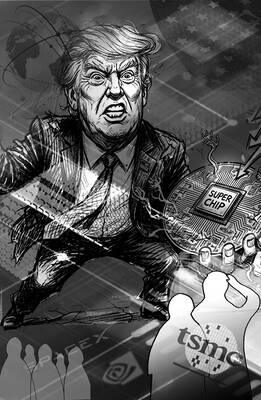
The White House’s decision to take a 9.9 percent stake in Intel Corp is looking like very shrewd business indeed. Since the government bought in at US$20.47 a share last August, the US chipmaker’s surging stock price has delivered the US a US$43 billion return. One of the reasons the investment has so far proved so sound is that the White House has made sure of it. According to The Wall Street Journal, Howard personally pushed deals on Intel’s behalf with some of the most lucrative clients imaginable. They include Nvidia Corp, the company at the heart of the AI
A single photograph can cut through a lot of noise, but it can also be used to misrepresent the truth. At the very least, it can concentrate the mind on something that requires further investigation. On Monday last week, Ma Ying-jeou Foundation CEO Tai Hsia-ling (戴遐齡) and former National Security Council secretary-general King Pu-tsung (金溥聰) held a news conference in which they showed a photograph of former foundation CEO Hsiao Hsu-tsen (蕭旭岑), now Chinese Nationalist Party (KMT) deputy chairman. In the image Hsiao is seated next to Xiamen Taiwan Businessmen Association chairman Han Ying-huan (韓螢煥). The two men were holding
I first met Professor Ray Jiing (井迎瑞) as a film and documentary student at Shih Hsin University’s (SHU) Department of Radio Television and Film in 1988. The following year, he went on to become the director of the Chinese Taipei Film Archive — forerunner of the Taiwan Film and Audiovisual Institute (TFAI). Over his eight-year tenure, Jiing rescued and restored over 200 classic Taiwanese films. In 1997, he established the Graduate Institute of Studies in Documentary and Film Archiving at Tainan National University of the Arts (TNNUA), and I joined the program in his third cohort of students. Beyond a
A recent report concerning a student who is suing his teacher posed the question in its headline: Does failing a student in two subjects constitute bullying? The college student in Chiayi County apparently sought NT$2 million (US$63,603) in state compensation, but a court dismissed the case. The first reaction of many might have been to ask: What has happened to students nowadays? Some say that teachers have lost their authority, while others say students are overindulged. Some even start reminiscing over the days when “whatever the teacher says goes.” However, the real issue might be overlooked if emotional reactions like that are the


 RSS
RSS