


Not long ago, National Cheng Kung University history professor Wang Wen-hsia (王文霞) compared democracy activist Deng Nan-jung (鄭南榕) to Islamist suicide bombers. The statement attracted a lot of criticism, but in the following discussion it has been said that everyone has a right to their own point of view and we should respect the freedom of expression.
The Cheng Kung University administration is taking a similar approach in its response.
The fact is that every time someone makes a similarly controversial remark, such as when Kuo Mei-chiang (郭美江), a pastor, made discriminatory remarks against homosexuals not long ago, someone will raise the banner of freedom of expression in defense of the remark. While this may seem to be a just and forceful point of view, it is in fact a complete distortion of the meaning of freedom of expression.
First, we must respect freedom of expression, but why should we respect absurd and wrong statements?
The biased position and ignorant arguments in the discriminatory statement against homosexuals by Kuo, or in the statement by Wang comparing Deng — who gave his life in the defense of the freedom of expression — to terrorists, are anti-intellectual and not worthy of our respect.
Whether intentionally or inadvertently, such statements confuse “expression” with “freedom of expression” — two completely different concepts.
Second, responses that are critical of those making such statements do not disrespect their freedom of expression. They have the right to respond to the criticism. True freedom of expression entails debate and criticism; true disrespect for the freedom of expression is what the Chinese Communist Party has displayed in its treatment of Nobel Peace Prize winner Liu Xiaobo (劉曉波) by sending him to jail for expressing views that differ from those of the party.
No one has restricted Kuo or Wang’s right to express their opinions, so how could there be any talk about disrespecting the freedom of expression?
Third, if we were to respect every kind of statement, we would have no standards by which to separate between what is right and what is wrong.
If any kind of statement could be made without any kind of restriction, our value systems would be a mess.
How are we going to strike a balance between guaranteeing the freedom of expression for every single person while at the same time establishing a set of universal values? It is quite easy: Absurd and wrong statements should be allowed, but as soon as they are uttered we should rise as one and expose them to the severest criticism, making such statements a target for public criticism.
This of course means that more people have to speak up and take a stand when they hear absurd statements. It is in this sense that everyone is responsible for protecting the freedom of expression.
Wang Dan is a visiting associate professor at National Tsing Hua University’s College of Humanities and Social Sciences.
Translated by Perry Svensson
Taiwanese pragmatism has long been praised when it comes to addressing Chinese attempts to erase Taiwan from the international stage. “Taipei” and the even more inaccurate and degrading “Chinese Taipei,” imposed titles required to participate in international events, are loathed by Taiwanese. That is why there was huge applause in Taiwan when Japanese public broadcaster NHK referred to the Taiwanese Olympic team as “Taiwan,” instead of “Chinese Taipei” during the opening ceremony of the Tokyo Olympics. What is standard protocol for most nations — calling a national team by the name their country is commonly known by — is impossible for
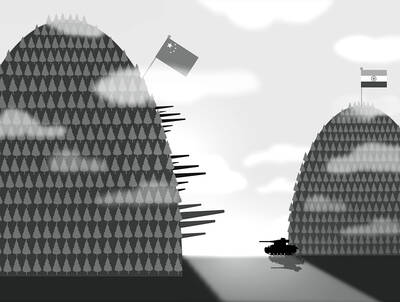
India is not China, and many of its residents fear it never will be. It is hard to imagine a future in which the subcontinent’s manufacturing dominates the world, its foreign investment shapes nations’ destinies, and the challenge of its economic system forces the West to reshape its own policies and principles. However, that is, apparently, what the US administration fears. Speaking in New Delhi last week, US Deputy Secretary of State Christopher Landau warned that “we will not make the same mistakes with India that we did with China 20 years ago.” Although he claimed the recently agreed framework
The Office of the US Trade Representative (USTR) on Wednesday last week announced it is launching investigations into 16 US trading partners, including Taiwan, under Section 301 of the Trade Act of 1974 to determine whether they have engaged in unfair trade practices, such as overproduction. A day later, the agency announced a separate Section 301 investigation into 60 economies based on the implementation of measures to prohibit the importation of goods produced with forced labor. Several of Taiwan’s main trading rivals — including China, Japan, South Korea and the EU — also made the US’ investigation list. The announcements come
Taiwan is not invited to the table. It never has been, but this year, with the Philippines holding the ASEAN chair, the question that matters is no longer who gets formally named, it is who becomes structurally indispensable. The “one China” formula continues to do its job. It sets the outer boundary of official diplomatic speech, and no one in the region has a serious interest in openly challenging it. However, beneath the surface, something is thickening. Trade corridors, digital infrastructure, artificial intelligence (AI) cooperation, supply chains, cross-border investment: The connective tissue between Taiwan and ASEAN is quietly and methodically growing


 RSS
RSS