


Randa, a 22-year-old from Cairo, has been dressing as a teenage boy throughout most of her country’s so-far disastrous two-year “transition” to democracy. The medical student thinks it is the only way to avoid sexual assault on the streets during a period of unprecedented abuse.
Randa (afraid of giving her full name) goes for the vaguely preppie American look of tracksuit bottoms, polo shirt, baseball cap and trainers when she joins a demonstration. It means she can blend in with vast numbers of men and run away if anyone sees through her disguise.
“As a young woman who is politically minded, I am an obvious target for the cowards, but not as a weak-looking boy,” Randa said this weekend, just after statistics in a new Human Rights Watch (HRW) report pointed to an “epidemic of sexual violence.”
Attacks including particularly sadistic rapes have become commonplace in a city that during the Arab spring was seen as the focal point of enlightenment and progress. Well over 100 women have been seriously attacked since the end of June, usually in a manner that is as arbitrary as it is cruel. One woman required surgery after a “sharp object” was forced into her.
“The only thing that the attackers are interested in is that the target is a woman,” Randa said. “It does not matter if she is young or old, or what her background might be — if you are female you are viewed as someone who is worthy of punishment — these violations transcend politics. They represent innate prejudice and hatred. The real problem is that they are getting worse, and more frequent.”
It would be naive to overlook the drastic increase in crime since former Egyptian president Hosni Mubarak was forced out of power in February 2011.
Fifty-one people were murdered in Cairo on Monday morning alone during demonstrations against the removal by military force of Mohamed Morsi, Egypt’s first democratically elected president. Yet there is something particularly disturbing about the rise in taharoch el jinssi — Arabic for sexual harassment — especially as it involves men of all ages and backgrounds.
The incidents laid out by HRW are only the very worst ones. Name-calling and random groping are now the norm, to the extent that they are unlikely to be reported. The really harrowing data are offered by the UN Entity for Gender Equality and the Empowerment of Women, who say that 99.3 percent of Egyptian women have suffered some form of sexual harassment.
Women are advised to travel in groups, to carry personal alarms, to make sure that friends and family know where they are at all times and — as in the case of Randa — even to disguise themselves.
Lara Logan, the South African CBS television reporter, brought the issue to worldwide public attention. She was subjected to an assault on Feb. 11, 2011 — the very day that Mubarak was deposed. It lasted around 25 minutes and involved up to 300 men who had been celebrating victory in Tahrir Square itself. After her attack, Logan returned to the US and spent four days in hospital. None of her tormentors were ever brought to justice. The majority of the crimes outlined in the HRW report also remain unpunished.
Highlighting how these kind of sexual assaults are now relatively normal, survivor Hania Moheed told HRW in a videoed interview: “They made a very tight circle around me, they started moving their hands all over my body, they touched every inch of my body, they violated every inch of my body.”
The reality is that many Egyptian men blame women for bringing attacks upon themselves with their conduct in public. Ahmad Mahmoud Abdullah, a radical Islamic preacher, suggested women protesting in Tahrir Square “have no shame and want to be raped.” In February 2012, members of the Shura Council, Egypt’s upper house of parliament, also blamed women for the assaults being carried out on them in Tahrir Square.
One member, Adel Afifi, said: “Women contribute 100 percent to their rape because they put themselves in that position [to be raped].”
Such comments reflect an arch-conservative belief that women should stay at home with their families rather than engage in the political process — a view that was given official sanction following the election of Morsi, the Muslim Brotherhood candidate, as head of state.
Some have tried to legitimize male “guardianship” by equating gender equality with anti-religious liberalism. Mubarak was a friend to the imperialist US and it was Suzanne Mubarak, the detested and now deposed first lady, who pushed for pro-women legislation, including a wife’s right to sue for divorce and a quota system favoring female election candidates. As the Muslim Brotherhood moved to reverse such measures, these policies became firmly associated with the rejected dictatorship.
Whichever government ends up administering the fledgling, post-revolutionary state of Egypt over the next few months, it is unlikely that controlling the abuse of women will be a priority.
Instead vigilante groups such as Tahrir Bodyguard and Operation Anti-Sexual Harassment (OpAntiSH) offer to discourage attackers usually through strength of numbers, but if necessary by using sticks and belts. It is a rough and potentially inflammatory form of deterrence, but in a country where almost everybody is becoming a victim of some kind it is pretty much all women can hope for.

On March 22, 2023, at the close of their meeting in Moscow, media microphones were allowed to record Chinese Communist Party (CCP) dictator Xi Jinping (習近平) telling Russia’s dictator Vladimir Putin, “Right now there are changes — the likes of which we haven’t seen for 100 years — and we are the ones driving these changes together.” Widely read as Xi’s oath to create a China-Russia-dominated world order, it can be considered a high point for the China-Russia-Iran-North Korea (CRINK) informal alliance, which also included the dictatorships of Venezuela and Cuba. China enables and assists Russia’s war against Ukraine and North Korea’s
After thousands of Taiwanese fans poured into the Tokyo Dome to cheer for Taiwan’s national team in the World Baseball Classic’s (WBC) Pool C games, an image of food and drink waste left at the stadium said to have been left by Taiwanese fans began spreading on social media. The image sparked wide debate, only later to be revealed as an artificially generated image. The image caption claimed that “Taiwanese left trash everywhere after watching the game in Tokyo Dome,” and said that one of the “three bad habits” of Taiwanese is littering. However, a reporter from a Japanese media outlet
Taiwanese pragmatism has long been praised when it comes to addressing Chinese attempts to erase Taiwan from the international stage. “Taipei” and the even more inaccurate and degrading “Chinese Taipei,” imposed titles required to participate in international events, are loathed by Taiwanese. That is why there was huge applause in Taiwan when Japanese public broadcaster NHK referred to the Taiwanese Olympic team as “Taiwan,” instead of “Chinese Taipei” during the opening ceremony of the Tokyo Olympics. What is standard protocol for most nations — calling a national team by the name their country is commonly known by — is impossible for
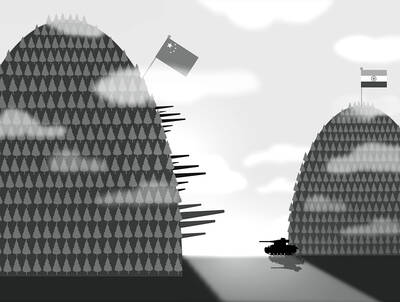
India is not China, and many of its residents fear it never will be. It is hard to imagine a future in which the subcontinent’s manufacturing dominates the world, its foreign investment shapes nations’ destinies, and the challenge of its economic system forces the West to reshape its own policies and principles. However, that is, apparently, what the US administration fears. Speaking in New Delhi last week, US Deputy Secretary of State Christopher Landau warned that “we will not make the same mistakes with India that we did with China 20 years ago.” Although he claimed the recently agreed framework


 RSS
RSS