


A fresh round of altercations over media monopolization broke out this week as a Macau-based professor and a media outlet accused a Taiwanese graduate student of having misled renowned US academic Noam Chomsky to gain the linguist’s endorsement for the movement against media monopolization and Chinese influence on Taiwan’s media.
An image of the 84-year-old Massachusetts Institute of Technology professor posing with a poster that read: “Anti-Media Monopoly. Say no to China’s black hands, defend press freedom. I am safeguarding Taiwan here in MIT,” was posted on Facebook, giving the local movement a morale boost.
University of Macau associate communications professor Liu Shih Diing (劉世鼎) was quoted by the Chinese-language China Times — owned by Want Want China Times Group, which is part of the consortium that bought Next Media Group’s four Taiwanese media outlets — as saying that Chomsky was not informed about the anti-China part of the cause and had been tricked by Taiwanese student Lin Ting-an (林庭安) into holding the sign.
The report prompted Lin to release her initial correspondence with Chomsky to rebut Liu’s claim, which also said that the advocates had wrongly connected the movement against media monopolization with concerns over Chinese influence over the media. US media have had much greater influence on Taiwanese, but no one opposes the US’ influence, Liu said.
Those who said that Chinese influence was not a concern have cited Taiwan’s high ranking in the global press freedom index as evidence, saying the nation ranked 47th — and first among Asian countries — in the latest World Press Freedom Index, released by Reporters Without Borders. A free country like Taiwan, they said, would not be easily influenced by any one country.
Want Want China Times Group chairman Tsai Eng-meng (蔡衍明) has brushed off concerns over his pro-China position and the source of his investment funds, saying that he has not taken a single penny from the Chinese government.
On the other side of the spectrum, concerns over China’s influence on Taiwan’s media, as well as the “Chinese cultural invasion,” which can be seen and felt in a wide range of areas, such as show business and the publishing industry, were raised by netizens, academics and democracy advocates.
In an article published on Christmas Day last year, Academia Sinica research fellow Wu Jieh-min (吳介民) went so far as to describe last year as the “First Year of the China Factor” because Beijing’s influence and fingerprints were everywhere — from the presidential election to the media merger deals.
Even though the Chinese influence has been felt among Taiwanese, opponents of China gaining control over local media outlets have had trouble proving that any significant influence exists, in particular on a legal basis, since the principle of presumption of innocence should be upheld in any democracy.
The government said there was no evidence that Tsai had received funding from Beijing and that Taiwan’s democracy was strong enough to withstand Beijing’s united front strategy and cultural invasion.
Ironically, the dilemma showed why China’s more sophisticated united front strategy and softer approach against Taiwan is a legitimate concern and how well it has been working.
The invisible impact, which has been felt, but could not be proved, was perfectly summarized by Sun Tzu (孫子) in The Art of War: “To subdue the enemy without fighting is the acme of skill.”
The dilemma also shows how much harder those who care about safeguarding Taiwan’s democracy and freedom will have to work from now on, because they can no longer locate the enemy as easily as before, when they could easily cite the more than 1,000 missiles directed at Taiwan.
A gap appears to be emerging between Washington’s foreign policy elites and the broader American public on how the United States should respond to China’s rise. From my vantage working at a think tank in Washington, DC, and through regular travel around the United States, I increasingly experience two distinct discussions. This divergence — between America’s elite hawkishness and public caution — may become one of the least appreciated and most consequential external factors influencing Taiwan’s security environment in the years ahead. Within the American policy community, the dominant view of China has grown unmistakably tough. Many members of Congress, as
The Hong Kong government on Monday gazetted sweeping amendments to the implementation rules of Article 43 of its National Security Law. There was no legislative debate, no public consultation and no transition period. By the time the ink dried on the gazette, the new powers were already in force. This move effectively bypassed Hong Kong’s Legislative Council. The rules were enacted by the Hong Kong chief executive, in conjunction with the Committee for Safeguarding National Security — a body shielded from judicial review and accountable only to Beijing. What is presented as “procedural refinement” is, in substance, a shift away from
The shifting geopolitical tectonic plates of this year have placed Beijing in a profound strategic dilemma. As Chinese President Xi Jinping (習近平) prepares for a high-stakes summit with US President Donald Trump, the traditional power dynamics of the China-Japan-US triangle have been destabilized by the diplomatic success of Japanese Prime Minister Sanae Takaichi in Washington. For the Chinese leadership, the anxiety is two-fold: There is a visceral fear of being encircled by a hardened security alliance, and a secondary risk of being left in a vulnerable position by a transactional deal between Washington and Tokyo that might inadvertently empower Japan
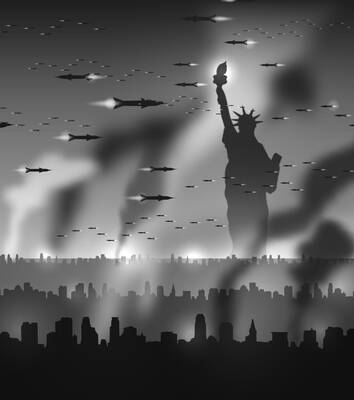
After declaring Iran’s military “gone,” US President Donald Trump appealed to the UK, France, Japan and South Korea — as well as China, Iran’s strategic partner — to send minesweepers and naval forces to reopen the Strait of Hormuz. When allies balked, the request turned into a warning: NATO would face “a very bad” future if it refused. The prevailing wisdom is that Trump faces a credibility problem: having spent years insulting allies, he finds they would not rally when he needs them. That is true, but superficial, as though a structural collapse could be caused by wounded feelings. Something


 RSS
RSS