


President Ma Ying-jeou (馬英九) has always been very fond of numbers, like a scientist or the chief executive of a Fortune 500 company.
He likes numbers so much that when presenting campaign strategies, such as his famous “6-3-3” campaign pledge and the “i-Taiwan 12 projects,” he explained almost everything using 16 Chinese characters or less and tends to describe his achievements using Taiwan’s world ranking according to various reports. This approach makes sense, as numbers are often easier to understand than a 1,000-word text explaining government policies.
Recently, Ma proudly announced that Taiwan ranks 13th in the World Bank’s Knowledge Economy Index and seventh in the International Institute for Management Development World Competitiveness rankings this year, showing that Taiwan has great potential and “there is no reason to hang our heads low.”
However, “good” numbers only tell part of the story, as Taiwan also finished next-to-last in the world last year in terms of direct foreign investment, according to the UN Conference on Trade and Development, and by now most people also know that the Ma administration has posted some of the worst unemployment rates and export numbers on record, and that the total national debt, including hidden debt, has surpassed NT$15 trillion (US$513 billion).
As people scratch their heads and try to figure out Ma’s obsession with numbers and 16-character policy explanations, it seems that he has forgotten two of the most important numbers in Taiwan today — 9 million and 600,000: All-out class conflict appears to be brewing between the 9 million private-sector workers and the 600,000 active and retired public servants, who include military personnel, civil servants and public school teachers.
Private-sector workers have accused public servants of being the government’s “favorite sons,” since public servants enjoy a string of benefits which are either unfair, such as the 18 percent preferential interest rate, or are unsupported by law, such as the year-end pension bonus. By contrast, a series of measures implemented by the government this year, namely fuel and electricity price increases, the decision not to raise the minimum monthly wage and the recent insurance fund controversy, have further added to private-sector workers’ financial vulnerability.
Public servants claim they have long made sacrifices for the country with decades of dedicated service, adding that they have endured long periods of lower wages and minimal benefits which make their extra subsidies reasonable.
Both sides claim the hostility has been fueled by discrimination and hatred toward the other group.
The leader of the nation is obligated by the Constitution to take care of all people, regardless of their gender, class, profession or ethnicity. Unfortunately, despite the Cabinet limiting the year-end bonus to two groups of less-privileged retired public servants in order to quell public anger, the Ma administration has done nothing beyond this token measure of damage control to resolve the crisis.
Nor has Ma personally addressed the issue in a public setting to reassure the 9 million private-sector workers that they will be taken care of.
Taiwan used to be a country with one of the smallest wealth gaps. Workers who staged a protest last weekend in front of the Presidential Office did not ask for a reduction in this gap. They only asked to be treated fairly and for light at the end of the tunnel.
Ma should forget about the numbers for now and try to be — as he has said — “sensible” to people’s suffering and sensitive to the worsening social divide between the 9 million and the 600,000.
This situation will be resolved not by mathematics, but by chemistry, and Ma has to step forward and shoulder the responsibility.
A gap appears to be emerging between Washington’s foreign policy elites and the broader American public on how the United States should respond to China’s rise. From my vantage working at a think tank in Washington, DC, and through regular travel around the United States, I increasingly experience two distinct discussions. This divergence — between America’s elite hawkishness and public caution — may become one of the least appreciated and most consequential external factors influencing Taiwan’s security environment in the years ahead. Within the American policy community, the dominant view of China has grown unmistakably tough. Many members of Congress, as
The Hong Kong government on Monday gazetted sweeping amendments to the implementation rules of Article 43 of its National Security Law. There was no legislative debate, no public consultation and no transition period. By the time the ink dried on the gazette, the new powers were already in force. This move effectively bypassed Hong Kong’s Legislative Council. The rules were enacted by the Hong Kong chief executive, in conjunction with the Committee for Safeguarding National Security — a body shielded from judicial review and accountable only to Beijing. What is presented as “procedural refinement” is, in substance, a shift away from
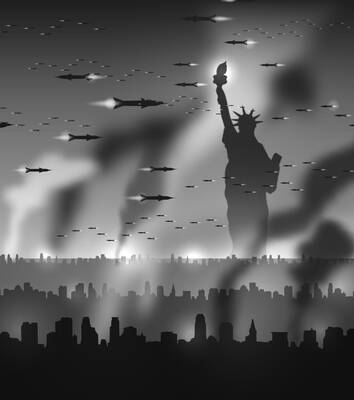
After declaring Iran’s military “gone,” US President Donald Trump appealed to the UK, France, Japan and South Korea — as well as China, Iran’s strategic partner — to send minesweepers and naval forces to reopen the Strait of Hormuz. When allies balked, the request turned into a warning: NATO would face “a very bad” future if it refused. The prevailing wisdom is that Trump faces a credibility problem: having spent years insulting allies, he finds they would not rally when he needs them. That is true, but superficial, as though a structural collapse could be caused by wounded feelings. Something
The shifting geopolitical tectonic plates of this year have placed Beijing in a profound strategic dilemma. As Chinese President Xi Jinping (習近平) prepares for a high-stakes summit with US President Donald Trump, the traditional power dynamics of the China-Japan-US triangle have been destabilized by the diplomatic success of Japanese Prime Minister Sanae Takaichi in Washington. For the Chinese leadership, the anxiety is two-fold: There is a visceral fear of being encircled by a hardened security alliance, and a secondary risk of being left in a vulnerable position by a transactional deal between Washington and Tokyo that might inadvertently empower Japan


 RSS
RSS