


As Taiwan gears up for its next legislative and presidential elections scheduled for Jan. 14, the debates about domestic and foreign policy issues are also heating up.
While many voters will decide for whom to cast their ballot on the basis of such issues as the economy, jobs, social welfare and good governance, one issue that weighs heavily on the minds of US policymakers is how the outcome of the vote will affect Taiwan’s relations with China.
As I wrote in an earlier article, the present “reduction of tension” is artificial in nature, as it is predicated on policies that give China the impression that Taiwan is moving toward China, increasing the belief that at some time in the not too distant future Beijing will be able to force Taiwan into some kind of political unification (“The myth about reducing tension,” May 14, 2010, page 8).
Taiwan has brought about this temporary reduction of tension through a policy of rapprochement which has focused on “easier” agreements on exchanges, tourism, cross-strait flights, etc, culminating in the Economic Cooperation Framework Agreement (ECFA), while the more “difficult” issues, such as sovereignty and political ties, are being postponed.
While these agreements may have given Taiwan some respite, they were also controversial, as in the eyes of critics they have tied the nation too closely to China. In other words, they effectively gave Beijing more leverage over Taiwan, while decreasing the nation’s room to maneuver internationally.
In particular, one concept that has been used as a basis for this rapprochement needs to be revisited: the so-called “1992 consensus.” The phrase itself sounds innocuous enough: Both sides acknowledge that there is “one China,” with each side retaining its own interpretation of what “one China” means.
However, the concept is controversial because former president Lee Teng-hui (李登輝) has said that there never was such a consensus and China has never acknowledged that it accepts different interpretations.
Instead of continuing to battle over this term in the run-up to the elections, it would be better for the political parties in Taiwan to come up with a longer-term consensus that focuses exclusively on Taiwan.
Taiwanese are rightfully proud of their democratic achievements and these accomplishments need to be defended.
Such a “Taiwan consensus” could include the following elements: One, Taiwan is a free nation and its democracy needs to be protected. Two, Taiwan wants to live in peace with all its neighbors. This also means that these neighbors need to respect Taiwan’s sovereignty. Three, Taiwan aspires to be a vibrant member of the international community and asks to be accepted as such. Four, relations with China need to be transparent, conducted on an equal footing, without the threat of force.
In view of the significant differences between the political and social systems in Taiwan and China, it cannot be expected that Beijing will easily accept Taiwan for what it is — a lively democracy that wants to chart its own course and determine its own future without undue pressure from China. Indeed, Taiwan’s mere existence as a democracy is a thorn in Beijing’s side.
That is why it is essential that the US and other democratic friends of Taiwan make it crystal clear that they will stand by the nation when it exercises its newfound freedom to elect a new legislature and president in January.
Only then can a true reduction of tension across the Taiwan Strait be achieved.
Nat Bellocchi is a former chairman of the American Institute in Taiwan and a special adviser to the Liberty Times Group. The views expressed in this article are his own.
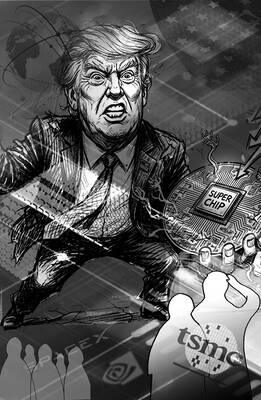
The White House’s decision to take a 9.9 percent stake in Intel Corp is looking like very shrewd business indeed. Since the government bought in at US$20.47 a share last August, the US chipmaker’s surging stock price has delivered the US a US$43 billion return. One of the reasons the investment has so far proved so sound is that the White House has made sure of it. According to The Wall Street Journal, Howard personally pushed deals on Intel’s behalf with some of the most lucrative clients imaginable. They include Nvidia Corp, the company at the heart of the AI
A single photograph can cut through a lot of noise, but it can also be used to misrepresent the truth. At the very least, it can concentrate the mind on something that requires further investigation. On Monday last week, Ma Ying-jeou Foundation CEO Tai Hsia-ling (戴遐齡) and former National Security Council secretary-general King Pu-tsung (金溥聰) held a news conference in which they showed a photograph of former foundation CEO Hsiao Hsu-tsen (蕭旭岑), now Chinese Nationalist Party (KMT) deputy chairman. In the image Hsiao is seated next to Xiamen Taiwan Businessmen Association chairman Han Ying-huan (韓螢煥). The two men were holding
I first met Professor Ray Jiing (井迎瑞) as a film and documentary student at Shih Hsin University’s (SHU) Department of Radio Television and Film in 1988. The following year, he went on to become the director of the Chinese Taipei Film Archive — forerunner of the Taiwan Film and Audiovisual Institute (TFAI). Over his eight-year tenure, Jiing rescued and restored over 200 classic Taiwanese films. In 1997, he established the Graduate Institute of Studies in Documentary and Film Archiving at Tainan National University of the Arts (TNNUA), and I joined the program in his third cohort of students. Beyond a
A recent report concerning a student who is suing his teacher posed the question in its headline: Does failing a student in two subjects constitute bullying? The college student in Chiayi County apparently sought NT$2 million (US$63,603) in state compensation, but a court dismissed the case. The first reaction of many might have been to ask: What has happened to students nowadays? Some say that teachers have lost their authority, while others say students are overindulged. Some even start reminiscing over the days when “whatever the teacher says goes.” However, the real issue might be overlooked if emotional reactions like that are the


 RSS
RSS