


In his article “Good education, made in Taiwan” (July 9, page 8), Bill Costello suggests ways that the US could learn from Taiwan’s educational system. Costello raised some excellent points, but I would caution against the suggestion that Taiwan serve as a model for education in the US.
Costello notes that Taiwanese students do well in math and science, but what about other crucial subjects?
Taiwanese students do well where rote learning is involved, but their independent thought and critical thinking skills leave much to be desired.
Ask a child to add numbers or repeat information and you’ll be amazed at their performance. But ask that same child to form an opinion or draw a conclusion about something and you’re likely to be met with a blank stare.
Students are taught to regurgitate information and are not encouraged to ask questions or apply logic to deduce things for themselves. Tests do not challenge their capacity for creative thinking, but rather check what they have memorized.
Costello suggests the US serve more nutritious lunches, keep students more active and use hands-on interdisciplinary learning. These are all great suggestions, but he also says the US should adopt the practice in Taiwan of requiring public school students to wear uniforms.
Making students don uniforms fits in with the simple input-output instruction employed at Taiwanese schools. Although Costello doesn’t mention it, each student is assigned a number. Students don’t have their names stitched onto their uniforms but their numbers.
This has the effect of discouraging individuality and independent thought. If this is our goal, school uniforms are a superb idea. But if that’s not what we’re shooting for, it is difficult to imagine what benefit uniforms could possibly bring.
Costello writes: “Studies show that school uniforms raise academic performance, while lowering violence, theft and the negative effects of peer pressure.”
I’m skeptical of this claim. What studies is he referring to and what methodology did they employ? How did they eliminate the countless variables that affect academic performance?
The suggestion that putting your son or daughter in a uniform increases his or her chances of performing well at school is ridiculous.
Likewise, we should not think students’ misbehavior is the result of allowing them to choose their own attire.
As for peer pressure, this is part and parcel of the experience of growing and learning, and prepares children for the “real world.”
Costello suggests Taiwanese students are taught more personal responsibility than their US counterparts, citing as evidence the daily cleaning ritual at schools. The question is whether they practice “personal responsibility” outside that ritual.
Students in my new classes have tended to be so messy that I had to clean up the classroom after every lesson. But my students were not incurable. I instilled a sense of responsibility in them not through a cleaning “ritual,” but by asking mess students questions such as how they would feel if the student who used their desk before them had left used tissues in it.
I explained the importance of respecting our shared space and each other. I discussed how our actions affect others, challenged students to think of examples and demonstrated the practicality of applying the golden rule in their daily lives.
When you speak to children as equals, allow them to express themselves, foster their curiosity, promote critical thinking and seek their opinions, the results are truly rewarding.
The effects of doing the opposite are less than desirable.
I agree with Costello that US schools need improvement and Taiwanese schools perform better in some respects. However, Taiwan’s educational system is in dire need of attention before we start touting it as a model for others.
Jeremy R. Hammond has taught English as a second language in Taiwan for seven years.
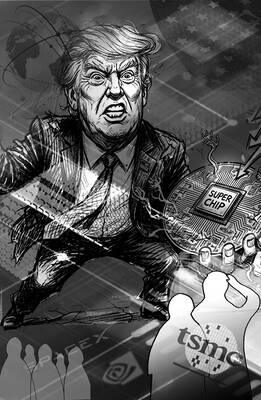
The White House’s decision to take a 9.9 percent stake in Intel Corp is looking like very shrewd business indeed. Since the government bought in at US$20.47 a share last August, the US chipmaker’s surging stock price has delivered the US a US$43 billion return. One of the reasons the investment has so far proved so sound is that the White House has made sure of it. According to The Wall Street Journal, Howard personally pushed deals on Intel’s behalf with some of the most lucrative clients imaginable. They include Nvidia Corp, the company at the heart of the AI
A single photograph can cut through a lot of noise, but it can also be used to misrepresent the truth. At the very least, it can concentrate the mind on something that requires further investigation. On Monday last week, Ma Ying-jeou Foundation CEO Tai Hsia-ling (戴遐齡) and former National Security Council secretary-general King Pu-tsung (金溥聰) held a news conference in which they showed a photograph of former foundation CEO Hsiao Hsu-tsen (蕭旭岑), now Chinese Nationalist Party (KMT) deputy chairman. In the image Hsiao is seated next to Xiamen Taiwan Businessmen Association chairman Han Ying-huan (韓螢煥). The two men were holding
I first met Professor Ray Jiing (井迎瑞) as a film and documentary student at Shih Hsin University’s (SHU) Department of Radio Television and Film in 1988. The following year, he went on to become the director of the Chinese Taipei Film Archive — forerunner of the Taiwan Film and Audiovisual Institute (TFAI). Over his eight-year tenure, Jiing rescued and restored over 200 classic Taiwanese films. In 1997, he established the Graduate Institute of Studies in Documentary and Film Archiving at Tainan National University of the Arts (TNNUA), and I joined the program in his third cohort of students. Beyond a
A recent report concerning a student who is suing his teacher posed the question in its headline: Does failing a student in two subjects constitute bullying? The college student in Chiayi County apparently sought NT$2 million (US$63,603) in state compensation, but a court dismissed the case. The first reaction of many might have been to ask: What has happened to students nowadays? Some say that teachers have lost their authority, while others say students are overindulged. Some even start reminiscing over the days when “whatever the teacher says goes.” However, the real issue might be overlooked if emotional reactions like that are the


 RSS
RSS