


Two government policies have been halted recently -- the establishment of private arms company Taiwan Goal and the privatization of the Grand Hotel. After these measures became public, they were questioned by the media and criticized by the opposition, which led the government to abandon the plans to avoid difficulties ahead of the presidential elections.
Taiwan's defense purchases have always been handled through official channels. Given Taiwan's unusual international situation, official purchases have always been problematic, which led the government and private parties to set up Taiwan Goal to act as a go-between. This would have allowed Taiwan the flexibility to obtain the necessary weapons and defense technology faster and cheaper. Many other countries use similar systems.
Taiwan Goal was stillborn, and if the idea of privatized arms purchases hasn't been abandoned for good, it has at least been postponed for a long time. This is harmful to Taiwan as a whole and a very high price was paid when minister of national defense Lee Tien-yu (
The Grand Hotel has always been managed by the Duen Mou Foundation (
These are good policies. Even if the current government can't implement them, a future government will. The opportunity will be missed simply because neither side wants the other to score any extra points in the run-up to the presidential election.
For eight years, Taiwan has been treading water, and a slack government and an unreasonable opposition are the main reasons these opportunities are slipping away.
Although the Cabinet believes these policies should be carried out, any positive policy should have been implemented long ago instead of being rushed through when the government's time seems to be running out. These and many other things have been left undone because of the government's wavering, the speed with which political appointees have been replaced, the brevity of their terms and the resulting lack of comprehensive, long-term policy.
The KMT insists that the Cabinet is a caretaker body that should abstain from making any major policy changes. This may make some sense, but why let an opportunity slip by if both the DPP and the KMT agree that these are positive policies? Because the policies involve vested interests -- both the Grand Hotel and arms dealing have long been part of the KMT's sphere of influence and the KMT doesn't want the DPP to stick its nose in there, nor does it want to see the DPP score political points.
The KMT's unwillingness to see any DPP accomplishments and the resulting legislative obstruction is one of the main reasons for Taiwan's slow progress since 2000. The presidential election is an opportunity for Taiwanese to express whether they think the problems were due to a slack government or an unreasonable opposition.
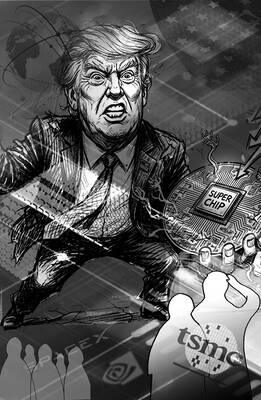
The White House’s decision to take a 9.9 percent stake in Intel Corp is looking like very shrewd business indeed. Since the government bought in at US$20.47 a share last August, the US chipmaker’s surging stock price has delivered the US a US$43 billion return. One of the reasons the investment has so far proved so sound is that the White House has made sure of it. According to The Wall Street Journal, Howard personally pushed deals on Intel’s behalf with some of the most lucrative clients imaginable. They include Nvidia Corp, the company at the heart of the AI
A single photograph can cut through a lot of noise, but it can also be used to misrepresent the truth. At the very least, it can concentrate the mind on something that requires further investigation. On Monday last week, Ma Ying-jeou Foundation CEO Tai Hsia-ling (戴遐齡) and former National Security Council secretary-general King Pu-tsung (金溥聰) held a news conference in which they showed a photograph of former foundation CEO Hsiao Hsu-tsen (蕭旭岑), now Chinese Nationalist Party (KMT) deputy chairman. In the image Hsiao is seated next to Xiamen Taiwan Businessmen Association chairman Han Ying-huan (韓螢煥). The two men were holding
I first met Professor Ray Jiing (井迎瑞) as a film and documentary student at Shih Hsin University’s (SHU) Department of Radio Television and Film in 1988. The following year, he went on to become the director of the Chinese Taipei Film Archive — forerunner of the Taiwan Film and Audiovisual Institute (TFAI). Over his eight-year tenure, Jiing rescued and restored over 200 classic Taiwanese films. In 1997, he established the Graduate Institute of Studies in Documentary and Film Archiving at Tainan National University of the Arts (TNNUA), and I joined the program in his third cohort of students. Beyond a
A recent report concerning a student who is suing his teacher posed the question in its headline: Does failing a student in two subjects constitute bullying? The college student in Chiayi County apparently sought NT$2 million (US$63,603) in state compensation, but a court dismissed the case. The first reaction of many might have been to ask: What has happened to students nowadays? Some say that teachers have lost their authority, while others say students are overindulged. Some even start reminiscing over the days when “whatever the teacher says goes.” However, the real issue might be overlooked if emotional reactions like that are the


 RSS
RSS