


One might question the appropriateness of presenting a dagger to Thai King Bhumibol Adulyadej, to mark his 60th year on the throne next month.
The gesture sounds doubly suspect when the weapon is coming from villages in Thailand's troubled deep south, where more than 1,200 people have died in government crackdowns, revenge killings, explosions and beheadings since January 2004.
But in Balukaluwa village in Raman district of Yala Province the special gift of a hand-crafted kris makes perfect cultural sense.
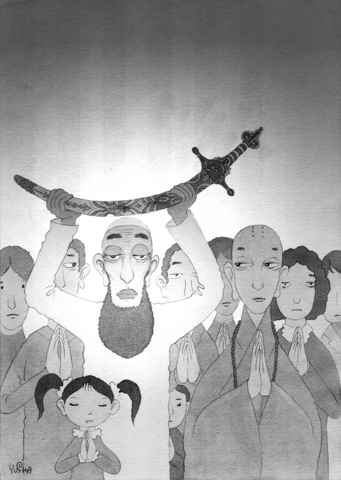
"Traditionally, the kris was the personal weapon of the sultan. It should only be worn by someone with great power," said Sakon Yotmannee, a Raman district officer who will preside over a competition planned for Sunday.
At least 20 artisans from Balukaluwa and other southern towns will enter the contest to choose the region's first kris fit for a king.
The winning weapon will be presented to King Bhumibol to celebrate the 60th anniversary of his ascension to the throne on June 9, 1946.
The kris is a small dagger with a wavy blade whose cultural roots are in Malaysia and Indonesia, where the weapon has long been a symbol of virility and strength.
The dagger, and the fairly sophisticated metallurgy technology that goes in to making it, might have completely died out in Thailand's deep south if not for the royal family.
"The art of kris making disappeared in Thailand for a generation," said Teepalee Atabu, one of the new generation of kris makers in Raman district.
Teepalee secretly studied kris-making with his "guru," Tuan Bukut Long Salee, one of the last Raman kris artisans who died two years ago.
Teepalee was teaching kris-making as part of a vocational training course held at the Chang Hai Buddhist temple in nearby Narathiwat in 1999, when the famed place of worship was visited by Thai Queen Sirikit.
"When she visited the temple and saw villagers studying kris-making, she encouraged the government officials to help us preserve the art as an important handicraft," Teepalee recalled.
Since that royal visit, nobody has prevented southern villagers from kris-making, even though the production remains illegal under Thai law.
The Raman district was formerly famed for its kris artisans, who sold their products in Pattani, Narathiwat and Yala -- Thailand's three, majority Muslim, southernmost provinces -- but also across the border in Malaysia.
Kris-making was banned in the area during World War II, under the iron-fisted rule of Thailand's military dictator Field Marshal Plaek Pibulsongkhram.
Plaek, an ultra-nationalist, outlawed all forms of weapon-making in the troubled southern provinces while also forcing residents to stop wearing Malay sarongs and speaking the Yawi (Malaysian) language in an effort to impose Thai culture on the area.
The deep south, once an independent Islamic sultanate, was first conquered by Bangkok in 1786, but only came under direct rule of the Thai bureaucracy in 1902.
A separatist struggle has simmered in the area for decades, fueled by the local population's sense of religious and cultural alienation from the predominantly Buddhist Thai state that remains today.
Kris-making, although more an offspring of Brahmanism than Islam, remains an essential aspect of the deep south's Malay identity.
Ironically, kris-making technology is also threatened in Malaysia and Indonesia, which may prove good news for the new kris artisans of Raman district.
"Many merchants from Malaysia come here to buy our krises," Teepalee said. "But we're hoping that after the competition in Yala we can form a kris-making association that we can use to pool our resources to help market the krises abroad."
And it appears that the violence in the region has yet to cut into the kris business.
"The violence has had no impact on sales because the villagers here can't make enough krises to keep up with demand," district officer Sakon said.
He acknowledged, however, that fewer buyers had visited the area over the past two years so it would be best for the villagers to begin marketing their products themselves.

A gap appears to be emerging between Washington’s foreign policy elites and the broader American public on how the United States should respond to China’s rise. From my vantage working at a think tank in Washington, DC, and through regular travel around the United States, I increasingly experience two distinct discussions. This divergence — between America’s elite hawkishness and public caution — may become one of the least appreciated and most consequential external factors influencing Taiwan’s security environment in the years ahead. Within the American policy community, the dominant view of China has grown unmistakably tough. Many members of Congress, as
The Hong Kong government on Monday gazetted sweeping amendments to the implementation rules of Article 43 of its National Security Law. There was no legislative debate, no public consultation and no transition period. By the time the ink dried on the gazette, the new powers were already in force. This move effectively bypassed Hong Kong’s Legislative Council. The rules were enacted by the Hong Kong chief executive, in conjunction with the Committee for Safeguarding National Security — a body shielded from judicial review and accountable only to Beijing. What is presented as “procedural refinement” is, in substance, a shift away from
The shifting geopolitical tectonic plates of this year have placed Beijing in a profound strategic dilemma. As Chinese President Xi Jinping (習近平) prepares for a high-stakes summit with US President Donald Trump, the traditional power dynamics of the China-Japan-US triangle have been destabilized by the diplomatic success of Japanese Prime Minister Sanae Takaichi in Washington. For the Chinese leadership, the anxiety is two-fold: There is a visceral fear of being encircled by a hardened security alliance, and a secondary risk of being left in a vulnerable position by a transactional deal between Washington and Tokyo that might inadvertently empower Japan

After declaring Iran’s military “gone,” US President Donald Trump appealed to the UK, France, Japan and South Korea — as well as China, Iran’s strategic partner — to send minesweepers and naval forces to reopen the Strait of Hormuz. When allies balked, the request turned into a warning: NATO would face “a very bad” future if it refused. The prevailing wisdom is that Trump faces a credibility problem: having spent years insulting allies, he finds they would not rally when he needs them. That is true, but superficial, as though a structural collapse could be caused by wounded feelings. Something


 RSS
RSS