


It's a sunny afternoon in the chic environs of Kensington High Street, west London. All around us four-wheel drives trundle and roar, basking in their natural habitat. But these motoring behemoths hold no fear for councillor Daniel Moylan, who steps into the traffic with confidence.
"Chelsea tractors," he declares, are no longer kings of the road, but mere coinhabiters, with pedestrians, of a more egalitarian streetscene.
Two years ago, as cabinet member for transport and deputy leader of the Conservative-run royal borough of Kensington and Chelsea, he initiated a ?4 million (US$7.1 million) scheme aimed at restraining the dominance of the car, adopting the minimalist approach to street safety pioneered by the Dutch traffic engineering guru Hans Monderman.
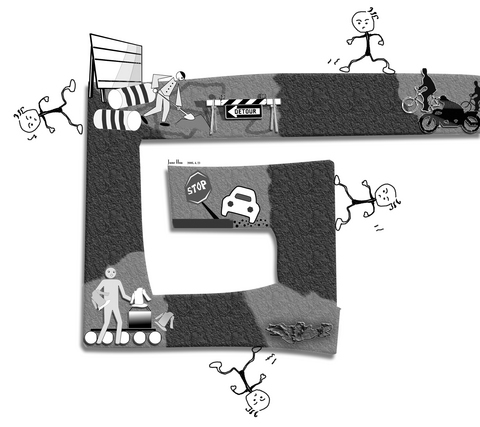
"When I took control of transport in 2000 the high street was a fragmented place full of guard rails and staggered crossings that just made getting across the road difficult," he says. "It seemed traffic always got priority."
The council embarked on a programme of works that involved "decluttering" its flagship high street of "furniture" that was originally installed to protect pedestrians. Guard railings between pavement and road were stripped away, kerbs were removed at junctions, and the number of street signs was reduced.
Aesthetics were partly behind the changes -- the street is now clad in York stone and granite -- but public safety was the other motivation and accident figures out today seem to justify the council's initiative. Figures for 1998 to 2000, before the changes, show there were 70 casualties on the high street, including eight people killed or seriously injured and 62 suffering slight injuries.
In the two years from September 2003 to August 2005 there have been 40 casualties (four killed or seriously injured) and 36 slight injuries -- a 43 percent decrease.
These interim results seem impressive even when set against a London-wide trend that shows casualties across the capital down over 17 percent in the same period, and down 35 percent across the whole borough. There are caveats: the comparison periods are slightly different and the figures are small in statistical terms so that a difference of one or two casualties has a disproportionate affect on the overall results.
But a report by Graeme Swinburne, the borough's director of transportation and highways, concludes that the initial results are encouraging.
"[They] indicate that the innovative approach to design and layout, and the type of materials, street furniture and equipment used, has not had an adverse effect on safety, and may have contributed to a slightly higher overall percentage reduction than that for the royal borough as a whole," Swinburne said.
Moylan, tall and pink-cheeked, is a Tory of the no-nonsense school with mischievous views punctuated with: "Don't quote me." For him the figures are a vindication of his belief in a self-help attitude to street safety -- take away the railings of the nanny state and you will create a new equanimity between the pedestrian, the driver and the cyclist.
He says council officers were initially reluctant to back the scheme. While its engineers and traffic officials were supportive of the proposals, they felt unable to actively endorse them "for fear of professional liability."
However, they indicated they were happy to go along with them as long as there was no paper trail back to them out of concern for "what happens when a child gets killed."
Moylan has more grandiose plans for a pedestrian-centric Sloane Square at the centre of the borough, and has courted controversy with disability rights groups by proposing a ?25 million lottery-funded redesign of London's museum mile, Exhibition Road, to sweep away all delineation between pavement and road surfaces.
Richard Simmons, the chief executive of the Commission for the Built Environment, says Kensington is to be congratulated on what seem to be promising results, which have improved both the aesthetic of the street and safety. But he feels that an ultra-minimalist Monderman approach would not be welcomed by wheelchair users or those with sight problems or other disabilities.
"If you are blind you have to have a mental map of the places you go, and that map has to mean tactile surfaces and edges," he said.
According to Simmons, not many councils are prepared to take the plunge on decluttering the streetscape. He cites the area around London's Waterloo railway station as in desperate need of help.
"I used to have responsibility for transport in a local authority and there is no more risk-averse, insurance-oriented group of people than local authority officers," he said.
Redesigning streetscapes is "all about changing the balance of power away from the motorist, slowing them down and putting them on the same level as other road users, the pedestrian, the cyclist and disabled groups. People tend to be less inclined to kill you if they have looked you in the eye," he says.
But the safest streets in every sense of the word are inhabited by the right balance of cars, pedestrians and cyclists.
"Space Syntax, a research company, has suggested that having cars on the streets makes them safer places. Having cars passing at frequent intervals means there is less chance of crime," Simmons says.
Not everyone is convinced. Colin McBane has been selling flowers at the junction of Wrights Lane and Kensington High Street for more than 16 years. He believes the high street is less safe since the changes, which removed the delineating kerb from between his stall and turning traffic.
"Look at this corner. I have seen cars stop and drivers get out and knock pedestrians to the floor. It happened to a friend of mine," he says.
He points to recently repaired paving stones.
"That's where lorries have been parking up on the pavement because there is no kerb to stop them," he says.
But Attila Szabad, who has been selling newspapers outside Kensington High Street subway train station for 18 months, says he has only seen one minor car accident in that time.
"I think it's a good thing. Cars go slowly. I think it's safe," he says.
Moylan says he has his mother to thank for his philosophy. "When cooking she used to say: `You can add salt later but you can never take it out once it is in.' If you leave things out of the streetscape first you can see how it goes, weigh up the evidence and add as needed. Life is full of risk but ours is a more adult approach than just thinking of people as being channeled like atoms in a stream of water."
Taiwan’s higher education system is facing an existential crisis. As the demographic drop-off continues to empty classrooms, universities across the island are locked in a desperate battle for survival, international student recruitment and crucial Ministry of Education funding. To win this battle, institutions have turned to what seems like an objective measure of quality: global university rankings. Unfortunately, this chase is a costly illusion, and taxpayers are footing the bill. In the past few years, the goalposts have shifted from pure research output to “sustainability” and “societal impact,” largely driven by commercial metrics such as the UK-based Times Higher Education (THE) Impact
History might remember 2026, not 2022, as the year artificial intelligence (AI) truly changed everything. ChatGPT’s launch was a product moment. What is happening now is an anthropological moment: AI is no longer merely answering questions. It is now taking initiative and learning from others to get things done, behaving less like software and more like a colleague. The economic consequence is the rise of the one-person company — a structure anticipated in the 2024 book The Choices Amid Great Changes, which I coauthored. The real target of AI is not labor. It is hierarchy. When AI sharply reduces the cost
I wrote this before US President Donald Trump embarked on his uneventful state visit to China on Thursday. So, I shall confine my observations to the joint US-Philippine military exercise of April 20 through May 8, known collectively as “Balikatan 2026.” This year’s Balikatan was notable for its “firsts.” First, it was conducted primarily with Taiwan in mind, not the Philippines or even the South China Sea. It also showed that in the Pacific, America’s alliance network is still robust. Allies are enthusiastic about America’s renewed leadership in the region. Nine decades ago, in 1936, America had neither military strength
The Chinese Nationalist Party (KMT) is often accused of getting close to, and even conspiring with, the Chinese Communist Party (CCP). There are certainly good reasons behind these accusations, yet the confounding truth is that it makes neither historical nor logical sense for it to do so. Whether one believes that the Chinese civil war fought between the KMT and CCP in the previous century has ended or has yet to be resolved, the KMT’s retreat to Taiwan in 1949 resulted in the CCP governing China and the KMT taking root in Taiwan. For years, the KMT refused to even


 RSS
RSS