


Corruption undermines the quality of life for people around the world, not only in poor countries. The US currently is witnessing several corruption scandals. Even the US' Federal Emergency Management Agency, responsible for providing relief after natural disasters and man-made catastrophes, was in the hands of inept political cronies rather than professionals. When hurricane Katrina struck the US' Gulf Coast, that incompetence proved fatal.
All societies require an effective government that can provide vital and irreplaceable public services and infrastructure. Thus, governments are invested with unique powers, especially the powers of policing and judicial control. But these powers are also readily abused. How, then, to ensure that governments are law-abiding as well as strong?
The best answer, both in theory and practice, is to find ways to hold governments accountable to the people that they serve. Elections are obviously one method, though campaign financing can be a source of corruption. Politicians around the world trade favors for cash needed to win elections, and they often use that cash to buy the votes of desperately poor people.
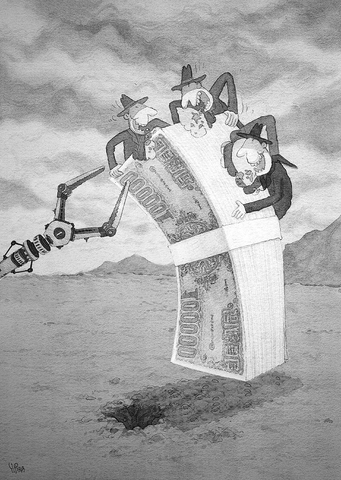
Clear electoral rules and procedures can help ensure transparency, but accountability also comes from the broad society in between elections. Privately owned newspapers, independent radio and television networks, trade unions, churches, professional societies and other groups provide a bulwark against despotism.
In the poorest countries, where illiteracy is high, desperate people are subject to government manipulation and there is a lack of independent control through the media and professional organizations, governments face only weak control by society. They tend to be the most despotic and corrupt, not because poor people care less about good governance -- on the contrary, their very lives depend on it -- but because they lack the means to keep their government disciplined and law abiding.
The result is a trap in which poverty causes bad governance and bad governance causes poverty -- a two-way spiral downward that can lead to such extreme deprivation that the government, lacking computers, telephones, information systems and trained civil servants, couldn't function honestly even if it wanted to. The end result can be a collapse into a kind of anarchy, as in Liberia, Sierra Leone and Somalia.
One measure of the quality of governance in over 150 countries is provided by Transparency International, an organization dedicated to strengthening civil society in the fight against government corruption. It produces an annual ranking of "corruption perceptions," measuring the public's view of the extent of corruption in a country.
In this year's rankings, Iceland scored as the least corrupt country, with the Scandinavian countries, New Zealand and Singapore close behind. The US ranked 17th from the top, a not-so-glorious position for the world's leading power. In general, the poorer the country, the lower the ranking: tied for last place are Chad and Bangladesh.
A bit of statistical analysis reveals further important patterns. First, Sub-Saharan African countries are less corrupt on average than countries at the same income level in other parts of the world. For example, Burkina Faso, Ghana, Mali, and Rwanda rank much higher than Bangladesh, Indonesia, Pakistan and Vietnam. Yet the Asian countries' economies have tended to grow much faster over the past generation. Corruption therefore cannot be the unique factor that holds Africa back. Africa's problems have more to do with droughts, malaria, AIDS and lack of infrastructure.
Poor countries achieve lower levels of corruption when civil rights are protected. When people have the freedom to assemble, to speak and to publish their views, society benefits not only by increasing the range of ideas that are debated, but also by keeping corruption in check. It is no surprise that corrupt regimes routinely clamp down on the press, trade unions and on professional associations. In Africa, less corrupt countries like Ghana also have much better protection of civil liberties.
Finally, the data show that corruption is highest in oil and gas-producing countries. In general, natural resources like oil, gas, diamonds and other minerals breed corruption, because governments can live off of their export earnings without having to "compromise" with their own societies. The natural resources are therefore not only a target of corruption but also an instrument of holding power. Many foreign firms, intent on cashing in, fuel the pathology of corrupt regimes by peddling in bribes and political protection.
The implications for action are clear. By strengthening civil society -- through legal rights and long-term economic development -- and instituting clear rules to ensure accountability, political despotism and corruption will be brought under control. We should be uncompromising, therefore, in our defense of civil liberties.
The rich world should offer impoverished regions like sub-Saharan Africa more economic support to end poverty. Of course, aid should be directed to specific needs -- malaria control, food production, safe drinking water and sanitation, for example -- whose fulfillment can be measured and monitored to resist corruption. By raising living standards, we would also be empowering both civil society and impoverished governments to defend the rule of law.
Jeffrey Sachs is professor of economics and director of the Earth Institute at Columbia University.
Copyright: Project Syndicate
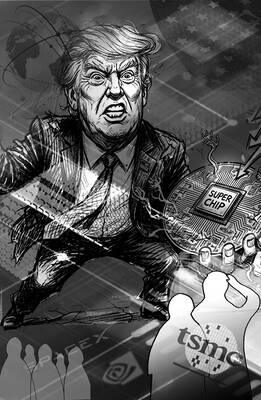
The White House’s decision to take a 9.9 percent stake in Intel Corp is looking like very shrewd business indeed. Since the government bought in at US$20.47 a share last August, the US chipmaker’s surging stock price has delivered the US a US$43 billion return. One of the reasons the investment has so far proved so sound is that the White House has made sure of it. According to The Wall Street Journal, Howard personally pushed deals on Intel’s behalf with some of the most lucrative clients imaginable. They include Nvidia Corp, the company at the heart of the AI
A single photograph can cut through a lot of noise, but it can also be used to misrepresent the truth. At the very least, it can concentrate the mind on something that requires further investigation. On Monday last week, Ma Ying-jeou Foundation CEO Tai Hsia-ling (戴遐齡) and former National Security Council secretary-general King Pu-tsung (金溥聰) held a news conference in which they showed a photograph of former foundation CEO Hsiao Hsu-tsen (蕭旭岑), now Chinese Nationalist Party (KMT) deputy chairman. In the image Hsiao is seated next to Xiamen Taiwan Businessmen Association chairman Han Ying-huan (韓螢煥). The two men were holding
I first met Professor Ray Jiing (井迎瑞) as a film and documentary student at Shih Hsin University’s (SHU) Department of Radio Television and Film in 1988. The following year, he went on to become the director of the Chinese Taipei Film Archive — forerunner of the Taiwan Film and Audiovisual Institute (TFAI). Over his eight-year tenure, Jiing rescued and restored over 200 classic Taiwanese films. In 1997, he established the Graduate Institute of Studies in Documentary and Film Archiving at Tainan National University of the Arts (TNNUA), and I joined the program in his third cohort of students. Beyond a
A recent report concerning a student who is suing his teacher posed the question in its headline: Does failing a student in two subjects constitute bullying? The college student in Chiayi County apparently sought NT$2 million (US$63,603) in state compensation, but a court dismissed the case. The first reaction of many might have been to ask: What has happened to students nowadays? Some say that teachers have lost their authority, while others say students are overindulged. Some even start reminiscing over the days when “whatever the teacher says goes.” However, the real issue might be overlooked if emotional reactions like that are the


 RSS
RSS