


China's constant attempts to oppress and isolate Taiwan have constricted the nation's ability to maneuver on the international stage. The Democratic Pacific Union (DPU), established by Vice President Annette Lu (
In fact, international organizations have long been established as a way to achieve certain types of objectives. The informal, non-governmental Workshop on Managing Potential Conflicts in the South China Sea, financed by Canada and hosted by Indonesia, has been held annually since 1990. In recent years, the group has shifted its focus from solving the South China Sea disputes to studying functional cooperation among nations. The Council for Security Cooperation in the Asia-Pacific (CSCAP), inaugurated in 1993, aims to look into security issues in the Asia-Pacific region from a non-governmental perspective, to make up for deficiencies in the ASEAN Regional Forum (ARF) and become an unofficial advisory body on ARF policy.
As for China, it established the Boao Forum for Asia in 2001 to ally itself with other nations and create a multilateral international organization to uphold "Asian values" in an increasingly globalized world. The organization seeks to undermine the US' "Asia-Pacific" construct and soothe fears over China's rise.
In Taiwan, Lu's recently established DPU is composed of elites from home and abroad among Pacific Basin countries. Its aim is to find solutions for maritime security and discuss the maritime environment and technology. This will allow Taiwan to have a say in an international, if non-political forum. By presenting itself as a forum, rather than an international alliance, the DPU can certainly minimize unnecessary external interference.
This also complies with "the new internationalism" that President Chen Shui-bian (
Therefore, faced with China's across-the-board oppression of Taiwan's international status, Lu's attempts to break fresh ground on the international stage have not only fulfilled her long-standing aspirations, but also realized the hopes of the Taiwanese people.
Wang Kun-yi is an associate professor in the graduate institute of international affairs and strategic studies at Tamkang University.
Translated by Daniel Cheng
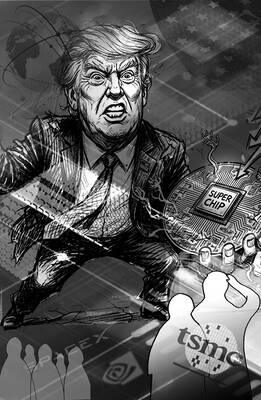
The White House’s decision to take a 9.9 percent stake in Intel Corp is looking like very shrewd business indeed. Since the government bought in at US$20.47 a share last August, the US chipmaker’s surging stock price has delivered the US a US$43 billion return. One of the reasons the investment has so far proved so sound is that the White House has made sure of it. According to The Wall Street Journal, Howard personally pushed deals on Intel’s behalf with some of the most lucrative clients imaginable. They include Nvidia Corp, the company at the heart of the AI
A single photograph can cut through a lot of noise, but it can also be used to misrepresent the truth. At the very least, it can concentrate the mind on something that requires further investigation. On Monday last week, Ma Ying-jeou Foundation CEO Tai Hsia-ling (戴遐齡) and former National Security Council secretary-general King Pu-tsung (金溥聰) held a news conference in which they showed a photograph of former foundation CEO Hsiao Hsu-tsen (蕭旭岑), now Chinese Nationalist Party (KMT) deputy chairman. In the image Hsiao is seated next to Xiamen Taiwan Businessmen Association chairman Han Ying-huan (韓螢煥). The two men were holding
I first met Professor Ray Jiing (井迎瑞) as a film and documentary student at Shih Hsin University’s (SHU) Department of Radio Television and Film in 1988. The following year, he went on to become the director of the Chinese Taipei Film Archive — forerunner of the Taiwan Film and Audiovisual Institute (TFAI). Over his eight-year tenure, Jiing rescued and restored over 200 classic Taiwanese films. In 1997, he established the Graduate Institute of Studies in Documentary and Film Archiving at Tainan National University of the Arts (TNNUA), and I joined the program in his third cohort of students. Beyond a
A recent report concerning a student who is suing his teacher posed the question in its headline: Does failing a student in two subjects constitute bullying? The college student in Chiayi County apparently sought NT$2 million (US$63,603) in state compensation, but a court dismissed the case. The first reaction of many might have been to ask: What has happened to students nowadays? Some say that teachers have lost their authority, while others say students are overindulged. Some even start reminiscing over the days when “whatever the teacher says goes.” However, the real issue might be overlooked if emotional reactions like that are the


 RSS
RSS