


The death of Pope John Paul II was not unexpected, and his immense influence on the modern world will be judged and commented on by everybody who thinks that he has something to say. Before explaining one of the less known aspects of his teaching, it should be emphasized that one of the comments that is now being heard repeatedly is based either on stupidity or on a lack of understanding of what the Catholic Church is about. The charge that the Pope was and is "conservative" is nonsense.
John Paul II was undoubtedly conservative when he commented on Catholic dogma, but the institution of the Catholic Church is based on the Ten Commandments and dogmas which cannot be changed. Being truthful and faithful to what is the bedrock of Church teaching cannot be deemed conservative.
In reality, John Paul II was called "conservative" because he was against abortion and some other progressive ideas. But if you want a Pope who is for abortion, then you want a different Church. Some things, some values that constitute both the faith and membership in the Catholic Church, are neither conservative nor liberal or progressive; they are fundamental, inevitable and immutable.
John Paul II had a specific task that he implemented during his nearly 27-year papacy: following through on the changes in the teaching and behavior of the Catholic Church that were started by the Second Vatican Council over 40 years ago. Before then, the Catholic Church had lost almost two centuries (18th and 19th) because it refused to accept that the world had changed, that social and economic issues are among the most important, that modernity happened.
Only with the Second Vatican Council did things begin to change in the Church, and the impact of John Paul II was immense. One of the questions that the Church could not answer in a satisfactory way for nearly three centuries concerned its attitude towards the economy and society. The Church tried everything possible to avoid an unequivocal approval of capitalism.
After Leo XIII stated for the first time -- in the famous encyclical Rerum Novarum in 1891 -- that there are such people as workers and that there are serious social problems, Pius XI, in another encyclical in 1931, Quadrogesimo Anno, tried to show which economic approach is in keeping with the faith. He proposed a corporatist system, and some of his followers spoke about a "third way" between capitalism and socialism. The only country that with some, albeit very doubtful, success, introduced such economic devices was Salazar's Portugal.
So when a hundred years after Leo XIII, John Paul II issued his encyclical Centesimus Annus, no one expected that for the first time in history the Church would approve of the free market economy and capitalism. But the words of the Pope are clear and leave no doubt. "It would appear that, on the level of individual nations and of international relations, the free market is the most efficient instrument for utilizing resources and effectively responding to needs. But this is true only for those needs which are solvent, insofar as they are endowed with purchasing power, and for those resources which are marketable, insofar as they are capable of obtaining a satisfactory price." But the Pope added: "There are many human needs which find no place on the market."
That encyclical also contained a second fundamental statement concerning the idea of profit.
"The Church acknowledges the legitimate role of profit as an indication that a business is functioning well. When a firm makes a profit, this means that productive factors have been properly employed and corresponding human needs have been duly satisfied."
Once again, the Pope added a caveat: "But profitability is not the only indicator of a firm's condition. It is possible for the financial accounts to be in order, and yet for the people -- who make up the firm's most valuable asset -- to be humiliated and their dignity offended. Besides being morally inadmissible, this will eventually have negative repercussions on the firm's economic efficiency."
John Paul II was no follower of neo-liberalism. For him, markets and profits were not a solution to human problems, but a mechanism to be used for moral purposes. Indeed, both Adam Smith and Herbert Spencer's reasoning are very similar. Both of them -- the two greatest thinkers that promoted the idea of the free market -- were also moral philosophers.
For them, as for John Paul II, the free market and profits were ways to improve humanity. They were sometimes naive, as when Spencer hoped that rich citizens would nearly automatically be good citizens and thus find it natural to help those who were not so successful. John Paul II might have been naive, too, but only up to a point.
Everything depends on our idea of human nature. If we believe, as the Catholic Church believes, that human beings bear the burden of original sin, but are perfectible; that human beings can understand what is good and bad and can choose between them because we have free will, then approval of the free market is understandable and not naive. By this one encyclical, John Paul II moved Church teaching from the Middle Ages to modernity.
The debate the Pope began on the relationship between the free market and moral problems remains unfinished. Eliminating the abuses that accompany capitalism and harnessing it for the benefit of society and human morals still needs to be tackled. John Paul II had the courage to raise the fundamental questions that needed asking. Will we continue to ask them without his leadership and prompting?
Marcin Kr?l is dean of history at Warsaw University, holder of its Erasmus chair and publisher of Res, Poland's leading intellectual journal.
Copyright: Project Syndicate
A gap appears to be emerging between Washington’s foreign policy elites and the broader American public on how the United States should respond to China’s rise. From my vantage working at a think tank in Washington, DC, and through regular travel around the United States, I increasingly experience two distinct discussions. This divergence — between America’s elite hawkishness and public caution — may become one of the least appreciated and most consequential external factors influencing Taiwan’s security environment in the years ahead. Within the American policy community, the dominant view of China has grown unmistakably tough. Many members of Congress, as
The Hong Kong government on Monday gazetted sweeping amendments to the implementation rules of Article 43 of its National Security Law. There was no legislative debate, no public consultation and no transition period. By the time the ink dried on the gazette, the new powers were already in force. This move effectively bypassed Hong Kong’s Legislative Council. The rules were enacted by the Hong Kong chief executive, in conjunction with the Committee for Safeguarding National Security — a body shielded from judicial review and accountable only to Beijing. What is presented as “procedural refinement” is, in substance, a shift away from
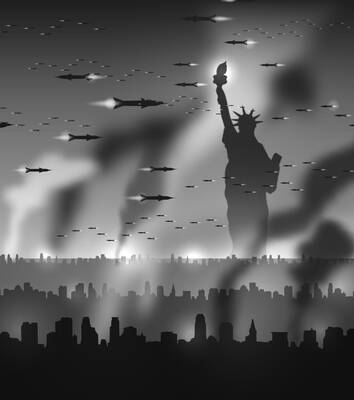
After declaring Iran’s military “gone,” US President Donald Trump appealed to the UK, France, Japan and South Korea — as well as China, Iran’s strategic partner — to send minesweepers and naval forces to reopen the Strait of Hormuz. When allies balked, the request turned into a warning: NATO would face “a very bad” future if it refused. The prevailing wisdom is that Trump faces a credibility problem: having spent years insulting allies, he finds they would not rally when he needs them. That is true, but superficial, as though a structural collapse could be caused by wounded feelings. Something
The shifting geopolitical tectonic plates of this year have placed Beijing in a profound strategic dilemma. As Chinese President Xi Jinping (習近平) prepares for a high-stakes summit with US President Donald Trump, the traditional power dynamics of the China-Japan-US triangle have been destabilized by the diplomatic success of Japanese Prime Minister Sanae Takaichi in Washington. For the Chinese leadership, the anxiety is two-fold: There is a visceral fear of being encircled by a hardened security alliance, and a secondary risk of being left in a vulnerable position by a transactional deal between Washington and Tokyo that might inadvertently empower Japan


 RSS
RSS