


Do you remember your PIN number? I vividly remember what PIN stands for -- "Personal Identification Number," which means that "PIN number" is redundant -- but I can never keep in my memory bank the number that unlocks the key to my computer-crazed bank account. I am tempted to write the PIN down and put it in a safe place, but my bank warns me never to do that.
The University of Chicago's Networking Services agrees: "Never write down a password," it warns and adds in a footnote: "If you do this, you should take extreme care not to lose the paper you have written it on. You should destroy the paper (e.g., tear it to shreds) once you have learned the password."
In the old days, I could safely hide my PIN by writing it on the back of the label that hangs underneath my couch. That stern, official label used to say "Do Not Remove This Label" -- but now, while it still proclaims "Under Penalty of Law," the newer couches have tags that read "This tag is not to be removed except by the Consumer Only," a clumsy formulation followed by some mumbo jumbo about flammability. That redundant "only" encourages furniture owners to yank the label off, and it means the back of the tag is no longer a safe hiding place on which to scribble PINs.
That has driven millions of us to the use of mnemonics. The m in mnemonic is pronounced the same as the p in pneumonia -- that is, not at all. A mnemonic, rooted in the Greek word for "mindful," is a mental string you tie around your brain in the form of a rhyme or an association. For example, to create a four-numeral PIN, I took the word most closely associated with that acronym, needle, stuck NEED in the new-memory hippocampus region of my cerebral cortex, then picked out the numbers on my telephone pad that spelled out NEED: 6333. (That sample PIN is only for purposes of illustration; distrustful of banking's disintermediation, I put my money in an old mattress, fiercely guarded by a harsh warning label.)
"Auditors and consultants are prodding companies to require that employees pick tougher passwords," notes The Wall Street Journal, "and change them more frequently." That poses a linguistic problem.
The Yahoo security center advises that passwords should be "unique" (not used for another of my accounts), "difficult to guess" (at least seven characters long) and "made up of both lower and upper-case letters, numbers and symbols." (Thanks a lot -- I'll never remember $@Feyeare, and that's my own last name.) "Bad passwords," in Yahoo's eyes, are complete words in any language; your own name or that of your spouse, child or pet spelled backward; information about you easily obtained, like birthday, street address or license plate number; or a sequence of numbers like 12345. In sum, if the code word is easy for you to remember, it's easier for a hacker to crack.
With all those words not to be used, what's left? "What people really do," says John R. Levine, co-author of Internet Privacy for Dummies, "is pick the first thing that comes to mind. Several studies claim that the most popular password in the country is `susan,' which I can easily believe. This would be horrifying except that an awful lot of the stuff protected by passwords is barely worth protecting."
As a privacy nut, I consider every click of my keyboard worth protecting; does Levine have usable advice for paranoid dummies? "Think up a little phrase and use its initials, throwing in 4 in place of `for' and r for `are' and $ for `money' and anything else that seems memorable. For example, mltw10? could be `my laptop weighs 10 pounds' and W$m2vgop could be `George paid me to vote Republican."'
Too complicated? The dummymeister suggests free association: "Recalling the joke where a gourmand described ptarmigan as ptasty but ptough, if I had a memorable friend named Terry whom I met in 1990, I might use a password like pTerry90."
Language students are witnessing the emergence of a new form of coded communication, similar to Cockney rhyming slang (in which feet were "plates of meat"). In passwordage, however, we observe the crossing of the euphonic signage of license plates (the sporty 10SNE1 and the green-eyed YRUNVS) with the ancient cognitive device of mnemonics -- recollection by association.
If you have found this page instructive, follow the prudent privacy advice of the University of Chicago: "Tear it to shreds."
People power
Standing in Kiev's frigid Independence Square making a political statement, with an orange scarf around her neck, 16-year-old Tatiana Fedurchuk said of the reversal of a fraudulent election in Ukraine: "This is a victory for people power."
When I wrote of other manifestations of people power in the past generation in Poland, Czechoslovakia, South Korea, Indonesia and Russia, my New York Times colleague Jack Cushman noted: "You left out the Philippines, where that phrase was adopted by Cory Aquino when she courageously stepped in after her husband's assassination in 1983. I still have a yellow (Laban Party color) T-shirt emblazoned with people power and another with a picture of a tank with a flower in the barrel."
That grew out of "power to the people," the slogan of Students for a Democratic Society in the 1960s, preceded by the slogan of the Bolsheviks in 1917, "All power to the Soviets." In its shortened form, use of the phrase was reported in The Times of London on Jan. 19, 1971: "Mr. George Wallace ... returned to the governor's mansion in Alabama today, issuing a rallying cry for `people power' to combat the `despotic tyranny' of federal government." Earliest use I can find is by a New York City Welfare Department caseworker, who watched a crowd of 5,000 union demonstrators and their supporters march across the Brooklyn Bridge to urge community control of education, and told a New York Times reporter, Maurice Carroll, on Oct. 15, 1968: "This was a beautiful example of people power."
The sudden surge of usage in coverage of the peaceful uprising in Kiev shows that the phrase, and its underlying slogan, has staying power. Alliteration also aids.
A gap appears to be emerging between Washington’s foreign policy elites and the broader American public on how the United States should respond to China’s rise. From my vantage working at a think tank in Washington, DC, and through regular travel around the United States, I increasingly experience two distinct discussions. This divergence — between America’s elite hawkishness and public caution — may become one of the least appreciated and most consequential external factors influencing Taiwan’s security environment in the years ahead. Within the American policy community, the dominant view of China has grown unmistakably tough. Many members of Congress, as
The Hong Kong government on Monday gazetted sweeping amendments to the implementation rules of Article 43 of its National Security Law. There was no legislative debate, no public consultation and no transition period. By the time the ink dried on the gazette, the new powers were already in force. This move effectively bypassed Hong Kong’s Legislative Council. The rules were enacted by the Hong Kong chief executive, in conjunction with the Committee for Safeguarding National Security — a body shielded from judicial review and accountable only to Beijing. What is presented as “procedural refinement” is, in substance, a shift away from
The shifting geopolitical tectonic plates of this year have placed Beijing in a profound strategic dilemma. As Chinese President Xi Jinping (習近平) prepares for a high-stakes summit with US President Donald Trump, the traditional power dynamics of the China-Japan-US triangle have been destabilized by the diplomatic success of Japanese Prime Minister Sanae Takaichi in Washington. For the Chinese leadership, the anxiety is two-fold: There is a visceral fear of being encircled by a hardened security alliance, and a secondary risk of being left in a vulnerable position by a transactional deal between Washington and Tokyo that might inadvertently empower Japan
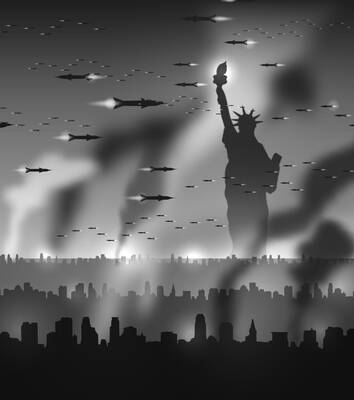
After declaring Iran’s military “gone,” US President Donald Trump appealed to the UK, France, Japan and South Korea — as well as China, Iran’s strategic partner — to send minesweepers and naval forces to reopen the Strait of Hormuz. When allies balked, the request turned into a warning: NATO would face “a very bad” future if it refused. The prevailing wisdom is that Trump faces a credibility problem: having spent years insulting allies, he finds they would not rally when he needs them. That is true, but superficial, as though a structural collapse could be caused by wounded feelings. Something


 RSS
RSS