


The veteran US politician Tip O'Neill famously said "all politics is local." But these days it's global too, and no election anywhere has been more closely watched worldwide than today's contest for the US presidency.
How you perceive it has much to do with whether you get your news from US or international media.
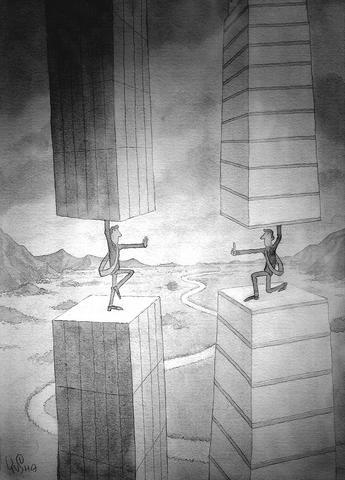
ILLUSTRATION: YU SHA
In his debates with Senator John Kerry, President George W Bush has cited the recent election in Afghanistan to claim "freedom is on the march" there and in Iraq. Columnist William Safire echoes Bush in the New York Times of Oct. 27: "American and British Wilsonian idealists can hold their heads high today; the defeatists who presume to call themselves realists were defeated."
But beyond US shores observers have a different take on the situation.
Pakistani journalist, Beena Sarwar, in her "Personal Political" column distributed worldwide by email says both Afghanistan and Iraq today are more unsafe places than ever before.
"[Both are] suffering from thousands of civilian casualties, destroyed infrastructure and no law and order to speak of," she said.
A UK-based international NGO's country director for Afghanistan -- himself an American -- confirmed this impression for me last week.
"About 50 percent of the country is no-go," he said. "And not just for foreigners but for ordinary Afghans."
Is Afghan President Hamid Karzai "one gutsy, deft and appealing politician" as Safire calls him, or "a nonentity" as a Pakistani who has worked for the UN in Afghanistan told me. And how can we account for these differing perceptions of the situation?
"People in America are totally brainwashed by Fox News," Pakistani lawyer Ghazala Minallah told me.
But notwithstanding William Safire and Fox News, there are signs many Americans are unconvinced. James Fallows is a veteran US journalist whose article "Bush's Lost Year." in last month's issue of The Atlantic Monthly magazine, chronicled everything the Bush administration has failed to achieve because of its single-minded focus on Iraq.
"The moment of the wheels coming off has arrived," Fallows told me in Washington in July. "A combination of fecklessness, dishonesty and lack of foresight is making the administration seem vulnerable -- the opposite of that air of invincibility that Bush had through 2002.
There are all sorts of dramatic parallels with the saga of his father, who went from even greater triumphalism to defeat. There are interesting signs of defection and dissension within the Republican machine."
Seeking out perspectives on their own country unavailable through their own news media, many Americans are turning to Britain. The Guardian's Web site (www.guardian.co.uk) is increasingly popular in the US, as are articles by The Independent's authority on the Middle East, Robert Fisk, and the UK-based Australian investigative journalist John Pilger. Last month The Guardian, The Observer and The Financial Times began distributing editions printed on the East Coast of the US.
Getting even closer to US readers (and voters) the Guardian, arguing the outcome of today's vote was of as much interest to non-Americans as to Americans, offered its readers the opportunity to write to US citizens in the crucial "swing state" of Ohio. The paper gave the name and address of one voter in Clark County, Ohio, to each reader who expressed an interest in the project.
Published responses to letters from Guardian readers to voters ranged from "Go back to sipping your tea and leave our people alone" to "Your idea is superb and frankly, we need a little help over here right now."
Meanwhile, citizens of small countries across the world are holding their breath hoping things will improve locally and globally with a different US president.
In 1994, former president Bill Clinton invaded Haiti to restore the popular elected President Jean-Bertrand Aristide.
Many Haitians believe the 1991 coup that had earlier ousted Aristide was sponsored by the administration of former president George Bush and that Aristide's second flight into exile this February was the doing of Bush Junior.
Kerry's assertion in March that he would have sent US troops to protect Aristide has become a source of bitter controversy within Haiti as the US election approaches.
'Bush -- unelected -- overthrows Aristide -- elected,' Dr Paul Farmer, an American who founded an innovative hospital in central Haiti, told me in Haiti in August. "Haitians see symmetry: Bush 1 overthrows Aristide 1, Bush 2 overthrows Aristide 2."
Farmer himself was highly critical of Clinton in his 1994 book The Uses of Haiti, but says George W. has made him rethink some of his stronger assertions.
"I hadn't realized just how vulnerable Haiti was to changes within the US government," he said.
Ethan Casey is the author of Alive and Well in Pakistan: A Human Journey in a Dangerous Time
From the Iran war and nuclear weapons to tariffs and artificial intelligence, the agenda for this week’s Beijing summit between US President Donald Trump and Chinese President Xi Jinping (習近平) is packed. Xi would almost certainly bring up Taiwan, if only to demonstrate his inflexibility on the matter. However, no one needs to meet with Xi face-to-face to understand his stance. A visit to the National Museum of China in Beijing — in particular, the “Road to Rejuvenation” exhibition, which chronicles the rise and rule of the Chinese Communist Party — might be even more revealing. Xi took the members
The Chinese Nationalist Party (KMT) and the Taiwan People’s Party (TPP) on Friday used their legislative majority to push their version of a special defense budget bill to fund the purchase of US military equipment, with the combined spending capped at NT$780 billion (US$24.78 billion). The bill, which fell short of the Executive Yuan’s NT$1.25 trillion request, was passed by a 59-0 margin with 48 abstentions in the 113-seat legislature. KMT Chairwoman Cheng Li-wun (鄭麗文), who reportedly met with TPP Chairman Huang Kuo-chang (黃國昌) for a private meeting before holding a joint post-vote news conference, was said to have mobilized her
Before the Chinese Communist Party (CCP) and its People’s Liberation Army (PLA) can blockade, invade, and destroy the democracy on Taiwan, the CCP seeks to make the world an accomplice to Taiwan’s subjugation by harassing any government that confers any degree of marginal recognition, or defies the CCP’s “One China Principle” diktat that there is no free nation of Taiwan. For United States President Donald Trump’s upcoming May 14, 2026 visit to China, the CCP’s top wish has nothing to do with Trump’s ongoing dismantling of the CCP’s Axis of Evil. The CCP’s first demand is for Trump to cease US
As artificial intelligence (AI) becomes increasingly widespread in workplaces, some people stand to benefit from the technology while others face lower wages and fewer job opportunities. However, from a longer-term perspective, as AI is applied more extensively to business operations, the personnel issue is not just about changes in job opportunities, but also about a structural mismatch between skills and demand. This is precisely the most pressing issue in the current labor market. Tai Wei-chun (戴偉峻), director-general of the Institute of Artificial Intelligence Innovation at the Institute for Information Industry, said in a recent interview with the Chinese-language Liberty Times


 RSS
RSS