


According to the Washington Post on Tuesday, US government officials have confirmed that the Chinese People's Liberation Army (PLA) will soon hold large-scale military exercises in the Fujian area. The Pentagon has also indicated that the US is closely watching the movement and direction of the PLA's exercises.
The truth of the matter is that all armies need to train, and military exercises are the best way to accomplish that. This is a necessary way of testing the strength of the armed forces. Therefore, our countrymen have no need to overreact to the PLA's military exercises. In fact, they have grown accustomed to it.
However, the PLA is making no effort to conceal the target of its exercises. Chinese military threats to Taiwan have become indisputable. President Chen Shui-bian's (
It is truly regretful that facing the military threats of the PLA and the endless diplomatic blockade and economic unification campaign of China, the pan-blue camp ignores the real source of Taiwan's problems and casts all the blame on Chen's administration. Pan-blue leaders even went as far as to disregard the image of the country by criticizing their own president in front of foreign friends during their overseas visits. It is truly inappropriate to use such campaign language during such occasions.
At the same time, as a member of the UN Security Council, China has coerced Liberia to sever diplomatic ties with Taiwan.
The number of countries holding diplomatic ties with Taiwan has now been reduced to 26. Yet, the pan-blue camp has failed to protest China's campaign to suppress Taiwan's international space. All they do is repeatedly ask our own government officials to step down. Such conduct is truly puzzling.
Actually, Chen spoke about Chinese assistance to the KMT and PFP with mixed feelings. The ruling Democratic Progressive Party (DPP) has repeatedly offered its goodwill to the other side of the Taiwan Strait, hoping to improve the cross-strait relationship. However, China continues to refuse to deal with the government, unwilling to give Chen any kind of recognition. The goal is to prevent Chen being re-elected by maintaining a cold and distant cross-strait relationship.
Therefore, to win over the trust of the Taiwanese people, the top priority of the pan-blue camp is not to demand from Chen, the DPP or the National Security Bureau evidence of Chinese assistance to the KMT and PFP.
Instead, they should prove with their actions and words that the PFP and the KMT hold a position no different from the rest of Taiwanese with respect to the Chinese obstruction of Taiwan. They must make the people believe that if elected they would be able to safeguard the future and sovereignty of Taiwan.
Unfortunately, to regain the presidency lost four years ago, the pan-blue camp has not only flirted with China, but also stood idly by as China undermines Taiwan. Their hope is to influence the outcome of the presidential election through China.
Actually, both the pan-blue and pan-green camps should realize one fact: China will show no mercy in its efforts to suppress Taiwan's international space, regardless of which party is in power. So long as the national sovereignty of Taiwan remains a reality, China will seek to destroy it.
Unless they are ready to accept the "one China, two systems" model and hand over the democracy, freedoms and human rights that Taiwanese have nurtured, both the pan-blue and pan-green camps should unite in supporting the government's efforts to stand up to China. Confusing our foreign friends or even becoming an international laughing stock by lodging grievances overseas is not the way to go.
The upcoming presidential election has become the key to the future direction of Taiwan. No candidate should try to deceive the voters and win votes with vague and illusory slogans.
Rather, each candidate must clearly give his or her views about Taiwan's long-term plans in the face of continuous Chinese threats, as well as how to rectify the people's confused national identity, so that Taiwan may become a unified, "normal" country.
It is wrong to have only campaign strategies and no blueprint for the country. It is wrong to have only enough rage to criticize the government, but not enough courage and determination to safeguard and uphold the interests of the Taiwan people.
It is unforgettable how a certain pan-blue camp figure criticized Chen's proposal for a new constitution as a "boring" idea and chastised Chen as being "ignorant" for bringing it up.
Yet, when the pan-blue camp discovered that public opinion supported rewriting the Constitution, they immediately changed their minds and decided to establish a task force to look into the matter.
The same thing was true about the issue of establishing a broadcasting and telecommunication commission. When a certain pan-blue camp figure suggested establishing such a commission once elected, little did he know that the Executive Yuan had done all the preparatory work for establishing it. As soon as the relevant bill is passed, the commission can begin to operate.
Perhaps the think tanks of pan-blue camp should keep in better touch with the government, so that its candidates won't mistake existing government policy for their own campaign white papers.
While overseas, the pan-blue leaders' response to questions about Chinese threats have been the expression of wishful thinking about self-restraint. Little do they know that asking self-discipline from a country that refuses to give up the threat of using force against Taiwan is a real joke.
A gap appears to be emerging between Washington’s foreign policy elites and the broader American public on how the United States should respond to China’s rise. From my vantage working at a think tank in Washington, DC, and through regular travel around the United States, I increasingly experience two distinct discussions. This divergence — between America’s elite hawkishness and public caution — may become one of the least appreciated and most consequential external factors influencing Taiwan’s security environment in the years ahead. Within the American policy community, the dominant view of China has grown unmistakably tough. Many members of Congress, as
The Hong Kong government on Monday gazetted sweeping amendments to the implementation rules of Article 43 of its National Security Law. There was no legislative debate, no public consultation and no transition period. By the time the ink dried on the gazette, the new powers were already in force. This move effectively bypassed Hong Kong’s Legislative Council. The rules were enacted by the Hong Kong chief executive, in conjunction with the Committee for Safeguarding National Security — a body shielded from judicial review and accountable only to Beijing. What is presented as “procedural refinement” is, in substance, a shift away from
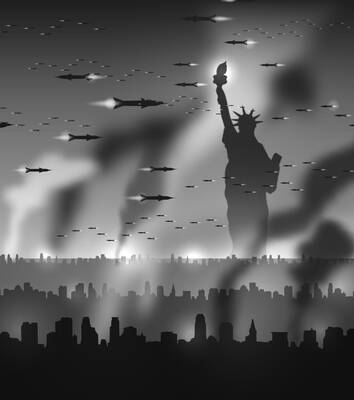
After declaring Iran’s military “gone,” US President Donald Trump appealed to the UK, France, Japan and South Korea — as well as China, Iran’s strategic partner — to send minesweepers and naval forces to reopen the Strait of Hormuz. When allies balked, the request turned into a warning: NATO would face “a very bad” future if it refused. The prevailing wisdom is that Trump faces a credibility problem: having spent years insulting allies, he finds they would not rally when he needs them. That is true, but superficial, as though a structural collapse could be caused by wounded feelings. Something
The shifting geopolitical tectonic plates of this year have placed Beijing in a profound strategic dilemma. As Chinese President Xi Jinping (習近平) prepares for a high-stakes summit with US President Donald Trump, the traditional power dynamics of the China-Japan-US triangle have been destabilized by the diplomatic success of Japanese Prime Minister Sanae Takaichi in Washington. For the Chinese leadership, the anxiety is two-fold: There is a visceral fear of being encircled by a hardened security alliance, and a secondary risk of being left in a vulnerable position by a transactional deal between Washington and Tokyo that might inadvertently empower Japan


 RSS
RSS