


Before people even had a chance to get over their shock and disbelief about the Chung Shan Institute of Science and Technology (CSIST) espionage case which made headlines last week, patrol boats of Taiwan's Coast Guard Administration and a suspected Chinese spy ship had the most volatile rendezvous in recent years. Although, in the end, there was no confrontation, it serves as a stunning reminder to the rest of us -- despite all the illusions of safety that may have been created by the busy and friendly cross-strait private economic and cultural contacts -- that there is a dangerous undertow beneath the surface caused by political rivalry.
It certainly was not the first time that suspected Chinese spy ships had openly entered Taiwan's territorial waters. Since April and May of this year, a number of them had approached dangerously close to the eastern and southern coast of Taiwan at least a dozen times. In fact, Xiangyanghong 14, the Chinese ship claiming to be conducting oceanographic research when approached by coast guard vessels on Wednesday, had previously intruded into Taiwan's 20km Exclusive Economic Zone. The stunt shook the Ministry of Nation Defense strategists to the bone, since it revealed a lethal blind spot in the radar-detection range of the Taiwan military near Orchid Island.
In the past, the military had typically resorted to passively monitoring the activities of these suspected spy ships from both the air and sea. This was obviously because these ships all claimed to be conducting legitimate oceanographic research, and because Taipei remains ambiguous regarding the sensitive issue about the delineation of its territorial waters. Of course, there is also the danger of being yanked into the depths of a cross-strait military clash.
However, this time around, Taiwan adopted a somewhat tougher stance in dealing with Xiangyanghong 14. For the first time, not only did the coast guard put the Chinese ship under close surveillance, but actually attempted to board the ship for inspection before it finally left. This subtle change in attitude by the military reflects the emergence of a new awakening about how safe the cross-strait relationship is -- an attitude prompted in part by the CSIST case.
Ironically, while this may be a new realization for some people in Taiwan, Beijing has never had any misconception about what Taiwan is to China -- a renegade province that must be disciplined into submission, even if the use of force is necessary.
A most clear indication of what Beijing thinks about the cross-strait relationship is the ongoing "spy war" in which Taiwanese businessmen are playing increasingly prominent roles. On the one hand, the Chinese authorities recruit them to spy in Taiwan; and on the other hand, they have become Beijing's main targets for investigations on the suspicion of spying on China.
To Beijing, another group of potential spies working for Taiwan are Taiwanese scholars and ethnic Chinese scholars engaging in research activities in China. The most obvious example is the US-based democracy activist and Chinese scholar Yang Jianli (
It is only at times like these that you can feel the pull toward actual confrontation -- the last thing that Taiwan wants. Reading the warning signs is essential to effective self-defense and survival. All we need to do is read the sign on the beach of which China already is certainly aware: "Beware -- dangerous undertow."
A gap appears to be emerging between Washington’s foreign policy elites and the broader American public on how the United States should respond to China’s rise. From my vantage working at a think tank in Washington, DC, and through regular travel around the United States, I increasingly experience two distinct discussions. This divergence — between America’s elite hawkishness and public caution — may become one of the least appreciated and most consequential external factors influencing Taiwan’s security environment in the years ahead. Within the American policy community, the dominant view of China has grown unmistakably tough. Many members of Congress, as
The Hong Kong government on Monday gazetted sweeping amendments to the implementation rules of Article 43 of its National Security Law. There was no legislative debate, no public consultation and no transition period. By the time the ink dried on the gazette, the new powers were already in force. This move effectively bypassed Hong Kong’s Legislative Council. The rules were enacted by the Hong Kong chief executive, in conjunction with the Committee for Safeguarding National Security — a body shielded from judicial review and accountable only to Beijing. What is presented as “procedural refinement” is, in substance, a shift away from
The shifting geopolitical tectonic plates of this year have placed Beijing in a profound strategic dilemma. As Chinese President Xi Jinping (習近平) prepares for a high-stakes summit with US President Donald Trump, the traditional power dynamics of the China-Japan-US triangle have been destabilized by the diplomatic success of Japanese Prime Minister Sanae Takaichi in Washington. For the Chinese leadership, the anxiety is two-fold: There is a visceral fear of being encircled by a hardened security alliance, and a secondary risk of being left in a vulnerable position by a transactional deal between Washington and Tokyo that might inadvertently empower Japan
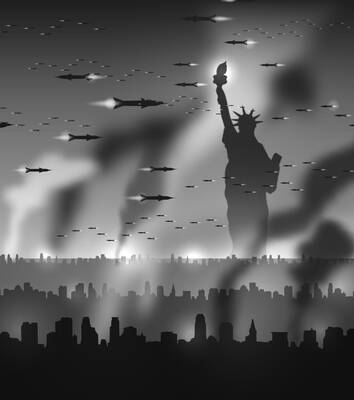
After declaring Iran’s military “gone,” US President Donald Trump appealed to the UK, France, Japan and South Korea — as well as China, Iran’s strategic partner — to send minesweepers and naval forces to reopen the Strait of Hormuz. When allies balked, the request turned into a warning: NATO would face “a very bad” future if it refused. The prevailing wisdom is that Trump faces a credibility problem: having spent years insulting allies, he finds they would not rally when he needs them. That is true, but superficial, as though a structural collapse could be caused by wounded feelings. Something


 RSS
RSS