


After Chen Shui-bian (
The KMT, in the previous 50 years of its rule, transformed itself from a totalitarian to a democratic party. Its political and economic contributions to Taiwan are undeniable. The KMT was defeated not because it had performed poorly as a ruling party but because of its own internal divisions and its failure to understand the peoples' will. For these reasons, the people voted for a change of government.
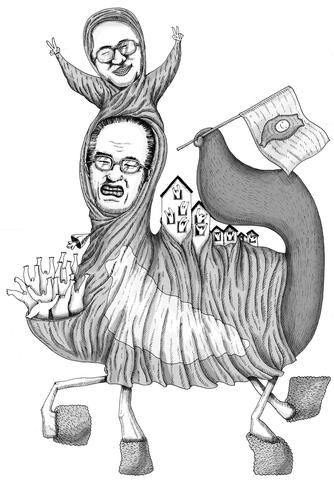
PHOTO: MOUNTAIN PEOPLE
While President Chen and his party hold the steering wheel of the country, the driving wheels of the vehicle are spinning. This is because, in the past year, neither the ruling nor the opposition party has successfully settled into their roles. Neither has understood the mainstream popular will. Interaction between the minority ruling party and the majority opposition party has become chaotic, bringing political turmoil, an economic slump, and social instability to Taiwan. Politicians form both government and the opposition owe the people an apology. They should vow unity and put aside their differences in a joint effort to build a new Taiwan.
Taiwan's political dynamics have undergone tremendous and sudden changes. While the KMT and the DPP were able to accomplish a peaceful transfer of power, the parties have yet to settle into their new roles.
Popular support for the KMT, to a certain extent, derived from black-gold politics, which distorted indications of Taiwan's popular will and its political structure.
Also, the presidential and Legislative Yuan elections were held at different times. As a result, while President Chen may have won the support of the people, he is powerless against the legislators. The alliance between the opposition KMT, PFP, and the New Party makes up two thirds of the seats in the legislature. Government policies face constant opposition boycotts in implementation. In the next three years, the Chen administration may continue to be plagued by this problem.
This opposition apparently arose because of the halt on construction of the Fourth Nuclear Power Plant. However, it is actually directed at President Chen's refusal to accept the "one China" principle. Chaos in the Legislative Yuan reflects vengeance and hatred on the part of the opposition. Against this backdrop of vindictiveness, the opposition alliance may have won the battle, but it has lost the support of the people. Many people are beginning to realize that only a change in the Legislative Yuan will bring stability to Taiwan, and foster economic development. Legislative opposition far surpasses the executive power of the government, and the minority government has been unable to implement many of its most popular plans.
Taiwan's opposition parties are basically all the same. They are all inclined to endorse the "one China" principle. There is also a phenomenal sense of "greater China nationalism" brewing among the opposition.
The New Party broke off from the KMT, because former KMT chairman Lee Teng-hui (
James Soong (
On the other hand, Lien Chan (
Together, the above three parties take up two thirds of the seats in the Legislative Yuan. Among these lawmakers, 70 percent have "great China consciousness," while only 30 percent have "Taiwanese consciousness." This figure is the complete opposite from the population in Taiwan -- 30 percent pro-unification and 70 percent "Taiwanese conscious."
In other words, the Legislative Yuan currently does not reflect what the people of Taiwan want.
To save the minority government from being paralyzed, the only solution is to have the ruling party become the majority party in the legislature. However, it is impossible for the DPP to jump from its current 60 or so seats in the Legislative Yuan to 115 seats. So, the only way to do it is to ask those who think similarly in terms of ideologies and ideals, and those with "Taiwanese consciousness" to participate in the year-end legislative election.
The Northern Taiwan Society (
Now, let us view the Chen-Lee alliance from the perspective of political and social science.
Society is an organic organization. Whenever problems occur in the operation of social organisms, activities by other social organisms are triggered that achieve an equilibrium. Such self-initiated activities are called "the reorganization process." It is the accomplishment of a balance between systems through the readjustment of power structures and social-group structures. A three-branched political entity has balanced political relations. These are the basic principles of political and social science.
Today, whenever the government wants to proceed with policy administration, it is limited by the fact that it holds less than half of the seats in the Legislative Yuan. As a result, the legislative power far outweighs the executive power. Executive power, as a result, loses control on important policy decisions and activities concerning the legal system, budgets, and policies. Confined and controlled by the Legislative Yuan, the Executive Yuan is hogtied in its activity. It lacks sufficient legislative support to deal with political, economic, social, national defense, and national security affairs.
The motivation for the Chen-Lee alliance is to make up for the basic flaws in this minority government situation. To change a legislature that is no longer truly representative of the popular will, and do away with the structural defects in Taiwan's present politics, the Chen-Lee alliance will promote to the legislature more lawmakers with a "Taiwanese consciousness," perhaps changing the substantive structure of the Legislative Yuan as a result. Intellectuals with this way of thinking should fully realize the real goal of this political maneuvering deeply concerns the safety of the 23 million people in Taiwan, and its development and integrity.
People who demonize the Chen-Lee alliance either have ulterior motives or no political common sense.
The basis of political democracy is the will of the people. Taiwan's popular will has already elected DPP's Chen Shui-bian to serve as the 10th president. However, the incumbent members of the Legislative Yuan were elected in 1998. A re-election of the Legislative Yuan won't take place until the end of this year. At this critical moment, the Chen-Lee alliance is organizing a new political group, in an attempt at turning the minority government into a majority government. The move has drawn condemnation from the KMT, PFP, and New Party. However, their condemnation divides national identification of local Taiwanese and Chinese mainlanders, as well as driving a wedge between native and non-native camps.
The existence of groups is consistent in human nature. A democratic society must attach importance to harmony between groups. This is an unquestionable principle. The existence of group divisions in Taiwan is a fact and a problem. Most ethnic Taiwanese hope to have a independent sovereign nation of their own and maintain Taiwan's dignity and security. On the other hand, most mainlanders hope that Taiwan can be returned to China. Mainlanders here have long been critical of former president Lee and President Chen as "president of Taiwan," rather than "president of the ROC." The mainlanders refuse to concede the fact that the presidency has been handed to President Chen by the popular vote. Their attitude has caused much pain for the people of Taiwan, including some mainlanders as well. In the past, their mentality was "we are Taiwan's rulers." Now, after losing political power, they have become "comrades of the communists" in criticizing Chen and Lee.
We cannot help but ask why the politicians and pro-unification media did not worry about the risk of division between ethnic groups when the New Party broke off from the KMT and Soong organized a new political party, the PFP? Why do they only speculate that political cooperation between Lee and Chen is seeking to divide ethnic groups? These groundless accusations and speculations just happen to come from the mouth of mainlanders politicians. Their treatment of intellectuals in Taiwan as incapable of determining right and wrong is what is truly dividing this country.
The pro-unification camp and it media allies are incapable of steering the development of the country, society, and economy in the right direction. They, in fact, exploit their privileges in the legislature and media to belittle Taiwan, and attempt to trample on the confidence of the general public. They also use spurious logic to lure Taiwanese businessmen into blindly heading to China and channeling large amounts of capital there, while disregarding national security. As a result, the spirit of the people of Taiwan is depressed, the industry of Taiwan is weakened, the quality of life on the island declining, and the misery index surging. This is the main reason for the difficult dilemma facing Taiwan today.
To uphold national security and the political stability of Taiwan, help the economy recuperate, and lessen social problems, the intellectuals of Taiwan must band together to support the political alliance of Lee and Chen. This will enable the achieving of a new level of "Taiwanese consciousness" and lead the popular will in the right direction. Hopefully, after the legislative re-election at the end of the year, the popular nativization mainstream will once again be adequately represented in the legislature, and lawmakers who give top priority to Taiwan's interests will be elected to shape the country's legislation and future.
Lee Chang-kuei (
A gap appears to be emerging between Washington’s foreign policy elites and the broader American public on how the United States should respond to China’s rise. From my vantage working at a think tank in Washington, DC, and through regular travel around the United States, I increasingly experience two distinct discussions. This divergence — between America’s elite hawkishness and public caution — may become one of the least appreciated and most consequential external factors influencing Taiwan’s security environment in the years ahead. Within the American policy community, the dominant view of China has grown unmistakably tough. Many members of Congress, as
The Hong Kong government on Monday gazetted sweeping amendments to the implementation rules of Article 43 of its National Security Law. There was no legislative debate, no public consultation and no transition period. By the time the ink dried on the gazette, the new powers were already in force. This move effectively bypassed Hong Kong’s Legislative Council. The rules were enacted by the Hong Kong chief executive, in conjunction with the Committee for Safeguarding National Security — a body shielded from judicial review and accountable only to Beijing. What is presented as “procedural refinement” is, in substance, a shift away from
The shifting geopolitical tectonic plates of this year have placed Beijing in a profound strategic dilemma. As Chinese President Xi Jinping (習近平) prepares for a high-stakes summit with US President Donald Trump, the traditional power dynamics of the China-Japan-US triangle have been destabilized by the diplomatic success of Japanese Prime Minister Sanae Takaichi in Washington. For the Chinese leadership, the anxiety is two-fold: There is a visceral fear of being encircled by a hardened security alliance, and a secondary risk of being left in a vulnerable position by a transactional deal between Washington and Tokyo that might inadvertently empower Japan
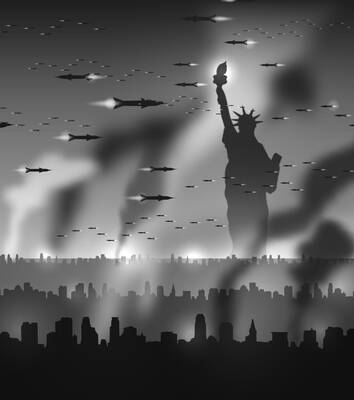
After declaring Iran’s military “gone,” US President Donald Trump appealed to the UK, France, Japan and South Korea — as well as China, Iran’s strategic partner — to send minesweepers and naval forces to reopen the Strait of Hormuz. When allies balked, the request turned into a warning: NATO would face “a very bad” future if it refused. The prevailing wisdom is that Trump faces a credibility problem: having spent years insulting allies, he finds they would not rally when he needs them. That is true, but superficial, as though a structural collapse could be caused by wounded feelings. Something


 RSS
RSS