


DPP Secretary-General Wu Nai-jen (吳乃仁) has surprised the public by lashing out at Premier Tang Fei's (唐飛) performance. Although President Chen Shui-bian (陳水扁) was not elected by an absolute majority and his party, the DPP, is not the majority party in the Legislative Yuan, the DPP is viewed as Taiwan's only ruling party because of Chen's forceful leadership of government policy and personnel matters. When the ruling party's spokesman severely attacks the president's most valuable ally in public, therefore, it only serves to confuse matters.
To repair the damage, Chen immediately expressed his "100 percent support" for Tang. Wu, under huge pressure from inside and outside the party, also apologized to Tang for his inappropriate speech.
The question is, although a major uproar has been played down as a minor one, the problem remains. In fact, Wu's speech honestly bespoke many DPP members' worries that the party itself -- not to mention its prospects in next year's legislative election -- might be hampered by a premier who belongs to the biggest opposition party, the KMT. That's probably why Wu chose to condemn Tang's performance; bidding to release the pressure on the DPP by putting all the responsibility on the premier as early as possible.
If this is so, it is wishful thinking on Wu's part. The public will not necessarily view Tang's poor performance as merely down to Tang himself. They might, furthermore, blame it on the president's distrust of and failure to empower the premier.
Once the public turns to Tang out of sympathy, Wu's words may be interpreted as a bid by the DPP to cruelly force Tang to step down after he has helped the ruling party successfully form the new government.
On the whole, Tang's poor performance is due more to the president's failure to empower him than to flaws in his leadership skills. First, Tang was not given sufficient authority over personnel, so he could not choose his ideal Cabinet members freely. Second, Tang has not been adequately empowered to make major policy, so it is extremely difficult for him to put policy into practice. Third, the DPP is not the majority in the Legislative Yuan, so Tang has to face stiff challenges from the opposition parties at all times.
Tang's lack of power is not his fault. It is the consequence of Chen's suspicion and distrust. The more Chen gets involved in governmental personnel matters, the harder it is for Tang to win his staff members' faithful support. The more Chen controls government policies, the harder it is for Tang to carry out his own ideals. The more Chen stresses rising above party politics, the harder it is for Tang to gain support from opposition parties such as the KMT.
Unfortunately, Chen still doesn't understand the philosophy of "delegation of power" (放權). In fact, Chen is not only taking precautions against Tang but also against his other political rivals such as KMT Chairman Lien Chan (連戰), DPP Chairman Frank Hsieh (謝長廷), People First Party Chairman James Soong (宋楚瑜) and Taipei Mayor Ma Ying-jeou (馬英九) who beat him in the previous mayoral election. Chen's suspicious personality was also reflected in his choice of Cabinet members such as the Minister of Transportation and Communications Yeh Chu-lan (葉菊蘭), and Minister of Justice Chen Ding-nan (陳定南), who don't belong to any DPP factions, and Minister of the Interior Chang Po-ya (張博雅), an independent.
In the formation of a new government, it might be necessary to be cautious when dealing with personnel matters, especially in the case of military officials, in order to maintain a stable political environment. Now that the government has been formed, however, Chen should try to earn his power by pursuing the implementation of national policies with all his efforts, rather than trying to protect his power passively by suppressing others. If he really wants to put his ideal political revolution into practice, he should stop suppressing other political stars right away.
Chen's suspicious and distrustful style of leadership clearly reflect the fact that he lacks self-confidence. In order for Taiwan and its new government to stand up, Chen needs to recognize the importance of delegating power. After all, only a man who can appoint somebody stronger than himself deserves the title "great leader."
Julian Kuo is an associate professor of political science at the Soochow University.
Translated by Eddy Chang.

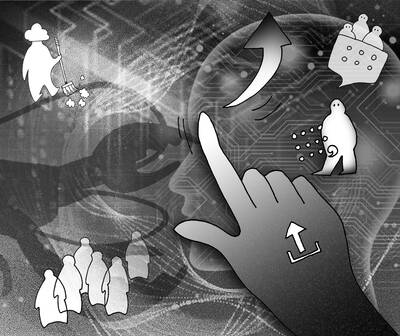
Weeks into the craze, nobody quite knows what to make of the OpenClaw mania sweeping China, marked by viral photos of retirees lining up for installation events and users gathering in red claw hats. The queues and cosplay inspired by the “raising a lobster” trend make for irresistible China clickbait. However, the West is fixating on the least important part of the story. As a consumer craze, OpenClaw — the AI agent designed to do tasks on a user’s behalf — would likely burn out. Without some developer background, it is too glitchy and technically awkward for true mainstream adoption,
On Monday, a group of bipartisan US senators arrived in Taiwan to support the nation’s special defense bill to counter Chinese threats. At the same time, Beijing announced that Chinese President Xi Jinping (習近平) had invited Chinese Nationalist Party (KMT) Chairwoman Cheng Li-wun (鄭麗文) to visit China, a move to make the KMT a pawn in its proxy warfare against Taiwan and the US. Since her inauguration as KMT chair last year, Cheng, widely seen as a pro-China figure, has made no secret of her desire to interact with the Chinese Communist Party (CCP) and meet with Xi, naming it a
A delegation of Chinese Nationalist Party (KMT) officials led by Chairwoman Cheng Li-wun (鄭麗文) is to travel to China tomorrow for a six-day visit to Jiangsu, Shanghai and Beijing, which might end with a meeting between Cheng and Chinese President Xi Jinping (習近平). The trip was announced by Xinhua news agency on Monday last week, which cited China’s Taiwan Affairs Office (TAO) Director Song Tao (宋濤) as saying that Cheng has repeatedly expressed willingness to visit China, and that the Chinese Communist Party (CCP) Central Committee and Xi have extended an invitation. Although some people have been speculating about a potential Xi-Cheng
The ongoing Iran conflict is putting Taiwan’s energy fragility on full display — the island of 23 million people, home to the world’s most advanced semiconductor manufacturing, is highly dependent on imported oil and gas, especially that from the Middle East. In 2025, 69.6 percent of Taiwan’s crude oil and 38.7 percent of liquified natural gas were sourced from the Middle East. In the same year, 62 percent of crude oil and 34 percent of LNG to Taiwan went through the Strait of Hormuz. Taiwan’s state-run oil company CPC Corp’s benchmark crude oil price (70 percent Dubai, 30 percent Brent)


 RSS
RSS